
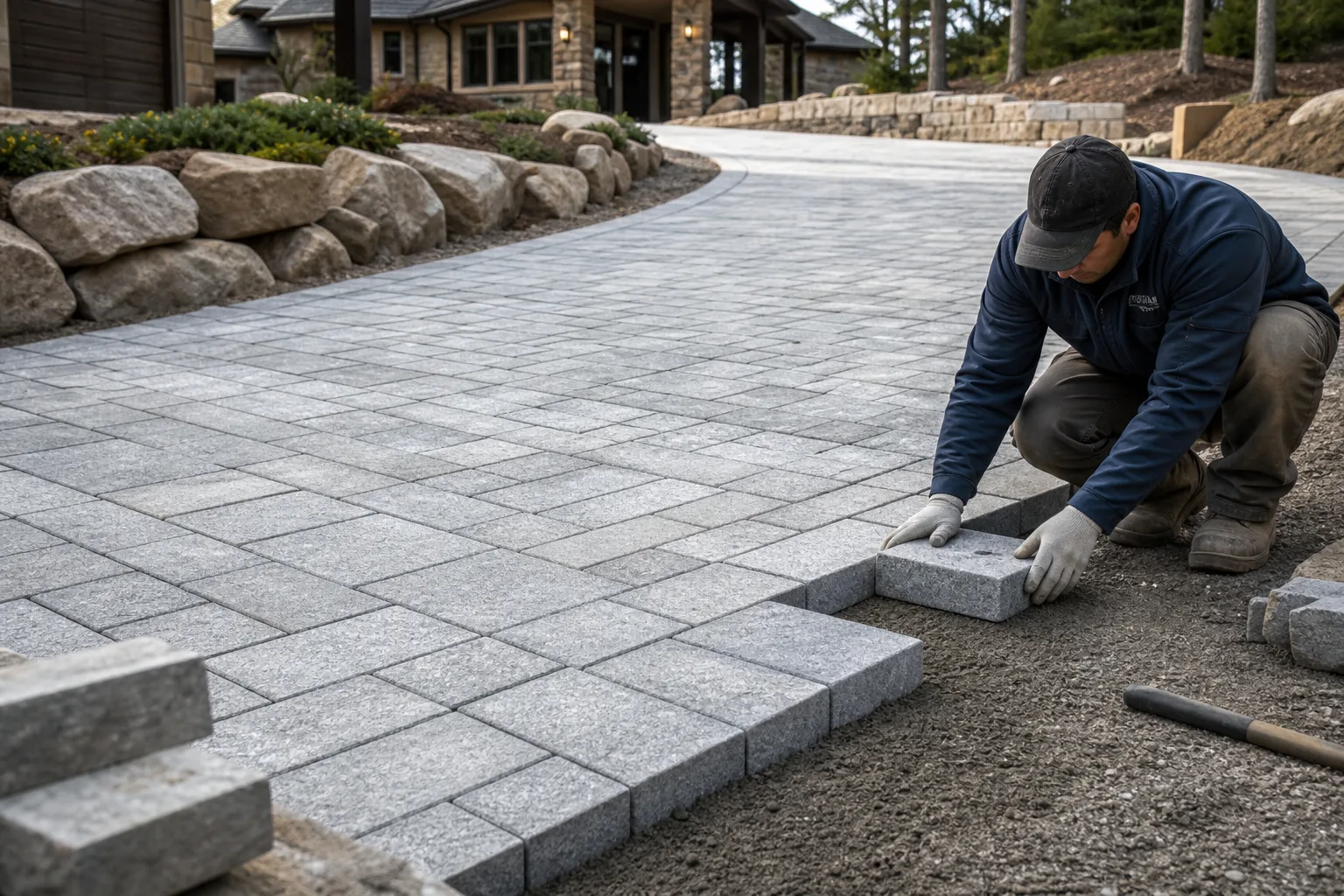
Granite is a practical driveway material when it is supplied as load-appropriate pavers, cubes, setts or engineered paving units—not selected merely by color or a familiar trade name. For most exposed driveways, begin with a textured finish such as flamed, bush-hammered or suitably rough sawn, then verify the stone’s physical properties, wet-surface performance, dimensions and proposed installation system. Unit thickness, base construction and joint design must be established for the expected vehicles, soil, drainage, climate and local requirements rather than copied from a general product listing.
Is granite suitable for a driveway?
Granite has an established history in exterior pavement and curb applications. The Natural Stone Institute identifies strength, abrasion resistance and weathering durability as reasons for its use in exterior paving and areas subject to vehicles. ASTM C615/C615M also covers granite dimension stone used for paving and landscape features. ([naturalstoneinstitute.org](https://www.naturalstoneinstitute.org/consumers/varieties/granite/?utm_source=openai))
Suitability is not automatic, however. A driveway is a system composed of the stone units, bedding or bonding materials, joints, edge restraints, base, subgrade and drainage. A strong stone can still crack, rock, settle or develop uneven joints if the supporting construction is inadequate.
Driveway formats
- Cubes and setts: Small, relatively thick units that can accommodate patterns and localized replacement. Their numerous joints make installation quality and joint restraint important.
- Rectangular pavers: Useful for running-bond, herringbone and modular layouts. Vehicle turning areas require particular attention to lateral restraint.
- Large-format paving: Creates fewer joints but places greater demands on unit strength, thickness, bedding uniformity and handling. Large units should be evaluated by the project designer.
- Drive strips or accents: Granite may be limited to wheel paths, borders or transitions, but differential movement between granite and adjoining materials must be addressed.
Thin interior flooring tiles should not be assumed suitable for driveway traffic. Ask the designer or installer to confirm the paving format and section for passenger vehicles, delivery vehicles and any occasional heavy loads.
Geological identity and trade names
Dimension stone is natural rock quarried and fabricated to meet requirements for size, shape, appearance and finish. USGS notes that durability, strength, mineral composition, hardness and past performance are among the relevant selection criteria. ([usgs.gov](https://www.usgs.gov/centers/national-minerals-information-center/dimension-stone-statistics-and-information?utm_source=openai))
In geological terminology, granite is a specific igneous rock. In the dimension-stone trade, “commercial granite” is broader and may include other visibly crystalline igneous rocks and some metamorphic rocks. Dark materials sold as black granite, for example, may be gabbro or another mafic rock rather than geological granite. The commercial category does not by itself predict performance.
Why the name is not enough
A code, English name or color label can be reused for stones from different sources. Even products sold under one trade name may show changes in grain, background color, mineral distribution or structure. A specification should therefore connect the approved sample and test documents to an identified quarry or source, not only to a name such as grey granite or G603.
Also distinguish the stone’s quarry country from its fabrication country. A Chinese processor may fabricate stone quarried in China or imported from another country. Neither origin nor processing location should be inferred from a supplier’s address.
Finish selection for traction and appearance
Finish changes surface texture, color expression, cleaning behavior and potentially wet-surface traction. The Natural Stone Institute warns that paving with inadequate slip resistance is more likely to contribute to slipping incidents. A finish description is not a substitute for project-relevant testing or approval by the responsible designer. ([naturalstoneinstitute.org](https://www.naturalstoneinstitute.org/stoneprofessionals/astm/?utm_source=openai))
| Finish | Driveway assessment | What to verify |
|---|---|---|
| Flamed | Common candidate for exposed granite paving because thermal finishing produces a textured surface. | Texture consistency, color change, loose grains, wet mockup and suitability of the particular stone for flaming. |
| Bush-hammered | Pronounced texture can suit vehicle and pedestrian areas where a rugged appearance is acceptable. | Specified texture grade, peak uniformity, cleanability, edge condition and actual sample approval. |
| Sawn or shot-blasted | May provide an understated textured surface, depending on the process and stone. | Measured or approved surface performance; “sawn” alone does not define one consistent roughness. |
| Honed | Matte and comparatively smooth; use only after assessing wet conditions, slopes and traffic. | Wet-surface performance, tire-mark visibility and maintenance expectations. |
| Polished | Generally not the first choice for an exposed driving or walking surface because it is smooth and reflective. | If proposed for a sheltered accent, obtain designer approval and evaluate wet conditions. |
| Split or natural cleft | Strong visual texture but potentially difficult to keep within surface-level tolerances. | Relief range, lippage, snow-removal method, accessibility and comfort where people walk. |
Marble.com lists flamed, bush-hammered, sandblasted, tumbled and sawn among available granite finishes, but its guide is primarily a finish overview rather than a driveway engineering standard. Use physical samples and project specifications to define the required surface. ([marble.com](https://marble.com/articles/granite-finishes?utm_source=openai))
Specifications and installation planning
Material test documentation
ASTM C615/C615M is the principal ASTM material specification for granite dimension stone. It addresses properties including absorption, density, compressive strength, modulus of rupture, abrasion resistance and flexural strength. Associated test methods include ASTM C97/C97M for absorption and bulk specific gravity, C170/C170M for compressive strength, C99/C99M for modulus of rupture, C241/C241M or C1353/C1353M for abrasion, and C880/C880M for flexural strength. The contract should identify the required editions, values and acceptance criteria rather than requesting a generic “ASTM certificate.” ([store.astm.org](https://store.astm.org/c0615-03.html?utm_source=openai))
Reports should identify the tested stone and specimen source clearly enough to relate them to the offered material. If freeze-thaw cycling, deicing chemicals, heavy traffic or another severe exposure is expected, ask the project professional whether additional evaluation is required. The Natural Stone Institute treats these as special conditions that should be identified during selection and design. ([naturalstoneinstitute.org](https://www.naturalstoneinstitute.org/events/calendar-of-events/exposed-environmental-exposures-that-create-special-selection-or-handling-concerns-for-natural-stone/?utm_source=openai))
Choose the paving system before ordering
The Natural Stone Institute’s horizontal-surface guidance recognizes multiple installation approaches, including sand, mortar and thin-set systems. That does not make every method suitable for every driveway; the system must be selected as a whole. ([pubs.naturalstoneinstitute.org](https://pubs.naturalstoneinstitute.org/pubview/2DD2874A-9480-AD2D-D813-B26A856F9B83?utm_source=openai))
- Flexible installation: Pavers are typically placed over a designed aggregate and bedding system with perimeter restraint. Subgrade preparation, compaction, drainage and joint stabilization govern performance.
- Rigid installation: Stone is installed over a concrete base using a compatible bedding or bonding assembly. Drainage, movement accommodation, mortar coverage and curing require detailed control.
- Special conditions: Slopes, trench drains, garage thresholds, heated pavement, expansive soil and freeze-thaw exposure require project-specific detailing.
Before fabrication, coordinate finished elevations, surface slope, drainage outlets, garage transitions, utility covers, perimeter restraints and movement joints. Water should not be trapped beneath units or directed toward buildings. A civil engineer, landscape architect or qualified paving professional should determine structural sections and drainage where site conditions or loads warrant professional design.
Approval samples and quality inspection
Natural stone varies, so inspection should compare production with an agreed range rather than demand artificial uniformity. Establish written tolerances and reference samples before the purchase order is finalized.
Pre-order checklist
- Record the trade name, commercial stone category, declared quarry or source and fabrication location separately.
- Approve several representative pieces showing the acceptable color, grain and natural variation—not one selected photograph.
- Approve a finish sample large enough to reveal texture direction, roughness and color change.
- Confirm unit length, width, thickness, thickness tolerance, squareness, edge treatment and permissible surface relief.
- Define acceptance rules for cracks, open seams, mineral concentrations, chips, fills, resin, mesh or other repairs.
- Review a dry and wet mockup under relevant light where appearance or traction is important.
- Confirm laying pattern, joint width assumptions, quantities by size and an appropriate allowance for cutting, selection and future repair.
Production and packing checks
Inspection may include random dimensional measurements, finish comparison, edge and corner review, visible defect classification, quantity reconciliation, crate identification and packing assessment. Reports should document what was inspected without implying that visual inspection proves hidden structural quality or long-term performance.
Driveway units are heavy and vulnerable to edge damage in transit. The purchase specification should address stable crates, separation between finished faces, protection from metal staining, package weight, lifting points and a packing list traceable to sizes and batches. Packaging claims should be verified for the specific order.
Price factors and sourcing granite from China
The cost of granite for driveway projects cannot be established reliably from a stone name or online square-meter price. Material listings may omit thickness, tolerance, finish detail, testing, packaging, inland transport, export charges, freight, duties, inspection, breakage allowance and installation.
Main quotation variables
- Stone source, current block availability and required color range
- Paver dimensions, thickness and number of custom sizes
- Flaming, bush hammering, sawing, edge work or hand finishing
- Dimensional and appearance tolerances
- Testing, samples, mockups and third-party inspection scope
- Order quantity, pattern yield, crate design and total shipment weight
- Incoterm, loading port, destination, insurance, duties and local delivery
StoneContact’s China listings demonstrate that the market includes many trade names, finishes, product formats and supplier profiles, but marketplace entries are supplier-submitted commercial information. They should be used to identify possible products, not as proof of quarry ownership, test compliance, capacity or quality systems. ([stonecontact.com](https://www.stonecontact.com/p/granite-tiles-slabs/china-supplier?utm_source=openai))
For comparable bids, send each candidate the same bill of quantities, drawings, finish reference, tolerance schedule, testing requirements, packing standard and delivery term. Follow the process outlined in importing granite from China, screen potential firms through the China granite supplier guide, and define hold points using the granite quality-control guide. Published marketplace prices should be separated from the full landed-cost analysis discussed in China granite price factors.
China is both a source and a major processing base for natural stone. Buyers may encounter domestic and imported materials fabricated by companies associated with stone-industry centers such as Xiamen and Fujian. Verify the actual quarry, processor and exporter for the order instead of treating a regional association as a capability claim.
Maintenance and final selection checklist
Remove grit and debris routinely, address oil or organic stains according to their type, and use cleaners compatible with the stone and any treatment. The Natural Stone Institute recommends neutral cleaners or mild detergent for general stone cleaning and warns that hydrofluoric-acid-containing products attack silicate stones, including granite. An impregnating treatment may improve stain resistance, but it does not make stone stain-proof and may not be required for every granite. ([naturalstoneinstitute.org](https://www.naturalstoneinstitute.org/consumers/care/?utm_source=openai))
Before authorizing production, confirm all of the following:
- The exact commercial stone and source are identified.
- The finish has been approved from representative dry and wet samples.
- Relevant test reports and project acceptance criteria have been reviewed.
- A qualified party has designed the unit format, thickness, base, drainage, joints and restraints for expected traffic.
- Dimensions, variation limits, defects, repairs and packing requirements are written into the order.
- Inspection scope, acceptance procedure and treatment of nonconforming material are agreed.
- The quotation separates product price from testing, logistics, import and installation costs.
Browse the broader granite applications, granite reference, stone database, finish library and product formats when preparing a driveway specification.
Frequently asked questions
What granite finish is best for a driveway?
A consistently textured finish such as flamed or bush-hammered is usually the starting point for an exposed driveway. The final choice should be approved from representative samples and evaluated for wet conditions, slopes, pedestrian use and maintenance.
How thick should granite driveway pavers be?
There is no universal thickness for every driveway. Required thickness depends on unit size, stone strength, bedding system, base support, vehicle loads, subgrade and climate. It should be specified by the responsible designer or qualified paving professional.
Can polished granite be used outdoors on a driveway?
Polished granite is generally not the preferred finish for exposed driving and walking areas because its surface is comparatively smooth. If it is proposed for a sheltered border or accent, wet-surface conditions and designer approval should still be considered.
What should a buyer request from a Chinese granite supplier?
Request the declared quarry and fabrication locations, representative samples, relevant test reports, finish reference, dimensional tolerances, defect and repair rules, packing details, production schedule and a quotation based on a clearly stated Incoterm. Verify each claim for the particular order.