
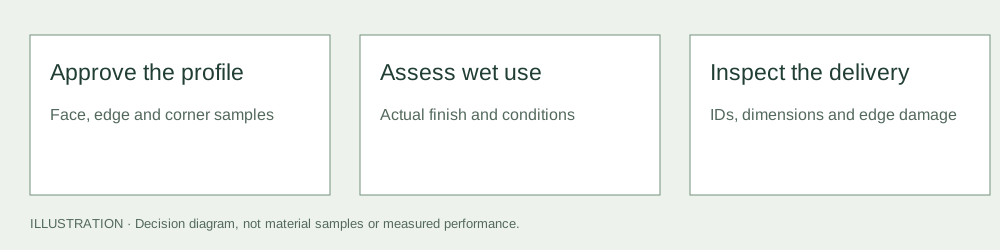
Choose pool coping as the edge of a wet-use assembly. The visible face, the edge people touch, the piece geometry and the way water leaves the surrounding area all matter. A stone advertised for pools is not automatically suitable in the offered finish or in a particular installation.
Start with the pool designer’s details and the operator’s intended use. Identify the exact stone, product form, exposure and maintenance plan before approving samples. This guide supplies purchase and inspection questions, not a pool design, a slip assessment or a universal coping thickness.
Define the edge before choosing a finish
Obtain a drawing showing the coping profile, face dimensions, thickness, visible overhang or projection, joints, corner pieces and the interface with the pool and adjacent paving. Ask who is responsible for the support and fixing details and for any movement or drainage interfaces.
Review a full profile sample where the edge is important. A small flat chip cannot show whether the edge shape, arris or underside will match the agreed appearance. State which faces and edges are to receive the approved finish, and how curved or corner pieces will be identified.
The slab guide and sizes and tolerances provide the general buying questions. Do not adopt a catalogue thickness as structural advice; the responsible designer and installer must confirm the assembly.
Wet use: require relevant evidence, not a finish slogan
Polished, honed, flamed and mechanically textured names describe processing or appearance. They do not by themselves establish barefoot grip or suitability in a contaminated wet area. The actual stone, texture, treatment and use condition need to be considered together.
The Health and Safety Executive’s flooring guidance links suitability to activity and foreseeable contamination. Its pool-management guidance also makes risk management specific to the facility. These are useful references for the questions to ask; neither is certification of the offered coping.
Request the assessment required for the project and confirm that it identifies the proposed surface and relevant conditions. Ask whether a treatment, cleaning product or subsequent wear changes the surface being assessed. Use slip-resistance guidance and the Finishes group to prepare the discussion. Do not promise that a rough-looking sample will remain safe in every wet condition.
Inspect the edge as well as the face
| Detail | Approval reference | Receiving check |
|---|---|---|
| Stone and visual range | Retained samples with lot and finish identity | Piece labels and appearance link to the approval |
| Walking and touch surfaces | Relevant finish assessment and full edge sample | Texture, sharp arrises, chips and incomplete finishing |
| Geometry | Drawings for straight, curved and corner pieces | Dimensions, thickness and profile against the agreed tolerance |
| Installation interface | Support, fixing, joint and drainage details | Piece form matches the drawings; unresolved design matters remain open |
| Treatments | Declared resin, enhancer or sealer and instructions | No unexplained change in sheen, colour or surface condition |
| Packing | Piece sequence, separation and edge protection | Counts, crate marks and damage photos before installation |
A small edge defect can be more consequential where people touch or step on the coping. Record it with a scale and piece ID, then use the contractual acceptance criteria rather than an assumed universal chip allowance. The edge-chip guide explains the need for that documented decision.
Exposure and maintenance need their own review
Ask for stone evidence relevant to the environment and intended service. Outdoor exposure, repeated wetting and the cleaning regime are separate from the initial colour approval. A generic granite name does not establish freeze-related performance or compatibility with the products the operator will use.
Do not prescribe a pool-water chemical recipe from a stone-buying page. Have the operator and appropriate specialists identify the actual exposures, then obtain suitable stone, treatment and product instructions. Follow the sealing guidance where treatment is proposed; a sealer does not resolve the support, drainage or wet-slip questions.
Maintain the approved finish instead of progressively changing it with unsuitable cleaners or abrasive trials. If surface condition changes, record the location, use and products involved and seek assessment before selecting a remedy.
Pack and receive by the installation sequence
Ask the supplier to number straight pieces, corners and other special forms against the drawings. Protect finished edges and prevent surfaces from rubbing in transit. The packing and loading guide connects the packing list with the order references.
At delivery, photograph crate exteriors and labels before unpacking. Check counts and piece IDs, photograph overall groups, then make close-ups of edge or corner damage. Keep affected pieces separate and preserve the relevant packing evidence. Use the receiving inspection and claim guide rather than relying on unlabelled phone photos after the stone has been installed.
Close approval with the whole team
Keep the designer’s details, material and finish references, relevant assessments, care requirements and inspection criteria together. Use Samples & approval for the selection record and Inspection & receiving for the delivery checks.
Resolve any missing support, edge or wet-use decision before the order is treated as complete. This page has not tested a coping surface, inspected a pool or verified an offered lot. Final suitability depends on the documented material and the designed, installed and maintained assembly.
Packing and receiving records
Agree edge-chip damage documentation before shipment. Match piece and crate identifiers to the order, photograph visible condition before installation and retain the packing material where it can be handled safely. Do not install a disputed piece while its condition and acceptance remain unresolved.
Questions & discussion
Share a question or a useful experience about this guide. Comments appear immediately. Your name and comment are public. Email is optional and stays private; reply emails are not enabled yet. Comment privacy.