
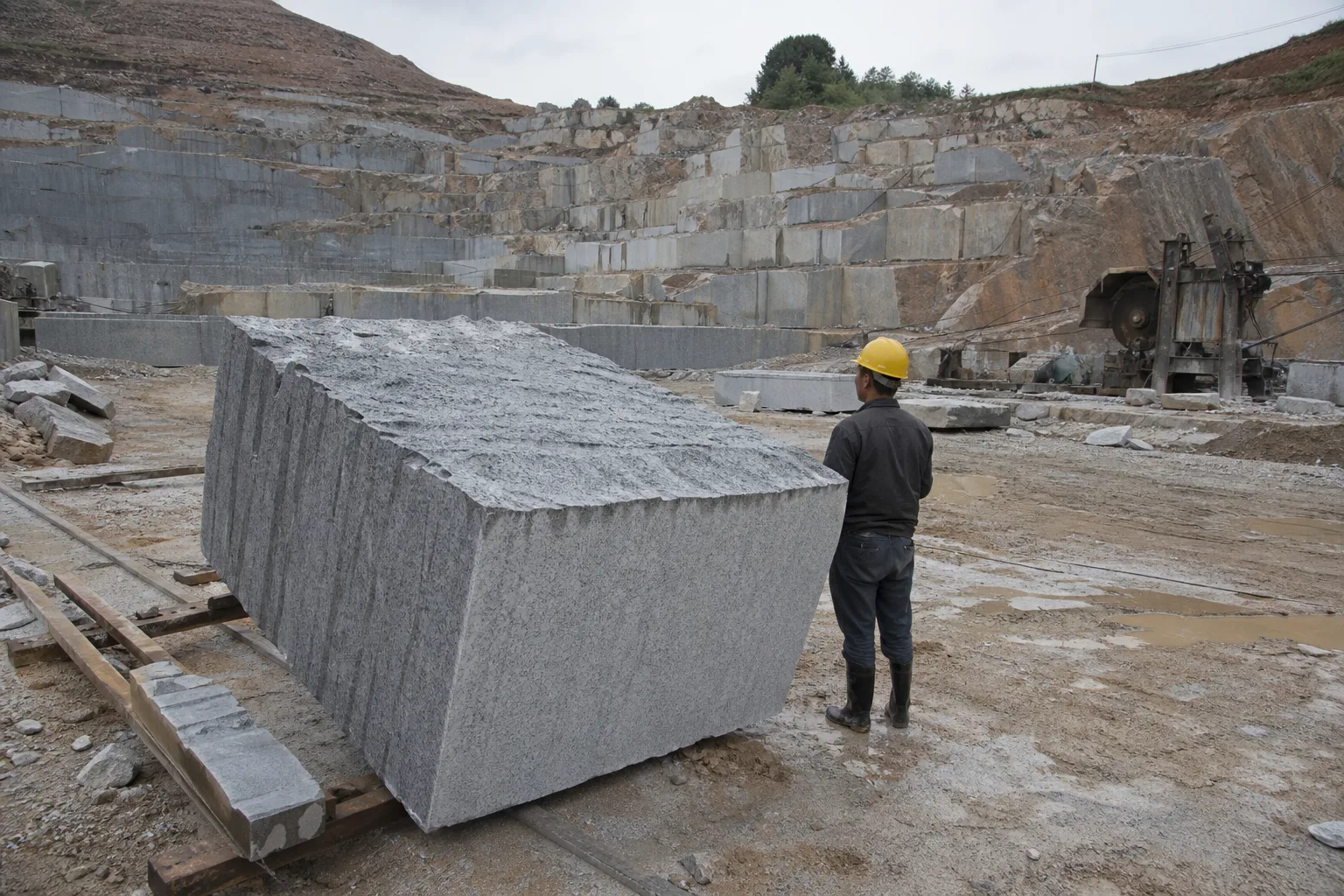
Buyers researching granite quarries in China should treat quarry identity as a verification task rather than relying on a color name, G-code or supplier address. China has an extensive stone-processing and export market, but material sold by a Chinese company may be locally quarried, imported as blocks, processed in China or traded through another company. For commercial investigation, the practical objective is to connect a specific stone, quarry or quarry area, processing route and approved sample range to the finished goods being purchased.
What buyers are actually sourcing
Dimension stone is natural rock quarried as blocks or slabs that must meet requirements for size, shape and intended architectural or engineering use. Color, grain, pattern, finish, durability and strength are also normal selection considerations.[1] This distinguishes a quarry product from crushed stone and from resin-bound or otherwise manufactured materials.
A China granite inquiry may refer to several different supply models:
- Chinese granite extracted and processed within China;
- Chinese granite blocks sold to an independent processor;
- imported granite blocks processed into slabs, tiles or project pieces in China;
- finished material purchased through an exporter or trading company rather than the quarry operator;
- remaining blocks or slabs from a quarry that is inactive, restricted or no longer the regular source.
None of these models is automatically unsuitable. The risk arises when the buyer assumes that factory location, company registration or a familiar trade name proves quarry ownership and origin. Ask the seller to state separately the country of extraction, quarry or quarry area, block supplier, processing factory and contracting exporter.
Geological identity and commercial trade names
Scientific granite is narrower than commercial granite
In geology, granite has a defined mineralogical meaning. In the dimension-stone trade, “granite” is a broader commercial group that can include other hard, crystalline rocks with similar working and performance characteristics. The Natural Stone Institute notes that scientific descriptions emphasize mineral composition and locality, while commercial descriptions often emphasize locality and color.[2] ASTM C119 provides standardized dimension-stone terminology, and its active 2026 edition is ASTM C119-26.[3]
This difference matters when a specification requires a petrographic identity rather than merely “commercial granite.” If geological classification is relevant, request a petrographic description from an appropriate laboratory instead of inferring composition from appearance.
G-codes and descriptive names
Chinese granites are commonly marketed under numerical codes and descriptive English names. Codes such as G603 or G654 can be useful commercial references, but they should not be treated as permanent, globally controlled geological identifiers. Marketplace quarry listings show repeated names, “new” variants and similar codes associated with different companies or locations.[5]
The purchase specification should therefore record more than the code. Include the seller's full material name, declared quarry location, current quarry photographs or video, block or slab reference numbers and an approved physical sample. For an example of how one widely traded code is discussed, see the G603 reference.
China quarry and processing context
Commercial directories contain China listings for grey, black, white, red, pink and yellow granite, with declared quarry locations across several provinces. These directories are useful for discovering names and potential counterparties, but they are not government quarry registers and should not be treated as proof of ownership, mining rights, reserves or current production. StoneContact, for example, displayed hundreds of China granite quarry listings when accessed for this guide, but the individual entries are supplier-submitted commercial information.[5]
The distinction between quarry and processor is especially important in established trading and fabrication centers. A company based in Xiamen may source blocks from another province or another country. Similarly, a factory in Fujian may process several unrelated granites. Review the broader China stone industry hub, Xiamen stone industry and Fujian granite industry for regional sourcing context.
Questions that establish the supply chain
- Does the contracting company own the quarry, hold extraction rights, buy blocks or act only as an exporter?
- Is the named quarry currently producing the required color range and block sizes?
- Will all units come from one quarry and one production period?
- Where will blocks be sawn, finished, cut to size, inspected and packed?
- Can the supplier identify any imported stone that will be processed in China?
- What happens if the approved quarry cannot supply enough matching material?
Answers should be incorporated into the purchase order where origin or continuity is commercially important. For counterparty assessment, compare the roles described in factory versus trading company and use a proportionate supplier audit.
Finishes and applications
Finish changes the appearance, texture, maintenance profile and sometimes the suitability of granite for an application. Polished granite has a reflective surface; honed granite is smoother and more matte; brushed or leathered surfaces add texture. Flamed, bush-hammered, sandblasted, sawn and split finishes are frequently considered for exterior or slip-sensitive work. Published finish descriptions can explain general appearance, but an approved finish sample is still necessary because results vary with mineral structure and processing.[2]
| Finish | Typical visual or tactile character | Common specification concerns | Potential applications |
|---|---|---|---|
| Polished | Glossy and color-enhancing | Gloss consistency, resin or mesh disclosure, edge polish and surface scratches | Countertops, interior walls and selected floors |
| Honed | Matte to low sheen | Hone level, handling marks, darkening and sealing requirements | Interior flooring, stairs and wall panels |
| Flamed or textured | Rougher, lighter-looking surface | Texture depth, dimensional loss, edge condition and slip testing | Driveways, patios and exterior paving |
| Bush-hammered | Uniformly pitted texture | Tool pattern, depth, chipped edges and cleanability | Steps, paving, landscaping and exterior walls |
| Split-face | Natural cleft or mechanically split relief | Projection range, thickness, joint allowance and anchoring design | Facades, walls and landscape features |
Do not select a finish from a small digital image alone. Approve a representative physical sample or mock-up under the lighting expected at the project. For variable stone, establish an acceptable range rather than approving one unusually uniform piece.
Specifications and test evidence
ASTM C615/C615M is the standard specification for granite dimension stone used for general building and structural purposes. Its scope addresses material characteristics, physical requirements and sampling, while related test methods cover properties such as absorption, density, compressive strength, modulus of rupture, abrasion resistance and flexural strength.[4] The project team should state the required standard edition, tests, specimen orientation and acceptance criteria rather than requesting a generic “ASTM certificate.”
Testing should correspond to the named material and current quarry source. A report for a similarly named stone, another quarry or an unidentified specimen does not establish compliance. Check the laboratory name, report date, sample identification, test method, units, number of specimens and individual results. If the application is exterior, structural, exposed to freezing or subject to foot traffic, the architect or engineer should determine the necessary testing.
Minimum purchase specification
- commercial name, code and declared geological description;
- country and quarry or quarry-area declaration;
- approved color, grain and defect range;
- finish and physical finish reference;
- length, width, thickness and permitted tolerances;
- edge profile, holes, cutouts, reinforcement and anchoring details;
- required test methods and acceptance values;
- dry and wet appearance requirements where relevant;
- repair, resin, mesh and surface-treatment disclosure;
- packing, labeling, traceability and replacement-piece requirements.
See sizes and tolerances, water absorption, compressive strength, slip resistance and freeze-thaw considerations when building an application-specific specification.
Inspection and approval checklist
Inspection should confirm both documentation and the physical goods. The following checklist can be adapted to slabs, tiles, paving, steps, cladding or landscape pieces.
| Stage | Checks | Suggested record |
|---|---|---|
| Before production | Company role, quarry declaration, current block availability, sample range, drawings, finish and test reports | Approved sample, signed specification, quarry statement and drawing register |
| Block or slab selection | Color range, grain, veins, inclusions, cracks, repairs, resin, mesh and sequential slab suitability | Numbered photographs, slab map and rejection notes |
| During fabrication | Dimensions, thickness, squareness, finish consistency, edge work, drilling and cutouts | Measurement sheet and production photographs |
| Pre-shipment | Quantity, piece marks, dry and wet appearance where specified, damage, packing, crate labels and document consistency | Inspection report, packing list and loading photographs |
| Container loading | Crate condition, bracing, weight distribution, moisture protection and seal number | Loading checklist and container record |
Define the inspection scope and acceptance rules before production. A general visual inspection cannot replace laboratory testing, engineering review or exhaustive verification of hidden defects. For additional controls, consult granite quality control, third-party inspection, samples and mock-ups and color variation.
Price factors and importing from China
There is no reliable single price for Chinese granite. Quotations depend on quarry availability, block yield, color selection, thickness, unit size, finish, edge work, cutouts, reinforcement, testing, inspection, packing, order volume, replacement allowance, inland transport, port charges, freight and the agreed Incoterm. Very low quotations may reflect a wider visual range, thinner nominal material, a different source, limited inspection or exclusions that become apparent only after order confirmation.
Request an itemized quotation and state whether it covers blocks, random slabs, finished slabs, standard tiles or project-specific pieces. Confirm the measurement basis, tolerance, crate assumptions, port, Incoterm, payment stages and validity period. Related planning references include granite price factors in China, minimum order quantities, Incoterms, container loading and shipping costs.
For U.S. imports, classification and entry requirements depend on the exact article, material, dimensions and degree of working. U.S. Customs and Border Protection advises importers to determine the applicable Harmonized Tariff Schedule classification and consider country-of-origin marking; requirements cannot be established from the general word “granite” alone.[6] Confirm current duties, additional measures, documentation and marking with a qualified customs broker before shipment.
The safest sourcing decision is based on a traceable material and an enforceable specification, not the largest directory listing or the lowest initial quote. Approve the source, range, finish and inspection plan before committing to production, and retain control samples for comparison with delivered goods. See the broader guide to importing granite from China and the directory-oriented discussion of China granite suppliers.
Frequently asked questions
Does a Chinese granite supplier necessarily own a quarry?
No. The supplier may be a quarry operator, processor, exporter, trading company or a combination of these roles. Ask for a written quarry declaration and verify the extraction source separately from the factory and contracting company.
Do granite codes such as G603 identify one specific quarry?
Not reliably. Commercial codes can be reused for similar materials or new sources. Record the declared quarry location, supplier-specific name, approved sample range and production reference in the purchase documents.
Can imported granite be processed and exported from China?
Yes. A Chinese processing or shipping origin does not by itself establish where the stone was quarried. Require separate declarations for country of extraction and country of processing.
What should be inspected before Chinese granite is shipped?
Check material identity, color range, repairs, finish, dimensions, quantity, piece marks, packing and document consistency. Structural or performance compliance also requires appropriate test evidence and cannot be confirmed by visual inspection alone.
Questions & discussion
Share a question or a useful experience about this guide. Comments appear immediately. Your name and comment are public. Email is optional and stays private; reply emails are not enabled yet. Comment privacy.