
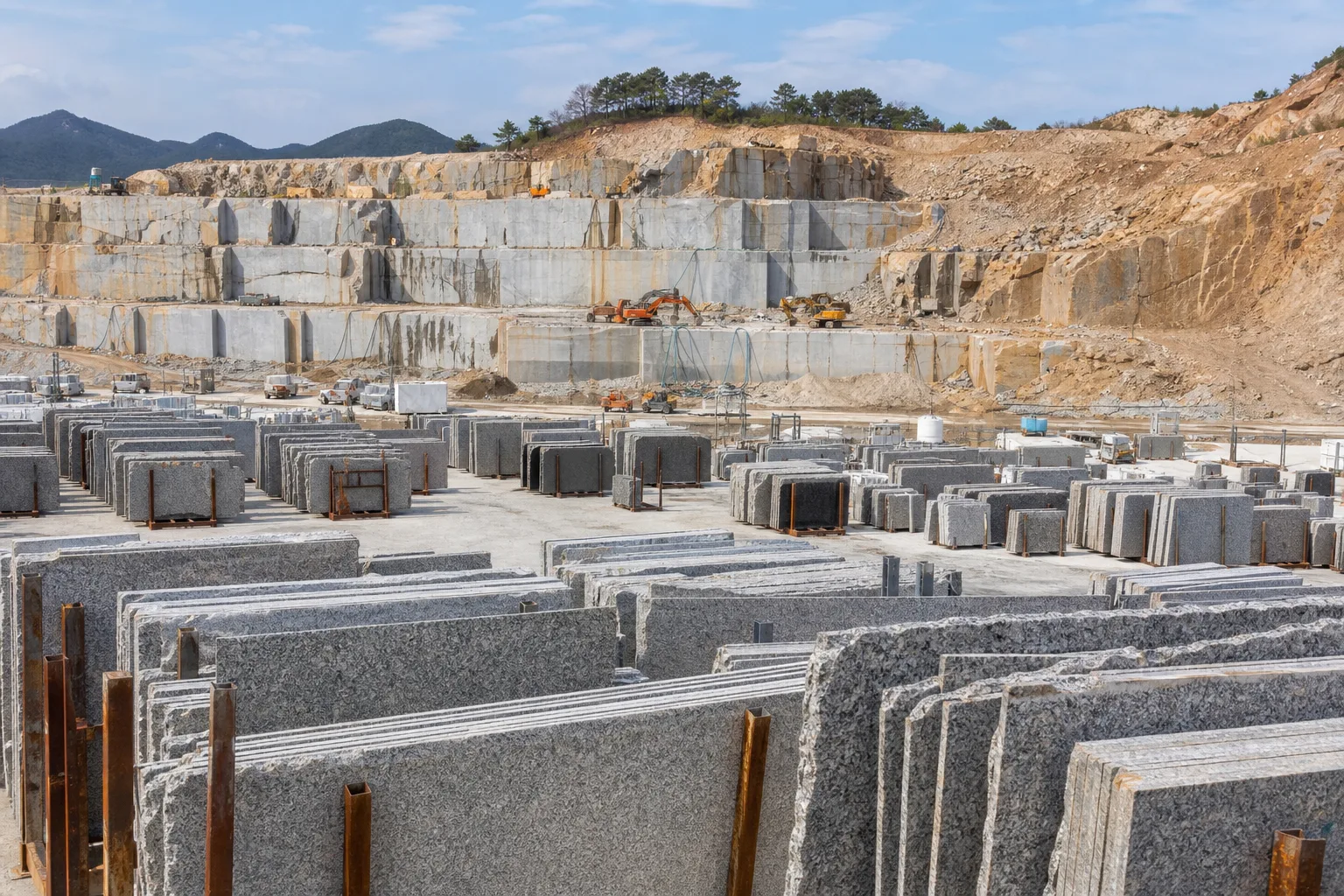
The Fujian granite industry is best understood as a connected but not uniform sourcing network. Granite and granite-like dimension stones are quarried in parts of the province, while factories around Shuitou in Nan’an process local, non-Fujian and imported materials. Xiamen serves as a major commercial and shipment coordination point for many stone exporters. For buyers, the practical advantage is access to quarries, block traders, slab processors, cut-to-size factories and export companies within one regional supply chain. The corresponding risk is assuming that a Fujian supplier, factory or shipping port proves a stone’s geological origin. It does not.
How the Fujian stone network is organized
Quarry and material-producing areas
Fujian is associated with several established Chinese commercial granite names. StoneContact’s material records identify G654 with Zhangpu, Fujian, and G664 with Luoyuan, Fujian. The same marketplace also contains quarry listings and products using multiple alternative names for these materials.[1][2] These records are useful for market orientation, but a directory entry is not independent proof that a particular shipment came from the stated quarry.
Quarry status, ownership and permitted output can change. A buyer should therefore request the current quarry name and location, block or bundle references, recent quarry photographs where appropriate, and a written declaration of origin. If origin is commercially or legally important, it should be made a contractual requirement rather than inferred from a trade code.
Shuitou and Nan’an processing
Shuitou, within Nan’an in the Quanzhou area, appears repeatedly in stone marketplace records as a location for factories, stone markets and processing operations. Listings cover slabs, tiles, countertops, paving, monuments, carvings and other fabricated products.[3] This breadth means that “Shuitou supplier” can describe very different businesses: a factory owner, an export office, a block or slab trader, or a company coordinating production through partner plants.
Buyers should establish which legal entity signs the contract, which facility performs each operation, and whether any work will be subcontracted. Factory address, business registration, equipment list and product photographs should be verified for the specific order rather than accepted as proof of general capability.
Xiamen sales and export coordination
Many marketplace listings pair a Xiamen sales address or exporter with production in Shuitou or elsewhere. Xiamen is also commonly identified as the shipment port in Fujian stone offers.[3] The exporter’s location should not be confused with the factory location, quarry origin or country of geological origin. A robust purchase file records all four separately: seller, producing factory, quarry or block source, and port of loading.
For more regional context, see the Xiamen stone industry guide and the broader China stone industry database.
Geological identity and commercial granite names
Commercial granite is a product category
In construction procurement, granite dimension stone is selected as a natural stone product that has been sawn, cut, split or otherwise shaped. ASTM C615/C615M covers material characteristics, physical requirements and sampling for granite used in general building and structural applications.[4] A commercial granite label does not, by itself, provide a petrographic classification, tested performance or suitability for a particular installation.
Specifications should separate the requested appearance from the required performance. Color, grain, mineral distribution and approved range samples control visual selection. Laboratory reports, engineering design and project standards address physical performance. Where geological identity matters, request a petrographic description from a qualified source rather than relying only on a catalog category.
Codes and alternative names
Chinese stone codes such as G603, G654 and G664 are widely used in commercial listings, but the same code may appear with several English or export-market names. G654 listings include names such as Padang Dark, Sesame Black and China Impala, while G664 is also marketed as Luoyuan Red or Bainbrook Brown.[1][2] Such names help communication, but they are not universal specifications.
- Put the code, trade name and declared origin on the quotation and purchase order.
- Attach dated photographs and an approved physical sample or control slab.
- Define the acceptable color and grain range, not merely an ideal sample.
- Prohibit substitutions unless the buyer gives written approval.
- Require new approval if quarry source, block selection or factory changes.
This approach is especially important when a quotation uses terms such as “new,” “similar,” “replacement” or “equivalent.” A visually related stone from another deposit is a different sourcing proposition and must not be treated as the original material without disclosure.
Products, finishes and applications
Common product forms
Fujian factories and exporters list a broad range of granite products, including rough blocks, gangsaw slabs, small slabs, calibrated tiles, project cut-to-size, countertops, vanity tops, stair components, kerbs, paving units, cobbles, monuments and carved work.[3] Availability on a marketplace does not establish that every factory can make every format. Large slabs, thin calibrated tile, complex countertop work and heavy exterior pieces require different machinery, handling systems and quality controls.
A request for quotation should identify finished dimensions, thickness, tolerances, surface finish, edge work, reinforcement, cutouts, visible-face requirements, quantity by item and packing method. For cut-to-size projects, issue revision-controlled drawings and a numbered schedule rather than relying on dimensions embedded in email messages.
Finish selection
Polished, honed and leathered surfaces are common for countertops and interior work. Flamed, bush-hammered, sandblasted, split and other textured finishes are frequently offered for paving, steps and exterior elements. Marble.com describes polished granite as reflective, honed granite as matte, and leathered granite as textured; it also lists flamed, bush-hammered, sandblasted, tumbled and sawn alternatives.[5]
Finish names are not sufficiently precise for project control. Gloss, texture depth, flaming intensity, brush sequence and color can vary by factory, machine settings and stone batch. The approved finish sample should be produced from the proposed material and be large enough to show both texture and mineral response.
| Product or use | Typical finish options | Points to specify and inspect |
|---|---|---|
| Interior slabs and countertops | Polished, honed, leathered | Slab size, thickness, gloss or texture, resin or mesh disclosure, fissures, color range and edge profile |
| Interior floor and wall tile | Polished, honed, brushed | Calibration, squareness, edge condition, shade sorting, flatness and finish consistency |
| Exterior paving and steps | Flamed, bush-hammered, sandblasted, split | Texture consistency, dimensions, exposed edges, drainage design and project-specific slip requirements |
| Kerbs and landscape pieces | Sawn, natural split, bush-hammered | Cross-section, length tolerance, arrises, visible faces, drillings and crate weight |
| Facade or cladding units | Polished, honed, flamed, textured | Engineering design, anchor slots or holes, thickness, testing, orientation and repair disclosure |
Explore individual granite finishes, granite slabs and application guidance for kitchen countertops.
Specifications and performance evidence
Use standards according to the application
ASTM C615/C615M identifies relevant granite dimension-stone properties including absorption, density, compressive strength, modulus of rupture, abrasion resistance and flexural strength.[4] The Natural Stone Institute advises project teams to review the performance required by the installation and obtain testing when suitable results are unavailable. Its standards reference lists methods including ASTM C97 for absorption and bulk specific gravity, C170 for compressive strength, C99 for modulus of rupture and C880 for flexural strength.[6]
Do not copy test figures from an online stone profile into a project specification. Results may represent another quarry face, sample, laboratory, test edition or geological variant. Ask for the complete report, including stone identification, sample source, conditioning, test method, report date and laboratory details. The design professional should decide which properties, limits and safety factors apply.
A practical purchase specification
- Material: commercial name, code, declared quarry origin and approved range samples.
- Product: item references, finished dimensions, quantity and permitted tolerances.
- Appearance: acceptable color, grain, mineral concentrations, veins, patches and natural features.
- Finish: approved physical sample, required visible faces and edge treatment.
- Fabrication: cutouts, holes, slots, drips, reinforcement and permissible repairs.
- Performance: applicable test standards and project-specific acceptance criteria.
- Marking: piece numbers, bundle numbers, crate marks and drawing references.
- Packing: crate construction, internal separation, moisture protection and weight limits.
- Documents: invoice, packing list, origin information, test reports and inspection records.
Reference standards by designation and edition where required. Do not state that a stone is “ASTM certified”: ASTM publishes standards, while conformity depends on the specified material, valid testing and acceptance process.
Supplier qualification and order inspection
Confirm the production chain
A supplier directory is a discovery tool, not completed due diligence. Before placing an order, confirm the contracting company, beneficiary bank account, factory location, relationship to the quarry or block supplier, and responsibility for subcontracted work. Ask for evidence directly related to the proposed product, thickness and finish. Claims about quarry ownership, capacity, certifications or export history should remain unaccepted until independently checked.
Inspection checklist
- Before production: approve material and finish samples; freeze drawings, tolerances, packing and defect criteria.
- At block or slab selection: record bundle or block numbers and check the proposed visual range.
- During fabrication: measure representative dimensions, thickness and finish; check drilling, edge work and repairs.
- Before packing: conduct quantity and appearance checks under agreed lighting, with pieces dry and clean where feasible.
- During packing: verify piece labels, crate lists, separation materials, supports and gross weights.
- Before shipment: reconcile the inspection result, packing list, commercial invoice and shipment booking.
The sampling plan and acceptance threshold should be agreed before production. Inspection does not replace technical testing, and a passed sample does not guarantee that uninspected pieces conform. For a fuller framework, consult granite quality control and China granite supplier qualification.
Price, logistics and buying context
What changes a Fujian granite quotation
There is no reliable standard Fujian granite price without a defined material, product and delivery basis. Cost is affected by quarry availability and block yield; slab or piece dimensions; thickness; finish; color-selection range; calibration and tolerances; edge processing; holes and cutouts; reinforcement or repairs; order volume; factory loading; packing; inland transport; port charges; freight and Incoterms. Tight visual selection can increase waste, while oversized or heavy pieces can change handling and container utilization.
Compare quotations on an equivalent scope. A low unit price may exclude packing, templates, dry layout, test reports, inspection access, inland haulage or export charges. See China granite price factors for a structured comparison method.
Shipping and import documentation
Common export documents include the commercial invoice, packing list and bill of lading. The U.S. Department of Commerce notes that the commercial invoice describes the goods and is used by customs authorities when assessing duties, while the packing list provides package, quantity and weight details.[7] The description, quantities and weights should remain consistent across the order, inspection report, invoice and packing list.
For U.S. imports, do not assume a duty rate from a generic product name. U.S. Customs and Border Protection states that classification depends on the information supplied and that the correct duty rate is determined by CBP; importers can seek a binding ruling for specific classification questions.[8] Confirm current tariff treatment, origin marking and entry requirements with a qualified customs broker before shipment.
Fujian can be an efficient region for consolidated stone sourcing, particularly when a project combines slabs, tiles and fabricated work. The safest commercial approach is nevertheless product-specific: identify the actual quarry or block source, audit the responsible factory, define the specification, inspect against agreed criteria and verify documents before release. The broader guide to importing granite from China covers the complete transaction sequence.
Frequently asked questions
Where is the Fujian granite industry concentrated?
The supply network includes material-producing areas such as Luoyuan and Zhangpu, processing and stone trading around Shuitou in Nan’an, and exporter or shipment coordination in Xiamen. These functions overlap, but the quarry, factory, seller and port should be recorded separately.
Are G603, G654 and G664 geological specifications?
No. They are widely used commercial stone codes. A code may be accompanied by several trade names and does not prove quarry origin, petrographic identity or tested performance. Buyers should approve samples, record the declared source and prohibit undisclosed substitutions.
What should buyers inspect before granite leaves a Fujian factory?
Inspection should cover material identity, color range, finish, dimensions, thickness, edges, holes, repairs, piece numbering, quantity and packing. The sampling plan and acceptance criteria should be agreed before production, and technical tests should be reviewed separately.
Why can two Fujian granite quotations differ substantially?
Differences may reflect quarry source, block yield, dimensions, thickness, finish, selection range, fabrication complexity, tolerances, packing, inland transport, inspection, shipment terms and excluded services. Quotations are comparable only when these elements use the same specification and Incoterm.