
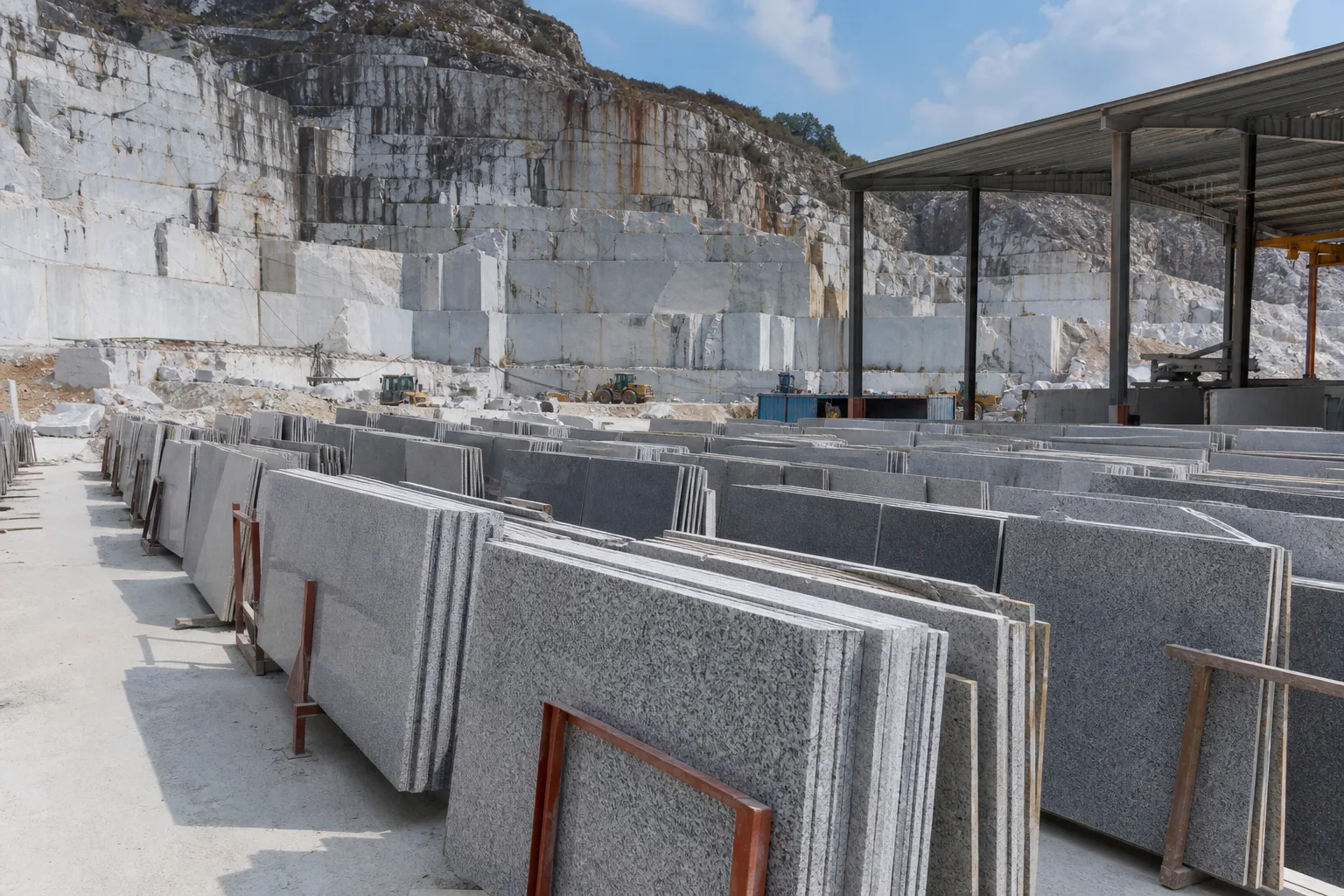
China stone production regions should not be treated as a simple map of quarry locations. A supplier’s address may identify a quarry area, a processing center, a trading office or an export gateway—and these can be in different provinces. For commercial investigation, the useful question is not only “Where is the supplier?” but also “Where is the stone quarried, processed, inspected and loaded?” Fujian, particularly the Xiamen–Shuitou commercial corridor, is prominent in granite processing and export activity. Other relevant areas include Shandong and northern China, Guangdong’s Yunfu processing market, and inland provinces associated with specific commercial stone names. None of these regional labels proves a material’s origin or a company’s capability without supporting records.
How China’s stone regions function
The dimension-stone industry converts naturally occurring rock into blocks, slabs and finished pieces made to specified dimensions. The U.S. Geological Survey notes that color, grain, pattern, finish, durability, strength and the ability to take a polish are normal selection considerations for dimension stone. ([usgs.gov](https://www.usgs.gov/centers/national-minerals-information-center/dimension-stone-statistics-and-information))
Within China, the supply chain commonly separates into several functions:
- Quarry or block source: the physical deposit from which the material is extracted.
- Primary processing: block sawing, slab production, resin treatment where used, calibration and polishing.
- Secondary fabrication: cutting tiles, countertops, steps, kerbs, pavers, cladding panels or project-specific shapes.
- Wholesale and slab distribution: yards or markets holding domestic and imported stone.
- Export coordination: quotation, documentation, inspection arrangements and shipment through a port.
A business registered in Xiamen, Qingdao or another commercial city may outsource production elsewhere. Conversely, a factory can process blocks transported from another Chinese province or imported from overseas. Buyers should therefore record the location and responsible company for every production stage.
Geological identity and granite trade names
Commercial granite is a broad category
The geological and commercial meanings of “granite” are not identical. The Natural Stone Institute explains that commercial classifications group some related crystalline rocks according to appearance and performance rather than strict petrographic identity. Commercial granite may therefore include materials that a geologist would classify as gneiss, granodiorite, syenite or another feldspathic crystalline rock. ([naturalstoneinstitute.org](https://www.naturalstoneinstitute.org/stoneprofessionals/varieties/definition/?utm_source=openai))
This distinction matters when a specification requires a petrographic description, a particular performance level or documented conformity with a material standard. A sales name, color description or “G-number” is not a substitute for geological identification and current test data.
Trade names can overlap
Chinese granite may be sold under a numeric code, an English color name, a Chinese market name or a name associated with a province or city. Similar names can be applied to visibly different stones, while one material may have several aliases. Even a familiar designation such as G603 can appear in listings connected with more than one commercial description or source. The order should therefore identify the approved material by supplier, quarry or block source when known, reference sample, finish and agreed visual range—not by trade name alone.
Regional sourcing map
The following table is a sourcing framework rather than a production ranking. Public supplier directories demonstrate commercial activity, but directory profiles and product listings are supplier-submitted leads and do not independently establish quarry ownership, capacity, certification or continuing availability. StoneContact’s China directory includes businesses offering slabs, tiles, countertops, paving and other products across multiple provinces. ([stonecontact.com](https://www.stonecontact.com/suppliers/china-country/25?utm_source=openai))
| Region or cluster | Commercial context | Buyer verification priority |
|---|---|---|
| Fujian: Xiamen, Shuitou, Nan’an and Quanzhou area | Concentrated processing, slab trading, fabrication, export sales and access to Xiamen shipping services. Supplier listings commonly place sales offices in Xiamen and factories or yards in Shuitou and Nan’an. | Confirm whether the contracting company owns the factory, uses a subcontractor or acts only as an exporter. Record the actual factory and loading addresses. |
| Shandong and the Qingdao–Laizhou commercial area | Northern China sourcing area associated in the market with granite products, project cutting, paving and monument supply. The precise product mix varies by company. | Verify quarry identity, seasonal availability, production site and inland transport route rather than relying on a Shandong business address. |
| Guangdong: Yunfu | A mixed-stone processing and trading market handling granite alongside marble, onyx, engineered products and decorative work. Public listings show Yunfu businesses offering slabs, paving and fabricated products. | Check whether the quoted stone is locally processed from domestic or imported blocks and whether the factory regularly makes the requested granite product. |
| Shanxi and neighboring northern provinces | Commercial names such as Shanxi Black are widely offered through suppliers located both inside and outside the named province. | Do not infer origin from the exporter’s location. Request quarry information, current slab photographs and comparison with the approved control sample. |
| Sichuan and other inland material-source areas | Trade listings associate several red, blue, green and dark granites with Sichuan. Other inland provinces also appear in the market as sources of grey and colored materials. | Confirm whether the name identifies a specific deposit or a broad color family. Check freight, replacement availability and consistency between extraction campaigns. |
| Other coastal sales and logistics cities | Shanghai, Ningbo, Shenzhen, Guangzhou and other cities may host traders, project offices or logistics providers without being the stone’s quarry or fabrication location. | Map the full transaction: seller, manufacturer, material source, inspection point, container loading point and port of departure. |
Regional specialization can change as quarries close, environmental controls change, factories relocate and companies alter subcontractors. A previous order is useful background but does not establish the circumstances of a new order.
Finishes and applications
Finish selection affects appearance, maintenance, dimensional control and suitability for use. Polished granite has a reflective surface that emphasizes color and pattern; honed granite is smoother and less reflective; leathered or brushed surfaces introduce texture. Flamed, bush-hammered, sandblasted, split and sawn finishes are often considered for exterior paving, steps, walls and landscape work. Marble.com’s finish overview distinguishes polished, honed and leathered countertop surfaces and also identifies flamed, bush-hammered, sandblasted, tumbled and sawn options. ([marble.com](https://marble.com/articles/granite-finishes?utm_source=openai))
A finish name alone is not a measurable acceptance standard. Flame intensity, brush depth, gloss, tool marks and color can vary with machinery, abrasive sequence, operator settings and the stone itself. Buyers should approve a finish sample large enough to show its texture and color response.
Typical application questions
- Countertops: inspect slab layout, fissures, mesh or resin, polish consistency, edge work and cut-out reinforcement.
- Flooring and stairs: define dimensions, thickness, calibration, edge condition, surface texture and required slip-resistance assessment.
- Facades: use project engineering to determine panel dimensions, stone properties, anchors and allowable defects.
- Paving and driveways: specify thickness, finish, edge type, piece sizes and visual blending; consider abrasion and environmental exposure.
- Landscaping and kerbs: define visible faces, split or sawn surfaces, tolerances, arrises and packing suitable for heavy pieces.
Specifications and test evidence
ASTM C615/C615M covers granite dimension stone for general building and structural purposes, including cut or finished natural stone used for cladding, paving, landscape features, structural components and monuments. Its physical-property categories include absorption, density, compressive strength, modulus of rupture, abrasion resistance where applicable and flexural strength. ([store.astm.org](https://store.astm.org/c0615_c0615m-18e01.html?utm_source=openai))
Testing should correspond to the actual material source and the intended application. The Natural Stone Institute lists commonly referenced methods including ASTM C97 for absorption and bulk specific gravity, C170 for compressive strength, C99 for modulus of rupture, C880 for flexural strength and C1353 for abrasion resistance of stone subject to foot traffic. It also advises obtaining testing or avoiding an unsuitable use when performance evidence is unavailable. ([naturalstoneinstitute.org](https://www.naturalstoneinstitute.org/stoneprofessionals/astm/?utm_source=openai))
Do not assume that a generic report for “Chinese granite,” a similarly named stone or an old quarry campaign represents the offered lot. Review the report date, laboratory, specimen identification, test standard and source description. Project specifications may require ASTM, European, national or other methods; results produced under different methods should not be treated as automatically interchangeable.
Pre-order inspection checklist
A practical inspection plan should be agreed before deposit payment or production release. The following checklist separates identity, workmanship and shipment control:
- Company identity: match the quotation, contract, bank beneficiary, business registration and export party.
- Production location: record the factory name and address, including any subcontractor responsible for finishing or cutting.
- Material identity: obtain the trade name, quarry or block-source declaration when available, current photographs and an approved physical sample.
- Visual range: define acceptable color, grain, movement, veins, spots, inclusions, repairs and natural fissures.
- Finish standard: approve representative samples under agreed lighting and viewing conditions.
- Dimensions: specify nominal size, thickness, tolerances, squareness, flatness, edge profile, hole positions and piece numbering.
- Test documents: request application-relevant reports without assuming that testing proves every lot is identical.
- Production inspection: inspect enough pieces from different crates or batches to detect variation, mixed materials and repeated defects.
- Packing: check crate construction, internal separation, moisture protection, labels, packing list references and any applicable wood-packaging requirements.
- Loading: reconcile crate numbers, quantities, container condition, weight distribution and seal details.
Samples are controls, not guarantees of perfect uniformity. Natural stone varies, so the contract should state how production is to be blended and what happens if the shipment falls outside the approved range.
Price factors and China sourcing context
Regional location is only one price factor. A quotation can change with block yield, selected grade, slab or tile dimensions, thickness, finish, edge work, reinforcement, inspection requirements, packing, inland freight, order quantity, exchange conditions and shipping terms. Dark stones requiring a consistent polish, heavily textured exterior finishes, tight color selection and complicated cut-to-size work may involve different cost structures.
Compare offers on the same commercial basis. Each quotation should state the material, source declaration, dimensions, tolerances, finish, selection grade, quantity, packing, lead time, Incoterm, loading port and validity period. An unusually low figure may reflect a different thickness, selection range, finish process, packaging method or source—not necessarily better purchasing efficiency.
For China sourcing, the most reliable regional strategy is to use Xiamen, Shuitou, Yunfu, Qingdao or another hub as a search and coordination point while verifying each order at the material and factory level. The region helps identify possible suppliers; the specification, approved sample, records and inspection determine whether a shipment is acceptable.
Frequently asked questions
Which region is the main starting point for sourcing granite in China?
Fujian, especially Xiamen and the nearby Shuitou–Nan’an processing area, is a practical starting point because it combines factories, slab markets, export companies and shipping access. This does not mean every stone offered there is quarried in Fujian or that every Xiamen company owns a factory.
Does a Chinese granite trade name prove its quarry origin?
No. Numeric codes, province names and English color names can have aliases or inconsistent market usage. Confirm the source through supplier declarations, quarry information where available, current production photographs and an approved reference sample.
What documents should a granite buyer request?
Request a detailed quotation, material and source declaration, approved sample record, shop drawings where relevant, applicable test reports, inspection criteria, packing details and commercial documents identifying the contracting and manufacturing parties.
Should granite be selected by region or by specification?
Use the region to identify possible suppliers and logistics options, but select the stone by verified identity, visual range, finish, dimensions, performance evidence and inspection results.
Questions & discussion
Share a question or a useful experience about this guide. Comments appear immediately. Your name and comment are public. Email is optional and stays private; reply emails are not enabled yet. Comment privacy.