
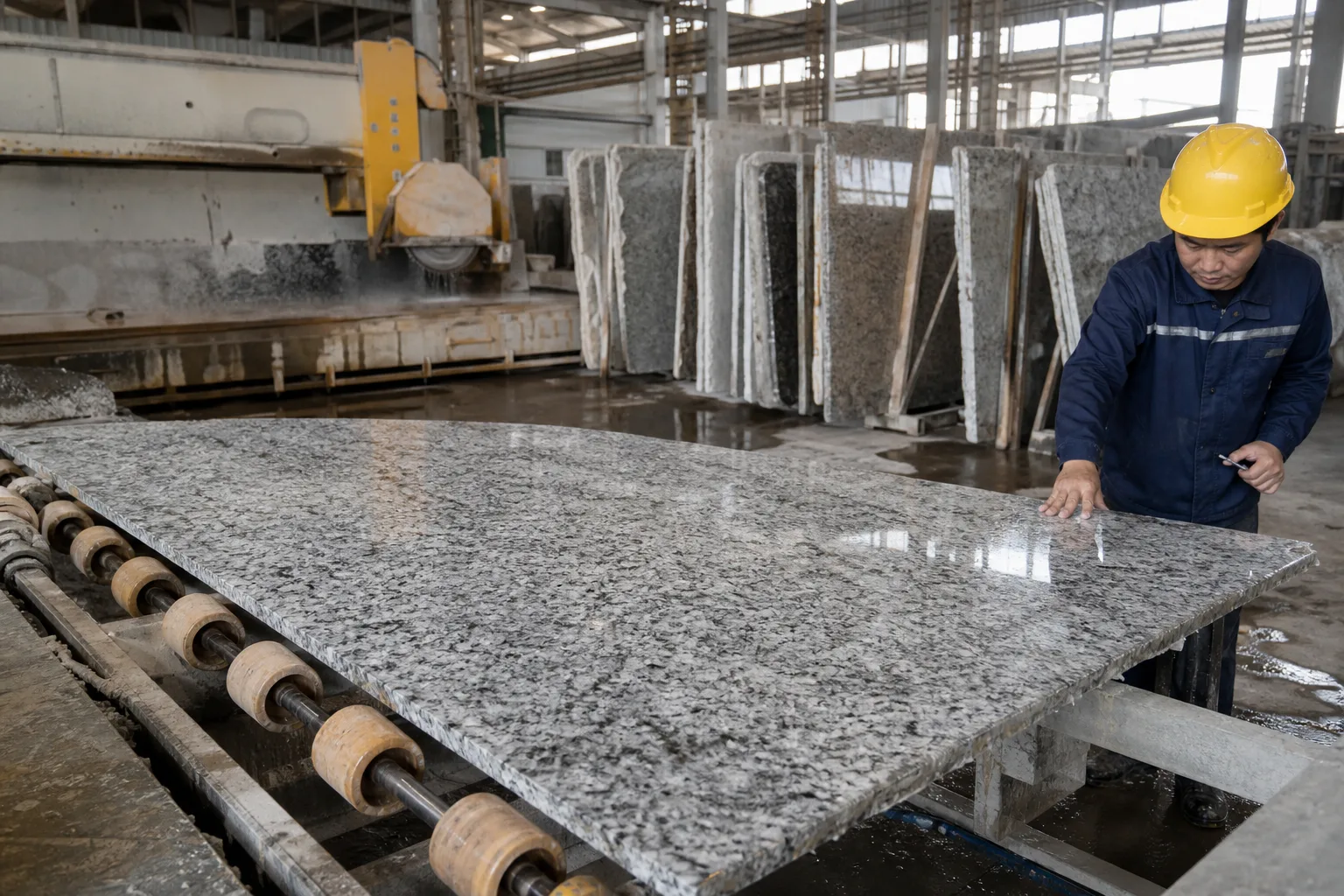
The granite manufacturing process normally follows a defined commercial sequence: identify and approve the stone, inspect rough blocks or slabs, saw the material, calibrate it, apply the specified finish, cut components to size, complete edges and openings, inspect the finished work, and pack it for transport. The exact route depends on whether the order is for unfinished slabs, standard tiles, countertops, paving or individually numbered architectural pieces. In China, a processor may use either domestically quarried granite or imported blocks, so the location of fabrication should never be treated as proof of geological origin.
Granite identity must be established before production
Geological identity and commercial classification
Dimension stone is natural rock quarried as blocks or slabs that must meet requirements for dimensions, shape, appearance and finish. Strength, durability and the ability to accept a finish are also relevant selection criteria.[1] In geological usage, granite is an intrusive igneous rock with a particular mineral composition. In the dimension-stone trade, however, the commercial granite category can include other hard, polishable igneous or metamorphic stones.
This distinction matters because a trade label alone does not establish mineralogy, performance or quarry source. If geological identity is important to the application, request a petrographic description or other appropriate technical documentation rather than relying on a color name.
Trade names and source declarations
A trade name may refer to a color, pattern, historical quarry name, distributor label or stone code. Similar-looking names can be used for materials from different quarries, while one material may be offered under several names. A purchase specification should therefore record, where available:
- commercial name and any recognized stone code;
- declared quarry, province and country of origin;
- block, bundle, slab or production-lot references;
- approved sample and dated approval record;
- reference photographs taken under agreed lighting;
- permitted ranges for color, grain, movement and natural features.
Fabrication in China does not necessarily mean that the stone was quarried in China. Chinese listings include both domestic varieties and materials marketed under names associated with other countries.[4] Buyers should keep the quarry origin, processing country and exporting company as separate data fields.
Principal stages of the manufacturing process
1. Block or slab selection
For block-based production, the processor first examines available blocks for dimensions, color range, grain direction, cracks, veins, inclusions and other visible features. Block orientation affects the pattern revealed after sawing. For projects beginning with finished slabs, the equivalent stage is slab-bundle selection and layout approval.
Natural variation cannot be eliminated through machining. The objective is to define an acceptable range and allocate the material consistently. Large or visually sensitive projects may require blocks from a coordinated production lot, but no supplier should claim uniformity without showing the actual material.
2. Primary sawing
Large blocks are divided into slabs or strips with suitable stone-cutting equipment. Commercial production may use gang saws, multi-blade systems, block cutters or wire-based equipment, depending on the material, dimensions and factory setup. StoneContact's overview of Chinese granite slab production describes block or gang sawing followed by shaping and surface processing.[4]
Sawing establishes nominal slab thickness but does not by itself guarantee a finished tolerance. Kerf behavior, blade condition, block stability and subsequent grinding can affect thickness and flatness.
3. Drying, treatment and calibration
After sawing, slabs may be dried, cleaned and inspected. Depending on the stone and agreed specification, a processor may fill localized voids, reinforce weak areas or apply resin. Such treatment is not universal and should not be assumed. Buyers should require disclosure of resin, mesh backing, fillers, dyes, waxes or other treatments when their use affects appearance, bonding, maintenance or suitability.
Calibration or grinding is used where tighter thickness control or a more even surface is required. Tiles and modular pieces often need particular attention to thickness consistency because accumulated variation can complicate installation.
4. Surface finishing
The face is processed to obtain the specified visual and tactile result. Finishing can involve successively finer abrasives, texturing equipment, heat or impact treatment. The approved finish must be defined by a physical sample or mock-up, not just by a finish name.
5. Cut-to-size fabrication
Finished slabs are cut into tiles, panels, steps, countertops, kerbs or other components. Production may include CNC profiling, waterjet cutting, drilling, sink and cooktop openings, grooves, slots, edge shaping, mitres and anchor preparation. The fabrication drawing should control dimensions, edge profiles, surface orientation, hole locations and identification marks.
6. Inspection, packing and loading
Finished pieces are checked against drawings and approved appearance references before packing. Protective film, foam, separators, corner protection, crates and A-frames may be used according to the product. Packing must restrain the stone without concentrating loads on unsupported edges or openings. A packing list should connect crate numbers to piece marks so that shortages and installation sequences can be checked.
Finishes and their application context
Finish selection changes color saturation, reflectivity, texture, cleaning behavior and slip considerations. Polished, honed and leathered finishes are common for interior slabs, while flamed, bush-hammered, sandblasted, sawn and split finishes are frequently considered for exterior or textured work.[5] These descriptions are general categories: texture depth and appearance can vary by stone and production method.
| Finish | Typical character | Common application context | Approval focus |
|---|---|---|---|
| Polished | Reflective surface with stronger color and pattern contrast | Countertops, interior walls and selected floors | Gloss consistency, scratches, resin visibility and edge polish |
| Honed | Smooth, low-reflective surface | Interior flooring, stairs, walls and work surfaces | Even sheen, sanding marks and color consistency |
| Leathered or brushed | Textured surface following aspects of the grain | Countertops, feature panels and selected interior floors | Texture depth, cleanability and treatment disclosure |
| Flamed | Coarse thermal texture | Patios, plazas, exterior paving and steps | Color shift, loose grains, flatness and texture uniformity |
| Bush-hammered | Regularly pitted impact texture | Exterior paving, stairs, walls and landscaping | Tool pattern, depth, edge damage and dimensions after finishing |
| Split-face | Irregular natural fracture | Walling, landscape pieces and rustic cladding | Projection limits, thickness range and safe handling |
A finish should be selected together with the application. A visual sample does not prove slip resistance, freeze-thaw durability, stain behavior or structural suitability. Where these properties matter, use application-specific test requirements and professional design review.
Specifications and test documentation
ASTM C615/C615M-23 is the active ASTM material specification for granite dimension stone. Its scope covers granite selected for general building and structural purposes, including sawed, cut, split or otherwise finished stone.[2] The specification addresses material characteristics, sampling and physical properties such as absorption, density, compressive strength, modulus of rupture, abrasion resistance where applicable, and flexural strength.[2][3]
Relevant current ASTM test-method listings include C97/C97M for absorption and bulk specific gravity, C170/C170M for compressive strength and C880/C880M for flexural strength.[3] ISO also maintains a natural-stone technical committee whose scope includes terminology, dimensions, tolerances, physical and mechanical properties, petrography and durability for blocks, slabs and finished products.[6]
A test report is useful only when it can be connected to the material being purchased. Before accepting a report, check:
- laboratory identity and report date;
- test method and edition;
- commercial and geological material description;
- declared quarry or sampling location;
- specimen orientation and surface condition where relevant;
- individual results, units and number of specimens;
- whether the tested material represents the current quarry bench or production lot.
Do not copy generic catalogue values into a project specification. Required values and tolerances should be selected by the project's architect, engineer or other qualified professional for the intended use. See the references on water absorption, compressive strength, slip resistance and freeze-thaw exposure for separate discussions of these properties.
Production inspection checklist
Inspection should follow an agreed specification, drawings and sampling plan. A marketplace profile, sample or factory photograph is not evidence that a shipment complies. For critical orders, define hold points before blocks are sawn, before components are packed and before the container is sealed.
| Control point | What to verify | Useful record |
|---|---|---|
| Material identity | Trade name, declared origin, block or bundle numbers and approved range | Block photos, slab inventory and sample approval |
| Appearance | Color, grain, veining, patches, repairs and piece-to-piece distribution | Dry and wet photographs under agreed lighting |
| Dimensions | Length, width, thickness, diagonals, squareness and flatness | Calibrated measurement sheet |
| Finish | Gloss or texture consistency, tool marks, scratches and edge quality | Approved finish sample and comparison photos |
| Fabrication | Profiles, cut-outs, holes, slots, mitres and piece marks | Signed shop drawings and piece checklist |
| Condition | Cracks, chips, open seams, staining, mesh, resin and repairs | Defect map with acceptance decision |
| Packing | Protection, crate strength, labels, quantities and loading restraint | Packing list and loading photographs |
Sampling levels, defect definitions and remedies should be agreed before production. Terms such as “premium,” “first quality” or “export quality” have limited value unless translated into measurable acceptance criteria. Additional planning resources include sizes and tolerances, color variation, defect assessment and third-party inspection.
Price factors in granite production
Granite prices cannot be inferred reliably from a trade name or country of processing. Quotations vary with block availability and yield, slab size, thickness, finish, quantity, component complexity, edge work, cut-outs, reinforcement, inspection scope, packing, inland transport and commercial terms.
Yield is particularly important. Cracks, irregular block dimensions, pattern matching and numerous small components can increase waste. A simple rectangular tile order may use material more efficiently than countertops requiring large uninterrupted areas or facade panels cut from coordinated slabs. Textured finishes, tight tolerances and low-volume custom work may also add processing stages.
Compare quotations on the same basis. Confirm whether the price covers material selection, treatments, templates or drawings, fabrication, dry layout, testing, inspection, crating, inland haulage and container loading. The named Incoterm, shipment point and currency should be stated. A guide to broader variables is available on the China granite price factors page.
China sourcing context
China has a broad commercial market for granite slabs, tiles and cut-to-size products, but directory scale does not verify the capability of an individual company.[4] Suppliers may operate as quarry-linked producers, independent fabricators, exporters, trading companies or combinations of these roles. Buyers should establish which legal entity receives payment, which facility performs each operation and whether any work is subcontracted.
Government sourcing guidance recommends careful partner vetting and clear alignment on commercial objectives; regional and sector specialization can also affect performance.[7] For granite procurement, practical due diligence can include business-registration checks, factory and equipment verification, review of comparable production records, confirmation of testing arrangements, and assessment of quality-control and packing procedures. These steps do not guarantee performance, but they reduce reliance on unverified marketing claims.
Before placing a production order, consider approving representative samples or a mock-up, then documenting acceptable natural variation and finish. For patterned slabs and countertops, slab photographs or a digital layout can help control seams and orientation. Relevant sourcing references include China granite suppliers, factory versus trading company, samples and mock-ups, supplier audits and container loading.
The manufacturing process can improve dimensional consistency and create the required finish, but it cannot make natural stone inherently uniform or prove suitability for every use. Procurement should connect the declared stone source, approved appearance, technical specification, production controls and shipment records. When those elements are documented separately, buyers can compare Chinese manufacturing offers on evidence rather than trade names or catalogue images alone.
Frequently asked questions
What are the main stages of the granite manufacturing process?
The usual stages are material selection, block sawing, slab inspection, optional treatment or reinforcement, calibration, surface finishing, cut-to-size fabrication, edge and opening work, final inspection, packing and loading. Some orders begin with purchased slabs rather than quarry blocks.
Does granite manufactured in China always come from a Chinese quarry?
No. Chinese factories can process both domestic and imported stone. Quarry origin, country of fabrication and exporter identity should be recorded separately and supported by order-specific documentation.
Which specification is commonly referenced for granite dimension stone?
ASTM C615/C615M is a commonly referenced material specification for granite dimension stone used for general building and structural purposes. Project requirements should identify the applicable edition, test methods and acceptance criteria rather than citing the standard without further detail.
How should a buyer inspect a Chinese granite order?
Inspection should compare the actual lot with approved samples, drawings and measurable tolerances. Typical checks cover stone identity, appearance range, dimensions, finish, fabrication details, repairs, piece marks, quantities and packing. Critical requirements and sampling rules should be agreed before production.
What most affects the price of manufactured granite?
Important variables include stone and block availability, usable yield, slab dimensions, thickness, finish, quantity, tolerance, cut-to-size complexity, edge profiles, openings, reinforcement, matching requirements, inspection, packing, inland transport and the quoted Incoterm.
Questions & discussion
Share a question or a useful experience about this guide. Comments appear immediately. Your name and comment are public. Email is optional and stays private; reply emails are not enabled yet. Comment privacy.