
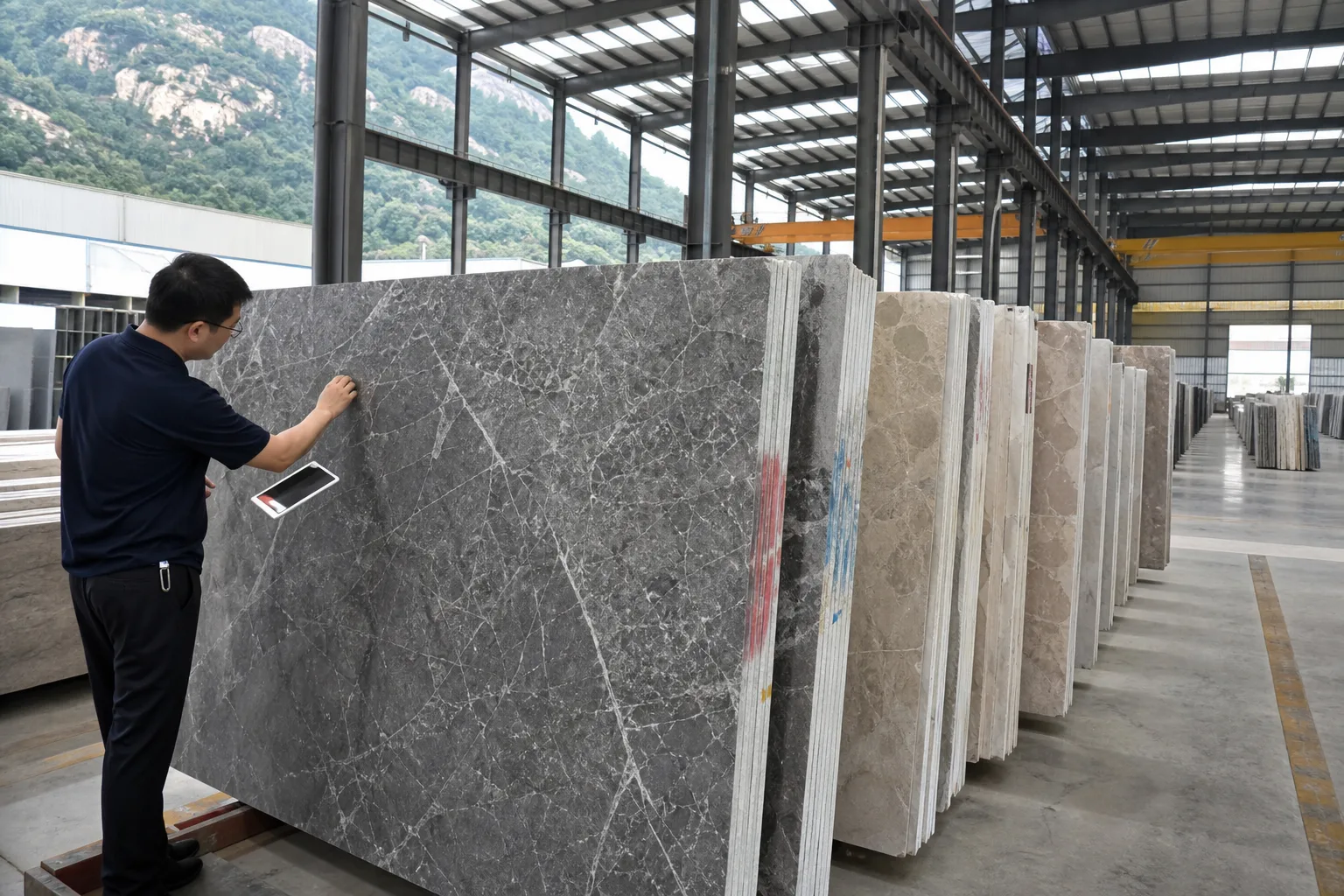
The Shuitou stone market is best understood as a commercial stone cluster in Shuitou Town, Nan’an, Fujian, rather than as a single supplier, quarry or uniformly controlled marketplace. Buyers use the area to investigate slabs, tiles, cut-to-size work and other stone products offered by factories, warehouses, galleries and trading companies. Its practical value is supplier and material concentration. Its principal sourcing risk is that a showroom location or product label does not, by itself, establish quarry origin, geological identity, stock ownership, factory capability or compliance with a project specification.
What the Shuitou stone market represents
Online industry listings place natural-stone businesses and industrial addresses in Shuitou Town, Nan’an City, Fujian Province. Listed product ranges include domestic and imported granite, marble, slabs, tiles and fabricated products. These listings provide evidence of the area’s commercial role, but individual company descriptions are supplier-submitted information and should not be treated as independent proof of capacity or performance. A StoneContact supplier listing, for example, identifies a Shuitou address and markets both imported and domestic granite; those claims still require transaction-specific verification.
A market visit is commercial investigation, not approval
A buyer may encounter several business models in the same area:
- Slab warehouse or gallery: displays stock that may belong to the operator, another supplier or a consignment owner.
- Factory: processes blocks, slabs or finished components, but its machinery and capacity must be verified for the proposed order.
- Trading company: coordinates material and production through outside factories.
- Integrated supplier: may claim control of quarrying, processing and export, but each stage should be documented separately.
Before requesting quotations, define whether the order requires quarry-controlled supply, selection from existing slabs, repetitive tile production or project-specific fabrication. See the wider China stone industry hub, the Fujian granite industry guide and the related Xiamen stone industry overview for regional context.
Geological identity, origin and trade names
Commercial granite is a broad category
“Granite” does not always have the same meaning in geology and in the dimension-stone trade. The Natural Stone Institute explains that commercial stone groups combine materials with similar working or performance characteristics, so some stones sold commercially as granite are not granite under a narrow scientific classification. Its glossary includes gneiss, granodiorite, syenite, monzonite, anorthosite and larvikite within the broader commercial granite category. The Institute’s scientific-versus-commercial guidance is therefore relevant when interpreting labels in a showroom or catalogue.
For procurement, record both the supplier’s trade description and the identity required by the project. If exact petrography matters, request a petrographic description or testing from a qualified laboratory. Do not infer mineralogy, durability or suitability from color alone.
Trade name is not proof of quarry origin
A trade name can vary by exporter, destination market or distributor. Different stones may be marketed under similar names, while one stone may have several names. Numeric labels such as “G” codes can be useful commercial references, but a code alone does not establish an active quarry, a fixed geological source or continuity between old and current production.
Ask the seller to state in writing:
- commercial name and any alternate names;
- stone type claimed by the supplier;
- country and quarry region of extraction;
- block, bundle, slab or production-lot references;
- whether processing occurred in Shuitou or elsewhere;
- whether the material is supplier-owned stock, third-party stock or made to order.
This distinction matters because stone may be extracted in one country and processed in another. “Supplied from Shuitou” is a statement about the transaction or processing chain, not necessarily geological origin. Buyers comparing a named Chinese material such as G603 should approve current production rather than relying on archived photographs or a historical label.
Products, finishes and intended applications
Shuitou suppliers may offer raw blocks, gangsaw or multiwire slabs, tiles, steps, countertops, wall panels, paving and custom components. Availability is supplier- and lot-specific. A displayed sample does not prove that matching commercial quantities are in stock.
Finish changes appearance and service conditions
Common slab finishes include polished, honed and textured or brushed surfaces. Polishing produces a reflective surface and usually strengthens the visual contrast of color and pattern; honing creates a lower-sheen appearance; leathered or brushed finishes introduce texture. Flamed, sandblasted, bush-hammered, split and sawn finishes are more frequently considered for paving, cladding and landscape work. Marble.com’s granite finish overview distinguishes polished, honed and leathered surfaces and notes that deeper texture can require more attention during cleaning.
Finish terminology should be supported by a physical control sample. Labels such as “honed,” “antique,” “leathered” and “brushed” do not define one universal gloss or texture. Approve the actual finish, color range and surface treatment under agreed lighting.
- Polished granite: commonly considered for countertops, interior walls and decorative floors.
- Bush-hammered stone: a visibly textured option for selected exterior or high-grip surfaces.
- Split-face stone: used where a naturally fractured appearance is intended.
Match the material to the application
Potential uses include kitchen countertops, flooring, facades, stairs, patios and landscaping. Suitability cannot be confirmed from the trade name or finish alone. Exterior exposure, freeze-thaw conditions, pedestrian traffic, anchorage design, panel dimensions, substrate and maintenance requirements can all change the necessary tests and acceptance criteria.
Specifications and technical evidence
A purchase specification should convert visual preferences into measurable requirements. ASTM lists C615/C615M-23 as the active specification for granite dimension stone. The standard covers material characteristics, physical requirements and sampling for granite used in general building and structural work. ASTM Committee C18’s current standards list identifies C615/C615M-23 among its active material specifications.
The Natural Stone Institute identifies relevant dimension-stone test methods including ASTM C97 for absorption and bulk specific gravity, C170 for compressive strength, C99 for modulus of rupture, C880 for flexural strength and C1353 for abrasion resistance. It also advises buyers to require appropriate testing when needed data are unavailable rather than assuming suitability. Its ASTM reference page emphasizes matching tests to the intended service conditions.
What to include in the purchase specification
- approved material name, origin statement and control sample;
- product type, nominal dimensions and measurement method;
- thickness, length, width, squareness and flatness tolerances;
- finish reference, gloss or texture expectation where measurable;
- permitted color, grain and movement range;
- rules for fissures, cracks, chips, pits, resin, mesh and surface repairs;
- edge profiles, cutouts, anchorage holes and drawing revisions;
- required test reports and applicable standard editions;
- piece identification, dry-lay or layout requirements;
- packing, crate marking, moisture protection and loading method.
Test reports should identify the tested stone and source clearly enough to connect the results to the offered lot. Check the laboratory, test method, date, specimen condition and units. A report for a similarly named stone or an earlier quarry source may not represent current production. Supporting references include guides to sizes and tolerances, water absorption, compressive strength, slip resistance and freeze-thaw evaluation.
Supplier investigation and inspection checklist
Commercial investigation should distinguish legal identity, sales representation, material ownership and production responsibility. A polished showroom and a broad catalogue do not demonstrate that the company controls the relevant factory or stock.
| Control point | Evidence to request | Main risk addressed |
|---|---|---|
| Company identity | Business name, registered address, license details and contract entity | Paying or contracting with the wrong entity |
| Supplier role | Written statement identifying factory, trader, warehouse and subcontractors | Undisclosed outsourcing or unclear responsibility |
| Material | Current slab photographs, bundle numbers, quantity list and origin declaration | Sample-to-lot mismatch |
| Production | Order-specific process route, machinery required and production schedule | Capability claims unrelated to the order |
| Quality standard | Approved sample, drawings, tolerances and defect criteria | Subjective acceptance disputes |
| Testing | Traceable reports or an agreed independent testing plan | Unsupported performance claims |
| Inspection | Inspection stage, sampling method, lighting, instruments and reporting format | Checks performed too late or inconsistently |
| Packing and loading | Crate design, labels, packing list, photographs and container-loading plan | Breakage, moisture exposure and quantity errors |
Use staged approvals
A practical sequence is sample approval, pre-production confirmation, in-process checks and pre-shipment inspection. For strongly patterned slabs, add slab selection and layout approval before cutting. Compare the physical sample with full slabs because a small piece may not represent movement, inclusions or color range across the lot. Relevant controls are explained in sample-versus-slab approval, slab layout and seam approval and granite quality control.
Inspection reports should record observations rather than vague grades such as “good quality.” State the number of pieces checked, measuring tools, acceptance criteria, defects found and disposition of nonconforming pieces. Buyers unable to inspect directly can consider a documented third-party inspection and a separate supplier audit.
Price factors, contracts and importing
There is no dependable market-wide price for “Shuitou granite.” Quotations depend on the actual stone, block or slab yield, grade selection, thickness, finish, dimensions, fabrication complexity, repairs, order quantity, packing, payment terms, delivery term and freight. Material that appears inexpensive per square meter may produce a higher installed or landed cost if selection losses, breakage, dimensional corrections or replacement delays are significant.
Compare quotations on an aligned basis. Each supplier should price the same drawings, finish reference, tolerances, packing standard, inspection scope and Incoterm. Identify exclusions and clarify whether quotations cover slabs, net finished area, gross production area, crates, inland transport, port charges or ocean freight. See China granite price factors, minimum order quantities, payment terms and container loading.
United States import controls
For U.S. imports, classification depends on the product’s material and degree of working. U.S. Customs and Border Protection advises importers to determine the appropriate Harmonized Tariff Schedule classification because duties and other requirements depend on that classification. CBP also notes that country-of-origin marking generally applies, subject to the relevant rules and exceptions. CBP’s import-requirements guidance recommends confirming commodity-specific requirements and current circumstances rather than relying on a generic duty assumption.
Do not use an old ruling, a supplier’s tariff code or a competitor’s entry as conclusive advice for a different product. Slabs, tiles, fully fabricated tops and assembled products may present different classification questions. The importer should confirm current treatment with a qualified customs professional before shipment.
How to use Shuitou effectively
Shuitou can be useful for comparing materials, finishes and potential production partners within a concentrated regional supply chain. The disciplined approach is to separate what is seen from what is proven: showroom sample from production lot, trade name from geology, warehouse from quarry, sales office from factory, and supplier promise from contract requirement.
Begin with a written sourcing brief, shortlist suppliers by order-specific capability, approve representative material, define measurable specifications and inspect before the balance payment or shipment milestone. For a broader procurement sequence, use the guides to importing granite from China, evaluating Chinese granite suppliers and factories versus trading companies.
Frequently asked questions
Is Shuitou a quarrying area or a stone marketplace?
Shuitou is primarily relevant to buyers as a trading, warehousing and processing cluster. A stone offered there may have been quarried elsewhere in China or imported from another country. Verify extraction origin separately from the supplier or processing location.
Can a buyer rely on a granite trade name in Shuitou?
No. Trade names can vary between suppliers and markets. Approve a representative sample and current slabs, record alternative names, and request traceable origin and lot information. Use petrographic or physical testing when the project requires verified identity or performance.
What should be inspected before stone leaves Shuitou?
Inspection should cover material and lot identity, color range, finish, dimensions, tolerances, cracks, chips, repairs, resin or mesh, fabrication details, quantity, labels, packing and container loading. The checklist must follow the purchase specification rather than a generic quality grade.
Why can quotations from Shuitou suppliers differ substantially?
Suppliers may be pricing different stone grades, slab yields, thicknesses, finishes, tolerances, fabrication work, quantities, packing methods, delivery terms and inspection scopes. Normalize these items before comparing totals.
Questions & discussion
Share a question or a useful experience about this guide. Comments appear immediately. Your name and comment are public. Email is optional and stays private; reply emails are not enabled yet. Comment privacy.