
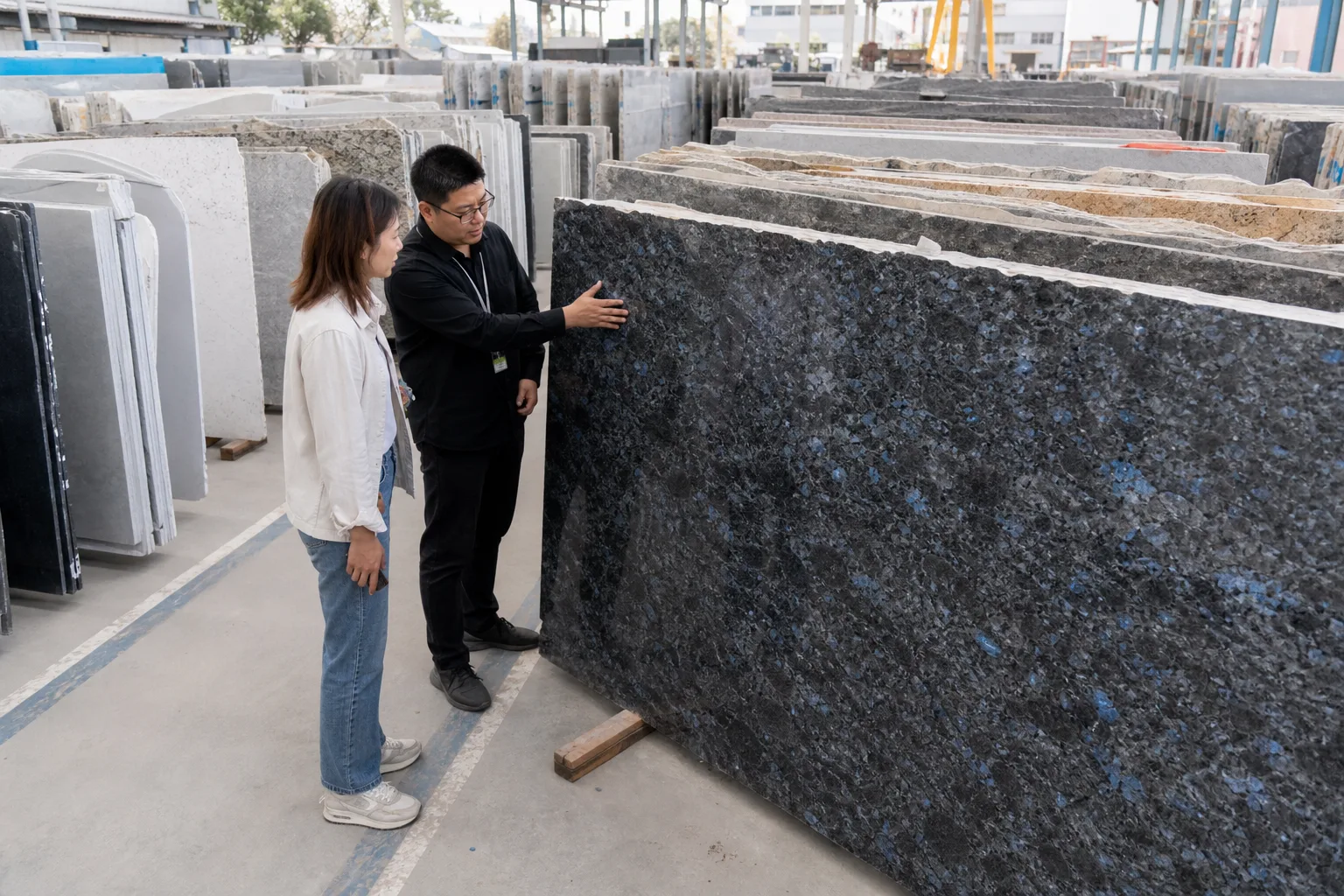
The Xiamen Stone Fair is best used as a structured commercial investigation: compare materials, identify possible suppliers, examine finishes and collect evidence for later verification. A booth meeting alone does not establish quarry control, factory ownership, production capacity, test performance or consistent quality. Buyers should arrive with an application-specific specification, record every material and company under a stable reference, and treat follow-up sampling, due diligence and inspection as separate procurement stages.
Fair scope and current schedule status
The Natural Stone Institute listed the 26th Xiamen International Stone Fair for March 16–19, 2026, in Xiamen, China. Its event notice described an exhibition spanning stone materials, finished products, technology and industry expertise, with more than 2,000 exhibitors and 150,000 attendees. These attendance and exhibitor figures are the institute's published event description rather than independently audited figures. ([naturalstoneinstitute.org](https://www.naturalstoneinstitute.org/events/calendar-of-events/xiamen-international-stone-fair/?utm_source=openai))
As of October 2, 2026, the 2026 event has concluded. This guide does not state a date for the next edition because a future date was not verified in the permitted research sources. Buyers should confirm current dates, registration requirements, venue access and exhibitor information before arranging travel.
What buyers can investigate
- Domestic and imported natural stone offered by China-based businesses.
- Blocks, gangsaw slabs, calibrated tiles, countertops, paving, steps, cladding and landscape units.
- Polished, honed, flamed, bush-hammered, split, brushed and other finish samples.
- Cutting, surface-finishing, handling, packaging and inspection equipment.
- Potential quarry companies, processors, exporters, trading companies and service providers.
The fair can shorten the initial search, but exhibitors may occupy different positions in the supply chain. Ask each contact whether it owns the quarry, operates the processing factory, purchases finished goods, acts as an exporter or combines several roles. Record the legal company name and factory address rather than relying only on a booth name or product catalogue.
Separate geology, trade names and supply origin
Dimension stone is natural rock quarried and shaped into blocks, slabs or units that meet requirements for size and form. Color, pattern, finish, durability and strength are also normal selection considerations. ([usgs.gov](https://www.usgs.gov/publications/dimension-stone?utm_source=openai))
In the stone trade, “granite” can be broader than the geological definition. Commercial groupings may include several crystalline igneous or metamorphic rocks that have similar fabrication or performance characteristics. The Natural Stone Institute therefore distinguishes scientific classification from commercial naming, while ASTM C1721 recognizes that stone can require both geological and commercial classification. ([naturalstoneinstitute.org](https://www.naturalstoneinstitute.org/stoneprofessionals/varieties/definition/?utm_source=openai))
Questions for every displayed stone
- What is the exact commercial name used on the quotation, sample and packing list?
- Are there alternative English names, Chinese names or legacy codes for the same material?
- What is the claimed quarry country, province and location?
- Is the exhibitor the quarry operator, an authorized distributor, a processor or a reseller?
- Is the material shown from current production, old stock or a one-off lot?
- Can blocks, slabs and finished units be traced to the approved batch?
- Is a petrographic description or independent laboratory report available?
A company located in Xiamen may process stone quarried elsewhere in China or imported from another country. Factory location, port of loading and geological origin are separate facts. Do not convert a trade name into a quarry-origin claim without documentary support. For strongly directional, veined or foliated materials, also document the proposed cutting direction and approved visual range.
Compare finishes by application
Finish samples should be evaluated on the exact stone under consideration. The same nominal finish can look and feel different according to mineral composition, grain, tooling, abrasive sequence and production line. Polished granite is generally reflective, honed granite has a smoother matte appearance, and leathered or brushed surfaces introduce texture. Flamed, bush-hammered, split-face and sawn finishes are commonly considered for architectural or exterior work rather than conventional countertop surfaces. ([marble.com](https://marble.com/articles/granite-finishes?utm_source=openai))
Application-focused review
- Countertops: Review full slabs for fissures, resin, mesh, repairs, pattern direction and layout yield. Confirm thickness, surface finish, edge details and cutout requirements.
- Interior flooring: Specify module size, thickness, calibration, squareness, surface finish and visual range. Slip performance must be addressed by the project specification rather than inferred from appearance.
- Exterior paving and steps: Evaluate texture consistency, dimensional tolerances, drainage design and project-specific resistance to weather, traffic and deicing exposure.
- Facades: Obtain engineering input on panel dimensions, flexural performance, anchorage and the effects of mineral alteration or weathering.
- Landscaping and kerbs: Confirm visible faces, split or sawn surfaces, chamfers, radii, lengths and packaging that protects corners during transport.
Do not approve a finish only by touching a small loose sample under exhibition lighting. Request a production-sized sample or mock-up and inspect it under the lighting and viewing distance relevant to the project. Wet and dry appearance may differ, especially on honed and textured surfaces.
Specifications and technical evidence
ASTM C615/C615M covers granite dimension stone intended for general building and structural purposes. Its scope includes material characteristics, physical requirements and sampling, while associated dimension-stone methods address properties such as absorption, density, compressive strength, abrasion and flexural strength. The Natural Stone Institute advises obtaining testing where required data are unavailable or avoiding an application when performance cannot be supported. ([store.astm.org](https://store.astm.org/c0615-03.html?utm_source=openai))
A test report should not be accepted merely because it contains the requested standard number. Check the laboratory identity, report date, specimen description, commercial name, geological description where available, finish, conditioning, sampling party, test-method edition and relationship between the specimens and the proposed production source.
Evidence to request after the fair
- Current data sheets and complete laboratory reports rather than selected result screenshots.
- Representative samples labeled with supplier, material, finish, thickness, date and batch reference.
- Drawings stating dimensions, tolerances, exposed faces, edge work, reinforcement and packaging.
- A written visual acceptance range covering color, grain, veining, mineral concentrations, repairs and natural openings.
- Production and inspection plans identifying measurable acceptance criteria.
- For demanding projects, petrographic examination addressing mineralogy, texture, alteration and constituents relevant to weathering or staining.
ASTM C1721 explains that petrographic examination can help classify a stone and identify minerals, structures, weathered constituents or potentially unstable components relevant to intended use. It does not replace the mechanical and physical tests required by the project. ([store.astm.org](https://store.astm.org/c1721-22.html?utm_source=openai))
Booth-to-order investigation checklist
| Stage | Question or check | Evidence to retain | Warning sign |
|---|---|---|---|
| Booth screening | Who is the legal seller and what role does it perform? | Business card, legal name, address and named contact | Only a brand name or changing company identity is provided |
| Material identity | What exact stone, quarry source, batch and finish are displayed? | Labeled sample, photographs and product reference | The same name is applied to visibly different materials |
| Technical review | Which tests support the proposed application? | Complete reports linked to the offered material | Untraceable tables, expired documents or another stone's data |
| Commercial quote | What is included in the unit price? | Dimensions, tolerance, finish, quantity, packing and Incoterm | A price is given without a measurable product specification |
| Supplier verification | Does the company control the claimed facility and process? | Registration checks, audit scope and factory address | Factory access is refused or the production location changes |
| Sample approval | Does the sample represent production variation? | Signed control sample, range sample or mock-up | A small ideal sample is treated as the entire acceptance standard |
| Production | Are dimensions, finish and appearance controlled during manufacture? | Inspection records and batch identification | Quality is assessed only after the order is fully packed |
| Loading | Are quantity, crate condition and container loading verified? | Packing list, crate marks, photographs and inspection report | Unlabeled crates or substitutions cannot be traced |
The U.S. Commercial Service recommends independent background research even when a service provider or business appears in a directory. The same principle should be applied to companies met at a trade fair: exhibition participation is a lead-generation signal, not proof of capability or integrity. ([trade.gov](https://www.trade.gov/china-business-service-providers?utm_source=openai))
Price factors and post-fair China sourcing
Fair quotations are difficult to compare unless every supplier prices the same specification. No reliable market price should be inferred from a single booth discussion. Granite cost can change with stone source, block selection, visual grade, slab or unit dimensions, thickness, finish, quantity, fabrication complexity, reinforcement, tolerances, inspection, packing, inland transport, ocean freight, duties and payment terms.
Build a comparable request for quotation
- Use one drawing set and one revision number for all bidders.
- State whether quantities are net finished area, production area, pieces, slabs or crates.
- Define acceptable color and pattern variation with reference samples.
- List every visible finish and edge instead of using “standard finish.”
- State tolerance, flatness, squareness and calibration requirements.
- Separate material, fabrication, packing, inland freight and international freight where possible.
- Name the required Incoterm and location precisely.
- Specify documentation, inspection points and substitution controls.
After shortlisting, determine whether the seller is a factory or trading company, verify the actual production site and approve samples before placing a production order. A trading company is not automatically unsuitable, and a factory is not automatically qualified; the relevant questions are responsibility, process control, technical competence, traceability and contractual accountability.
For shipments to the United States, import requirements depend in part on the correct Harmonized Tariff Schedule classification, and country-of-origin marking must also be considered. Product form and degree of working can affect classification, so buyers should obtain case-specific customs advice rather than copying a code from a different stone product. ([help.cbp.gov](https://www.help.cbp.gov/s/article/Article-1397?utm_source=openai))
The practical outcome of the fair should be a controlled shortlist, not an immediate assumption of approval. Keep separate records for the material, the legal seller, the quarry claim, the processing factory and the quoted product. Follow with company verification, technical review, representative samples, a written specification, contract controls and inspection before shipment.
Frequently asked questions
When was the 2026 Xiamen Stone Fair held?
The Natural Stone Institute listed the 2026 fair for March 16–19, 2026, in Xiamen, China. As of October 2, 2026, that edition has concluded. Confirm future dates with current event information before booking travel.
Can a supplier be approved during a fair meeting?
A meeting can support initial screening, but it does not verify legal identity, factory ownership, quarry control, capacity or quality consistency. Complete company checks, technical review, representative sampling and an appropriate factory audit or inspection before approval.
What should a granite buyer bring to the fair?
Bring drawings, quantities, required finishes, application details, tolerance requirements, visual references and a standard supplier questionnaire. Using the same information with every bidder produces more comparable quotations.
Does a Xiamen supplier necessarily sell Chinese granite?
No. A Xiamen-based company may offer stone quarried in another Chinese province or imported from another country. Verify quarry origin, factory location, seller identity and port of loading separately.
Which documents should be requested after the fair?
Request a formal quotation, company registration details, factory address, material data, complete test reports where relevant, labeled samples, drawings, visual acceptance criteria, packing details and a proposed quality-control plan.
Questions & discussion
Share a question or a useful experience about this guide. Comments appear immediately. Your name and comment are public. Email is optional and stays private; reply emails are not enabled yet. Comment privacy.