
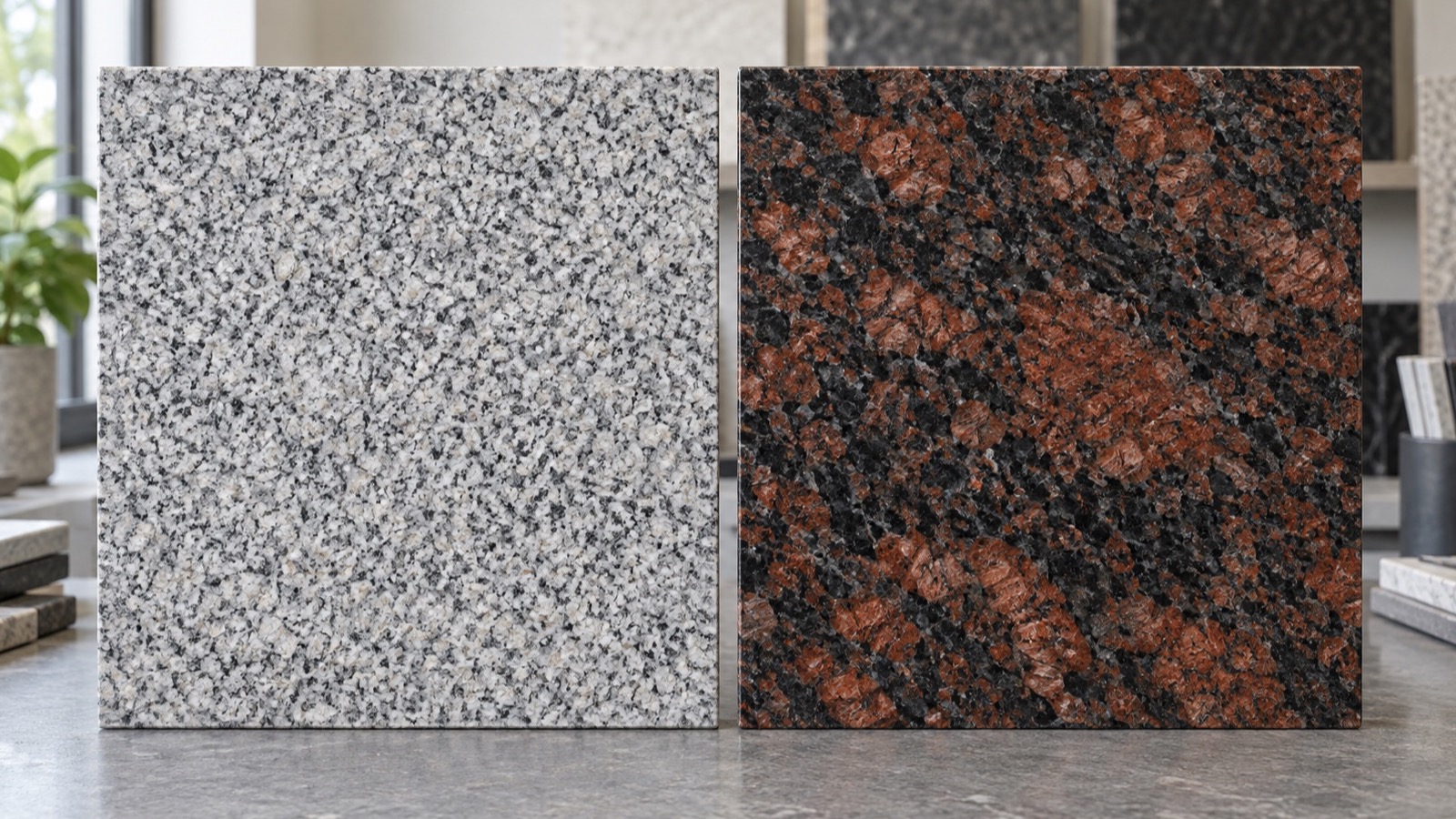
Chinese and Indian granite cannot be ranked accurately as two uniform products. Both countries supply many geological materials, finishes and fabricated formats through companies with different capabilities. The useful comparison is the exact stone and production route: identity, current source, visual range, test evidence, finish, dimensions, factory control, packing, logistics and landed cost.
Compare materials, not flags
“Granite” in dimension-stone commerce covers a broad group of crystalline rocks. Country of origin does not determine absorption, strength, color consistency or polish. Select candidate materials first, then compare representative samples and recent test reports using the same methods and acceptance criteria.
Commercial names can be ambiguous in both markets. Record quarry country and location, processing country, shipment origin, supplier’s code and approved sample. A familiar name from a new source should be treated as a new material until equivalence is demonstrated.
Color and range
China is associated in international trade with numerous grey, black, red, pink and yellow commercial stones as well as extensive fabrication capacity. India is known for many black, red, brown, green and strongly patterned materials. Those broad associations help discovery but are not selection rules. Availability changes, and a supplier catalog can contain domestic and imported stone.
Compare full slabs or a sufficient number of finished pieces. Assess background tone, grain, directional movement, mineral clusters, fissures, repairs and the effect of finish. Define an acceptable range for each candidate instead of expecting two natural stones to match.
Fabrication and finish capability
Both countries have factories capable of slabs, tiles, paving, monuments and custom fabrication. Capability is supplier-specific. Audit the actual facility or use a qualified inspector. Confirm cutting equipment, calibration, edge work, surface line, repair practice, template control, final inspection and packing.
Approve polished, honed, flamed or other finishes on the exact material. A process can change color and texture differently across mineral compositions. For walking surfaces, use a project-defined slip test and service condition rather than assuming one national product is safer.
Cost comparison
Compare landed cost, not an isolated factory price. Include material grade, dimensions, thickness, finish, fabrication, yield, packing, inspection, inland transport, freight, insurance, duty, port charges, storage, delivery, damage and spare pieces. Currency, container utilization, route capacity and lead time can change the result.
A lower quote may reflect different selection, tolerance, net area or packing. Normalize the specification and exclusions before comparing. Avoid undated price claims because stone and freight markets move independently.
Supply continuity and lead time
Ask each supplier about current quarry access, block inventory, production capacity for the specific finish and realistic milestones. Quarry continuity matters for phased projects; factory capacity matters for fabricated orders. Retain approved samples and require notice before any source substitution.
Longer distance does not always mean longer delivery. Vessel schedules, transshipment, port congestion, holiday shutdowns and destination handling affect lead time. Build a schedule with approval, production, inspection, booking and contingency stages.
Import and origin considerations
Destination rules can differ according to product classification, origin and degree of working. CBP advises U.S. importers to determine the HTS classification and address country-of-origin marking. Current tariffs or trade measures may differ between Chinese and Indian goods and can change. Confirm them for the exact product before ordering; do not rely on an old percentage in a comparison article.
Decision matrix
| Question | Chinese candidate | Indian candidate |
|---|---|---|
| Exact source documented? | Record quarry and processor | Record quarry and processor |
| Appearance approved? | Review current range | Review current range |
| Evidence comparable? | Same methods and dates | Same methods and dates |
| Factory capable? | Audit relevant line | Audit relevant line |
| Landed cost complete? | Include current trade costs | Include current trade costs |
| Schedule credible? | Check quarry, factory and vessel | Check quarry, factory and vessel |
Turn the selection into a measurable specification
A trade name, photograph or sample is a starting point, not a complete order. Record the approved material name, quarry or block reference when available, surface finish, nominal and minimum thickness, face dimensions, edge work, dimensional tolerances, visual range, repair policy, quantity, spare allowance, packing and labeling. State which measurements will be checked, how many pieces form the inspection sample and what happens when a result falls outside the agreed limit.
Natural stone varies. A sensible approval defines an acceptable range rather than asking production to match one small photograph. Review multiple full-size samples or a dry layout when appearance continuity matters. Keep the signed sample and dated photographs available to the factory and destination inspector. For performance-sensitive work, ask for recent reports from representative material and identify the test method; a generic claim that granite is “strong” does not establish suitability for a particular assembly.
| Control | Record before production | Verify before shipment |
|---|---|---|
| Identity | Trade name, source and approved range | Labels and production match approvals |
| Geometry | Dimensions, thickness and tolerances | Measurements across a defined sample |
| Finish | Process, sheen or texture reference | Consistency under normal lighting |
| Fabrication | Edges, cut-outs, repairs and reinforcement | Workmanship and critical locations |
| Packing | Crate design, sequence and marks | Dry stone, protection and count |
Buying and approval checklist
- Ask the seller to distinguish quarry origin, processing location and shipment origin.
- Approve representative samples and retain a signed control sample.
- Put measurable tolerances and visual criteria on the purchase order.
- Confirm test methods and report dates for performance claims that affect the project.
- Inspect a first piece before full production and a defined sample before shipment.
- Match packing, crate marks and piece labels to the installation sequence.
- Keep a reasonable spare allowance for natural variation, cutting and future repair.
These controls do not remove variation or project risk. They create a record that lets the buyer, fabricator, installer and inspector evaluate the same requirements. Local building codes, engineering requirements and installation-system instructions remain controlling for the finished work.
Frequently asked questions
What should buyers verify before ordering Chinese granite vs Indian granite?
Verify the exact material and source, current representative samples, finish, dimensions and tolerances, relevant test evidence, repairs, packing, inspection plan and complete commercial terms.
Does a trade name or country guarantee performance?
No. Natural stone properties and factory controls vary. Evaluate the actual material, batch, finish, thickness and installation conditions with project-specific evidence.
How should natural variation be approved?
Review multiple representative pieces or full slabs, define an acceptable range, retain signed samples and record how veins, mineral clusters, fissures, fills and repairs will be judged.