
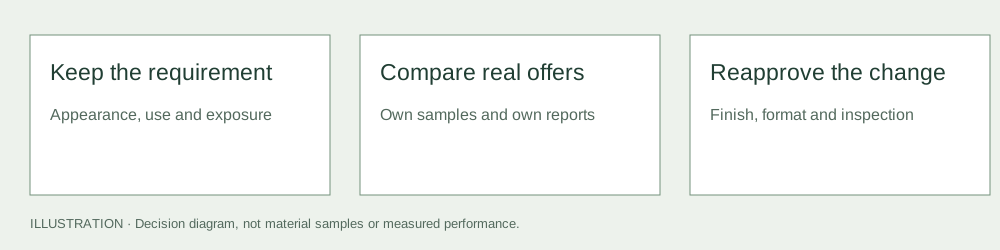
G603 and G654 are different starting points for a stone selection, not interchangeable specification codes. G603 is commonly offered as a lighter grey family, while G654-labelled offers usually enter a darker-grey selection discussion. Neither label supplies a universal quarry, density, absorption result or finish performance. Compare the actual offers, then decide whether the project can accept the differences.
Keep the G603 record and G654 record open alongside the samples. Their unestablished values remain unestablished in this comparison; the table is not a source of missing laboratory data.
First decide what must remain the same
Ask why the substitution is being considered. A change made to match an existing installation has different constraints from a redesigned project where the purchaser deliberately accepts a darker or lighter stone. Record which requirements are fixed: colour distribution, source declarations, product form, finish, dimensions, exposure and maintenance expectations.
Do not approve a replacement merely because a quotation calls it equivalent. A seller can offer a commercially reasonable alternative that still fails a visual match or lacks a report required by the project. Make those differences explicit before discussing price or lead time.
Compare appearance and source declarations
Pizrog’s G603 entry describes its own grey/silver material and alternative names. SRS’s G654 entry describes its own dark-labelled supply and a replacement offering. These are primary seller statements about their products, not independent verification of the stone another supplier will ship.
| Question | G603 offer | G654 offer | What substitution changes |
|---|---|---|---|
| Appearance | Approve the actual lighter-grey range, grain and conspicuous minerals | Approve the actual darker range, flecks and tonal differences | A new range and an installed-area layout may be needed |
| Origin | Retain the full material name, suffix and source documents | Retain its own source declaration and replacement description | Do not carry forward the original quarry assumption |
| Finish | Review production-finish samples from the offered material | Review the same finish on the replacement material | The same process name may give a different visual result |
| Physical data | Values on the record are not established for an unidentified lot | Values on the record are not established for an unidentified lot | Obtain the replacement’s own relevant reports |
| Product form | Confirm actual sizes, edges and fabrication capability | Confirm those details again for this supply | Drawings and packing may need revision |
| Inspection | Use the retained range and specification | Use the newly approved range and specification | Separate old references from the replacement acceptance set |
Supply availability is a dated seller confirmation, not a permanent property of the trade name. Ask what material and quantities can actually fulfil the order and whether the sample source is the proposed production source. This guide does not verify a quarry-closure history or a current stock position.
Finish behaviour: compare like with like
A polished sample can appear deeper or more reflective than a textured piece of the same material. Compare both offers in the intended finish, with agreed lighting and moisture conditions. Approve the edges and arrises as well as the face. Record whether an enhancer, resin or other treatment is contributing to the appearance.
Use the Finishes group and polished-versus-honed comparison to define what is being compared. A darker face is not proof of lower absorption, and a rougher face is not by itself a wet-slip result. Avoid converting a visual preference into an unsupported performance claim.
For colour-controlled work, arrange representative pieces across an area rather than evaluating a single attractive chip. Ask which variations are included in the offer and whether the supplier can maintain the approved selection range through the quantity being ordered.
Match the application and test evidence
Both labels may appear in proposals for flooring, patios, stairs and other dimension-stone work. A listed use does not establish suitability for a particular support arrangement, loading or exposure.
ASTM’s granite specification scope provides context for the categories of physical evidence used in selection. It does not certify either offered lot. Request reports that identify the specimens, method, date and condition, then have the responsible specifier judge their relevance. Do not transfer a report from the retained stone to a new material simply because both are sold as granite.
Where the substitution affects thickness, edge geometry, holes, repairs, reinforcement or support, obtain revised drawings. If a critical requirement is unresolved, leave it unresolved in the approval record rather than entering a borrowed value to finish the form.
Reapprove the purchase in a controlled order
- Identify the replacement material and explain which original requirements change.
- Approve a representative sample range in the actual finish, including visible edges and any treatments.
- Review the reports and the application-specific requirements for the new offer.
- Confirm dimensions, tolerances, fabrication, quantities, identification and packing against revised drawings.
- Replace superseded inspection references with a clearly dated approval set while retaining the old set as the history of the decision.
Follow Samples & approval, sizes and tolerances and Inspection & receiving to keep those steps connected. At delivery, photograph crate marks and piece IDs and compare the shipment with the replacement approval, not the original sample by accident.
Decide what the comparison cannot settle
A lower quotation, a similar photograph or a familiar G-number cannot settle missing identity or performance evidence. Ask whether the remaining differences are acceptable to the purchaser and responsible designer. If not, obtain stronger evidence or change the selection.
This comparison has not examined production samples, tested either lot or checked supplier stock. It provides the questions and record changes needed for a substitution decision; the actual approval belongs to the project’s documented evidence and authorised decision-makers.
Questions & discussion
Share a question or a useful experience about this guide. Comments appear immediately. Your name and comment are public. Email is optional and stays private; reply emails are not enabled yet. Comment privacy.