
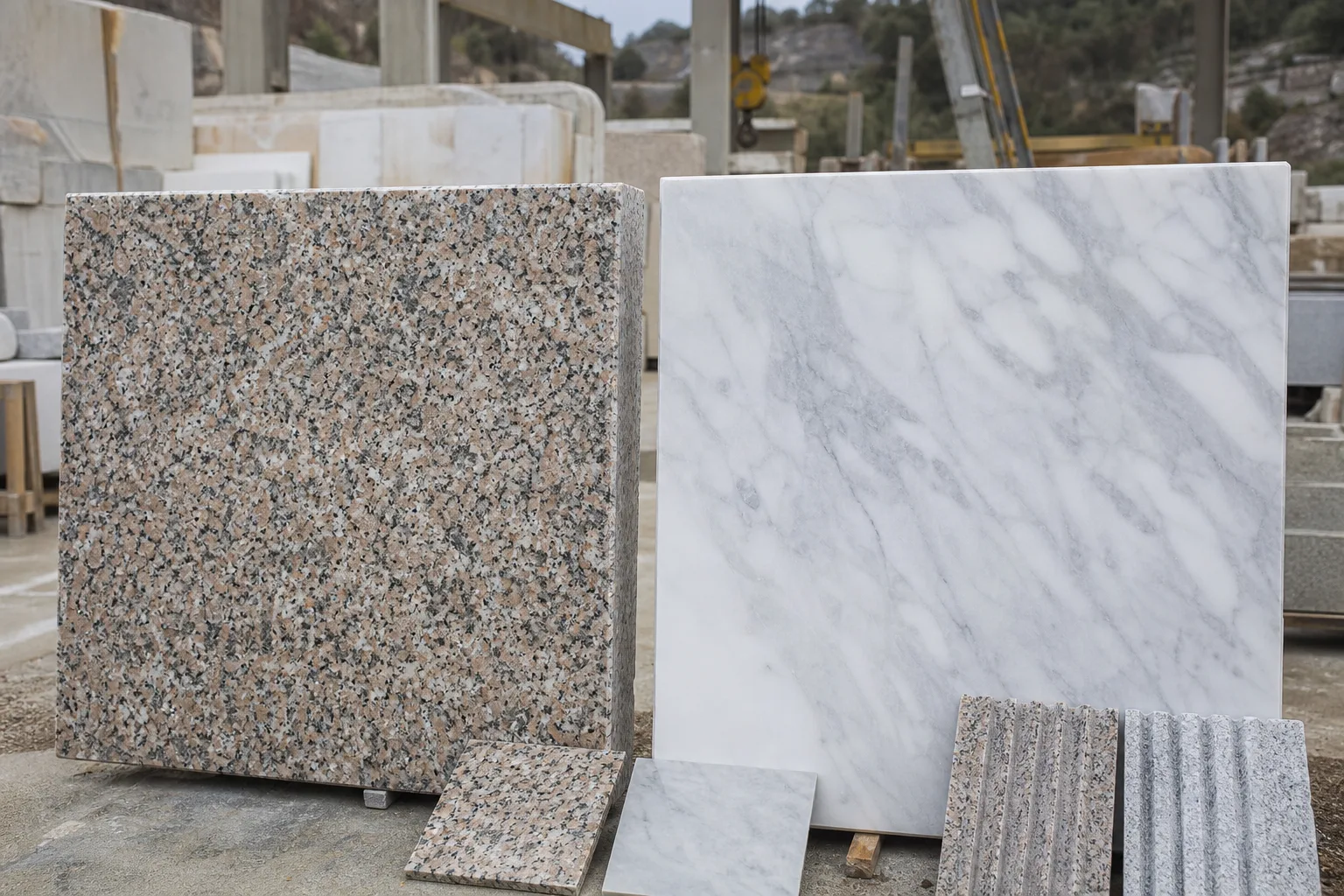
Granite is generally the safer choice for hard-use kitchens, busy floors, exterior paving and other abrasion-prone applications. Marble is commonly preferred when distinctive veining, carving potential or a softer decorative character matters more than resistance to acids and visible wear. This is a selection tendency, not a rule. Individual stones vary, commercial names can obscure geological identity, and the correct decision depends on the specific stone, finish, intended environment and verified test data.
Granite vs marble at a glance
Both materials are natural dimension stone: rock quarried and fabricated into blocks, slabs or pieces meeting dimensional and finish requirements. The U.S. Geological Survey identifies color, texture, pattern, finish, durability, strength and ability to take a polish as relevant selection criteria. ([usgs.gov](https://www.usgs.gov/centers/national-minerals-information-center/dimension-stone-statistics-and-information?utm_source=openai))
| Selection point | Granite | Marble |
|---|---|---|
| General identity | Usually a silicate-rich igneous rock, although the commercial group includes several related rock types | True marble is metamorphosed carbonate rock; the commercial group may include other polishable carbonate stones |
| Typical appearance | Granular, crystalline, speckled or flowing patterns | Veining, clouds, movement and comparatively soft visual transitions |
| Acid response | Usually less vulnerable to ordinary food acids, but mineralogy and surface treatments still matter | Calcite marble can etch when exposed to lemon, vinegar, wine and other mild acids |
| Abrasion and scratching | Generally more resistant in demanding service | Generally develops scratches and wear more readily |
| Common best uses | Kitchen worktops, busy flooring, stairs, paving, facades and landscaping | Vanities, wall cladding, fireplaces, decorative floors and design-led interior features |
| Maintenance expectation | Routine cleaning plus sealing when the particular stone needs it | Routine cleaning, possible sealing and acceptance or restoration of etching and wear |
| Cost conclusion | Neither material is automatically cheaper. Variety, grade, yield, finish, fabrication, testing, freight and project quantity control the quotation. | |
For a broader review of the first material, see the granite reference page. Application-specific decisions should also be checked against the requirements described under natural stone applications.
Geological identity and commercial trade names
What granite means
In strict geology, granite is a coarse-grained igneous rock with a defined mineral composition. In the dimension-stone trade, “granite” is a broader performance group that can include gneiss, gabbro, anorthosite and other visibly crystalline stones. The Natural Stone Institute explains that scientific and commercial classifications overlap but are not identical. ([naturalstoneinstitute.org](https://www.naturalstoneinstitute.org/consumers/varieties/definition/))
This distinction matters because two products sold as granite may differ in mineral content, absorption, fissuring, polish response and resistance to weathering. A trade name alone is therefore not a technical specification.
What marble means
True marble is a metamorphic rock formed from carbonate material. ASTM C503/C503M classifies dimension marble as calcite or dolomite marble, while commercial practice may place dense, polishable limestones in the marble group. ([store.astm.org](https://store.astm.org/c0503_c0503m-23.html))
Buyers should record the commercial name, geological description where available, quarry or block source claimed by the seller, country of extraction and country of fabrication as separate fields. A product processed in China is not necessarily quarried in China.
Do not approve by name alone
The same or similar trade name may be used for materially different selections. Conversely, one quarry material may be sold under several translated or marketing names. Approval should be tied to a physical control sample, current slab or tile photographs, finish, dimensions and an agreed range of color and movement. Guidance on managing this issue is available in sample versus slab approval and color variation control.
Performance and the best applications
Countertops and vanities
Granite is usually the more practical option for a working kitchen because most commercial granites offer strong abrasion resistance and good service durability. The Natural Stone Institute identifies granite as a common choice for countertops, floors and other heavily used surfaces, while still warning against concentrated thermal shock. ([naturalstoneinstitute.org](https://www.naturalstoneinstitute.org/consumers/varieties/granite/))
Marble can be used for kitchen countertops, but the user should expect a different aging pattern. Calcite, the principal mineral in true marble, is vulnerable to mild acids commonly encountered in kitchens and bars. Etching is a chemical change to the surface finish; it is not the same as an absorbed stain, and an impregnating sealer does not prevent it. ([naturalstoneinstitute.org](https://www.naturalstoneinstitute.org/consumers/varieties/marble/))
For a low-intervention family kitchen, granite is normally the better starting point. Marble becomes reasonable when the design value outweighs maintenance concerns and the owner accepts patina or periodic refinishing. See the kitchen countertop guide for application planning.
Floors and stairs
Both stones can be used for interior flooring and stairs, but traffic, grit, cleaning practices and finish must be considered. Granite is generally favored for heavily trafficked entrances and commercial circulation. Marble may perform well in residential and decorative interiors, although scratches and traffic paths can become visible sooner.
Do not describe a finish as universally “slip-resistant.” Required performance depends on the installation, contaminants, footwear, slope and applicable project rules. Where pedestrian safety is critical, specify the relevant test method and acceptance criterion for the finished product or installed assembly.
Exterior paving and cladding
Granite has an established role in cladding, curbs, paving and landscape work. ASTM C615/C615M covers granite dimension stone for building and structural purposes, including cladding, paving and landscape features. ([store.astm.org](https://store.astm.org/c0615-03.html?utm_source=openai))
Exterior marble requires more selective evaluation. Acidic weathering, moisture, freeze-thaw exposure, anchorage design and the stone's history in a comparable climate may affect suitability. The Natural Stone Institute notes that exterior marble use is more limited and that exceptions must be evaluated by stone type. ([naturalstoneinstitute.org](https://www.naturalstoneinstitute.org/consumers/varieties/marble/))
For hardscape projects, compare granite options for driveways, patios and landscaping. Exterior facades require project-specific engineering rather than selection by appearance alone.
Granite vs marble outdoors: specify the exposure first
For a terrace, entrance, pool surround or facade, write down the expected wetting, frost, cleaning chemicals, drainage and pedestrian use before selecting a stone. A material name and a polished showroom sample cannot establish how the completed work will perform in that setting. Compare the actual finish and construction details, including joints, supports and water management, with the project specification.
The Natural Stone Institute's marble guidance identifies acid rain and weathering as concerns for exterior marble. This does not make every granite suitable or every marble unsuitable. Ask for evidence tied to the proposed stone and exposure, rather than transferring a result from an unrelated colour or quarry. Sealing does not make carbonate marble immune to acid etching.
For walking surfaces, assess the specified finish under foreseeable wet or contaminated conditions; a finish name alone is not a slip rating. For suspended or anchored cladding, material selection is only part of a professionally designed assembly. Use the patio guide, pool-coping guide and facade guide to frame the application questions. Record repairs and treatments, retain the approved range sample and agree how pieces with transport damage will be documented before installation.
Finishes change appearance and service behavior
Polishing, honing and texturing do not change granite into marble or vice versa, but they can alter color depth, reflectivity, cleanability and the visibility of wear. Finish names also vary among factories, so a written name should be supported by an approved sample.
Polished and honed surfaces
- Polished: reflective and color-enhancing. Common for countertops, walls and decorative floors. Etching is usually conspicuous on polished marble because the affected area loses gloss.
- Honed: smooth with a matte or low-sheen appearance. It can make minor abrasion less obvious, but dark honed stones may show fingerprints, oils or handling marks differently from polished material.
- Leathered or brushed: produced with abrasive brushes to create a tactile surface. Texture depth is not standardized by the name alone and should be approved on the actual stone.
Marble.com distinguishes polished, honed and leathered granite and notes that textured surfaces can be more difficult to clean when debris collects in recesses. Its descriptions are useful as general finish guidance, not as evidence of a particular supplier's output. ([marble.com](https://marble.com/articles/granite-finishes?utm_source=openai))
Textured exterior finishes
Flamed, sandblasted, bush-hammered, split and sawn finishes are frequently considered for paving, steps, walls and landscape components. A heavily textured finish can obscure color and veining, increase exposed surface area and require different cleaning methods. Review the finish database, including polished, bush-hammered and split-face references, before fixing the finish schedule.
Specifications, samples and inspection
Use the correct material standard
ASTM lists C615/C615M-23 for granite dimension stone and C503/C503M-23 for marble dimension stone as active material specifications. Both address material characteristics, sampling and physical requirements such as absorption, density, compressive strength, modulus of rupture, abrasion resistance and flexural strength. The applicable edition and required thresholds should be confirmed in the project specification rather than copied from an unrelated product sheet. ([astm.org](https://www.astm.org/membership-participation/technical-committees/committee-c18/subcommittee-c18/jurisdiction-c1803?utm_source=openai))
A test report is useful only when its material identity, specimen orientation, finish or conditioning where relevant, laboratory, method, date and production source are traceable to the stone being purchased. Do not assume that a report for the same trade name represents every quarry face, block or shipment.
Practical pre-shipment checklist
- Confirm commercial name, claimed geological group, quarry source and country of extraction.
- Approve a control sample showing the required finish and an acceptable range, not only an ideal small piece.
- Define nominal and permitted dimensions, thickness, squareness, flatness, edge treatment and hole or anchor locations.
- State rules for veins, fissures, pits, chips, resin, mesh, filling, reinforcement and repairs.
- Review current slabs or a dry layout when veining continuity, shade grouping or seam placement matters.
- Check visible finish consistency under agreed lighting and viewing conditions.
- Match test reports to the specified standard and intended application.
- Specify packing, crate identification, piece marks, moisture protection and loading documentation.
- Record nonconformities with measurements and photographs before shipment.
Inspection criteria should be agreed before production. A generic instruction such as “first quality” does not define an enforceable acceptance range. Useful supporting references include samples and mockups, granite quality control, stone defect classification and third-party inspection.
Cost factors: why neither stone has one fixed price
A reliable granite-versus-marble cost comparison requires matched specifications. Comparing a common polished granite tile with a heavily selected book-matched marble slab says more about the two products than about the material groups.
Material and production variables
- Quarry availability, block size and consistency of supply
- Usable yield after cracks, veining, inclusions and color selection
- Slab or piece thickness and dimensional tolerances
- Polished, honed or specialist textured finish
- Cut-to-size complexity, edge profiles, sink cut-outs and drilling
- Resin treatment, mesh backing, filling or reinforcement where specified
- Testing, mockups, dry laying, numbering and inspection
- Order quantity, replacement allowance and production scheduling
Landed-cost variables
Packing, inland transport, port charges, ocean freight, insurance, tariffs, customs processing, local delivery, breakage risk and exchange-rate terms can materially change the landed total. Request a quotation that identifies the Incoterm, included work, exclusions and quotation validity. For China-specific planning, consult granite price factors in China, Incoterms, container loading and shipping cost factors.
Sourcing granite or marble from China
China is both a source of domestic stone and a processing base for materials extracted elsewhere. Public marketplace listings from Chinese sellers include Chinese granites alongside stones marketed under overseas names, illustrating why supplier location, fabrication country and quarry origin should not be treated as interchangeable. Marketplace entries are seller-provided leads; they do not independently prove origin, stock, factory ownership, quality or export capability. ([stonecontact.com](https://www.stonecontact.com/p/granite-tiles-slabs/china-supplier?utm_source=openai))
Define the supply chain
Ask whether the contracting party is the quarry operator, slab processor, cut-to-size factory, trading company or a combination of these. Verify the legal entity receiving payment and identify any subcontracted production stages. The U.S. International Trade Administration recommends careful partner evaluation and notes that suitability requires thorough vetting and clear alignment on business goals. ([trade.gov](https://www.trade.gov/country-commercial-guides/china-market-entry-strategy))
Start with importing granite from China, China granite supplier assessment and factory versus trading company. These checks should be applied to both granite and marble orders.
Build approval around evidence
The purchase specification should connect the approved sample, finish, dimensional schedule, test documentation and inspection plan to the sales contract. For veined marble, slab layout and seam approval may be commercially significant. For granular granite, shade grouping and finish consistency may dominate. In either case, retain dated approval records and require written consent before substitutions.
Bottom line: choose granite when resistance to wear and lower sensitivity to ordinary food acids are primary. Choose marble when its visual movement and decorative character justify greater care and possible patina. The agreed selection should always identify a named and sampled stone in a defined finish and application—not granite or marble as an abstract category.
Frequently asked questions
Which is better, granite or marble?
Granite is generally better for hard-use kitchens, busy floors and exterior paving. Marble is often better for decorative interiors where veining and visual character are the priority. The final decision should be based on the specific stone, finish, application and verified performance data.
Is granite always cheaper than marble?
No. Common granite may cost less than scarce or highly selected marble, but premium granite can exceed ordinary marble. Quarry availability, selection grade, usable yield, thickness, finish, fabrication, testing, packing, freight and order quantity all affect the quotation.
Does sealing stop marble from etching?
No. An impregnating sealer may reduce liquid absorption and staining, but it does not prevent acids from reacting with calcite marble. Lemon juice, vinegar, wine and some cleaners can still dull or etch the finish.
Does buying stone from China mean it was quarried in China?
Not necessarily. A Chinese supplier may process domestic blocks or imported blocks and slabs. Buyers should request separate declarations for the country of extraction, processing location, contracting company and actual production facility.
What should be inspected before granite or marble is shipped?
Check identity against the approved sample, color range, dimensions, thickness, finish, chips, cracks, repairs, resin or mesh treatment, dry layout where required, piece marks, packing and traceability of any test reports. Acceptance criteria should be written before production begins.
Questions & discussion
Share a question or a useful experience about this guide. Comments appear immediately. Your name and comment are public. Email is optional and stays private; reply emails are not enabled yet. Comment privacy.