
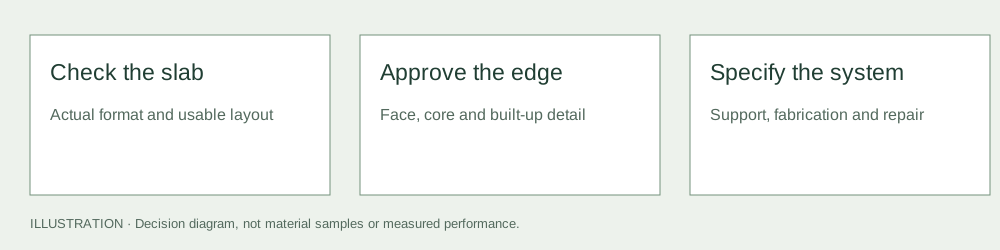
Choose between the proposed granite slab and the exact porcelain product as complete installed systems. Natural variation, a printed design, a built-up edge, the fabricator’s experience and the replacement plan can matter more than a generic material ranking. Neither “granite” nor “porcelain” supplies the dimensions, support details or exposure approval for your project.
Start with the drawings and the intended use. Obtain actual slab dimensions, usable areas, thickness and finish from both bidders, then ask each to show the seams, cutouts and visible edges on the same layout. This page supplies no current prices or universal thickness minimum.
Make the offers comparable
Granite is natural dimension stone; an offered slab may include variation, fills, resin or reinforcement that need to be declared. Porcelain slabs are manufactured ceramic products with product-specific faces, thicknesses and installation instructions. A porcelain tile and a large-format slab are not automatically interchangeable assemblies.
Daltile’s Panoramic reference describes its own slab range and professional installation requirements. Use that as an example of the documents to obtain for a named product, not a specification for every porcelain brand. Likewise, the granite specification’s public scope identifies a framework for dimension stone, not certification of the slab in the showroom.
| Project question | Granite | Porcelain slab | Decision evidence |
|---|---|---|---|
| Format and usable size | Actual slab range, fissures, repairs and layout affect yield | Offered format and pattern positions constrain layout | Dimensioned slab photos and proposed cutting plan |
| Thickness and support | Specify the actual stone thickness and assembly | Follow the exact product’s installation system | Shop drawings and support responsibility |
| Visible edges | Exposes the natural material, subject to repairs and finish | Face decoration may differ from edge/core appearance; edge design matters | Full-size edge sample and corner detail |
| Cost drivers | Selection, yield, fabrication, finishing and handling | Product, specialist cutting, edge construction and handling | Like-for-like installed quotations |
| Heat and scratching | Consider the stone, finish, treatments and thermal changes | Follow the manufacturer’s specific heat and care instructions | Care handover; cutting boards and appropriate protection |
| Staining and sealing | Determine treatment need for the actual stone | The slab face may not need sealer; joints and installation are separate | Product instructions and compatibility trials |
| Repair | Assess damage, finish matching and available replacement stone | Edge and face repair visibility may limit an acceptable result | Written repair and replacement criteria |
| Exterior suitability | Verify material, finish, exposure and assembly | Verify the named product is approved for that use | Exposure-specific documentation, not a category claim |
Sizes and thickness: approve the drawing rather than a category
Ask whether the slab sizes quoted are nominal, actual or usable after trimming. Put the desired seam positions, pattern direction and any return pieces onto a drawing. For granite, include the pieces rejected because they fall outside the approved range. For porcelain, show where the visible decoration will meet at seams and built-up edges.
Thickness is not the same as the apparent depth of a finished countertop edge. A mitred or built-up edge can change the appearance without making the entire slab that thick. Confirm which surfaces are factory finished and which need work after cutting. Do not apply a support rule from one material or thickness to another without the responsible fabricator or designer’s assessment.
The slab buying guide and sizes and tolerances help turn these questions into a measurable enquiry. Agree tolerances on the actual order; there is no meaningful single “standard slab size” that resolves every offer.
Heat, marks and care
Do not translate resistance claims into permission to abuse either surface. Follow the exact product instructions and take account of edges, adhesives, supports and any treatment. Use cutting boards rather than treating the installed top as a scratch test.
Daltile publishes a care guide for its Panoramic surfaces, including cautions specific to that range. For natural stone, identify the material and any resin or coating before choosing cleaners or deciding about sealing. A convenient cleaner for one product is not automatically compatible with the other.
Discuss maintenance with the owner using the actual finish sample. A pale matt face, a dark reflective face and a textured surface may reveal different marks even within the same material category. Document the agreed appearance rather than promising that either surface is maintenance-free.
Fabrication and damage: specify who decides
Confirm that the fabricator handles the selected material and has the necessary equipment and handling plan. Large pieces, narrow sections around cutouts and unsupported corners need more than a delivery date. Ask how pieces will reach the room and what on-site adjustment could be needed.
OSHA’s silica guidance identifies fabrication of stone and ceramic-related materials as a potential dust hazard. Neither option is a suitable basis for uncontrolled dry cutting in an occupied home. The fabricator must address the actual material, task and applicable safety requirements.
Agree how to assess a chipped edge, damaged corner, visible fill or face defect. A repair that restores usability may still be visually unacceptable in a prominent area. Ask whether the proposed repair can be demonstrated on a sample and what happens if it cannot match. Keep adequate replacement references; a later purchase may not reproduce the original natural slab or manufactured batch.
Outdoor use and the final choice
Some porcelain slab ranges are expressly offered for outdoor applications; require that approval for the exact product, thickness, finish and assembly. Do not generalise from one manufacturer’s range. Granite also needs an exposure and installation assessment, including wet use, weather, drainage and any treatments. For walking surfaces, use slip-resistance guidance rather than choosing by a dry showroom face.
Close the decision with the same documents for both offers: product and lot identity, approved range or design, finish, drawings, visible edges, support, packing, repair criteria and care instructions. Connect them to Samples & approval and Inspection & receiving. The better choice is the documented assembly that meets the project and can be supplied and maintained as agreed; this guide has not tested either offered product.
Questions & discussion
Share a question or a useful experience about this guide. Comments appear immediately. Your name and comment are public. Email is optional and stays private; reply emails are not enabled yet. Comment privacy.