
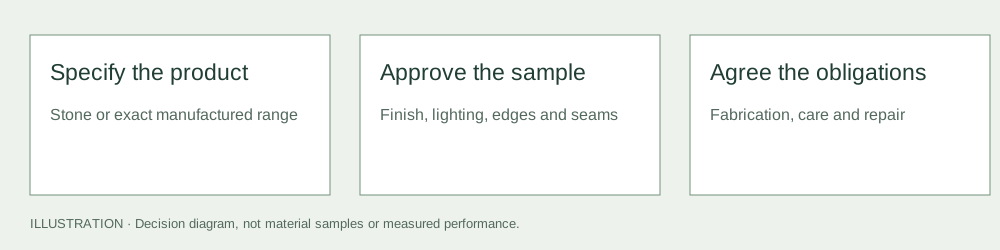
The practical choice is between an identified natural stone and a specified manufactured surface, not between two names on a showroom label. Choose granite when its actual slab range and finish fit the project and the owner accepts the documented care. Consider engineered quartz when the specified product gives the appearance and maintenance approach you want, subject to its heat, chemical and application restrictions. Neither choice removes the need for a capable fabricator, a support design and an agreed repair plan.
This comparison concerns natural stone sold as granite and manufactured quartz-composite surfacing. It does not equate quartz with natural quartzite. No price, laboratory ranking or service-life estimate is established for the products in your quotation.
Start with the application and the actual offer
Write down the installed use, indoor or outdoor exposure, sink and appliance details, visible edges and the owner’s cleaning habits before choosing a colour. Then identify the exact natural stone or manufactured product, finish and slab references. The stone library shows why a trade name alone is insufficient; the countertop guide connects the material to the installation questions.
For quartz, obtain the current product sheet and care instructions for that named range. Caesarstone’s description of its quartz products is a manufacturer source for its own range, not a guarantee that every manufactured surface has the same formulation or application approval. For granite, approve the offered slabs, including any resin, fills or reinforcement that affect fabrication and appearance.
Compare the obligations side by side
| Decision | Granite | Engineered quartz | What to put in the enquiry |
|---|---|---|---|
| Cost drivers | Slab selection, usable yield, repairs, finish and fabrication | Exact brand/range, slab layout, edges and approved fabrication | Same drawings, exclusions, packing and replacement scope |
| Heat | Stone, treatments and sudden temperature changes still need consideration | Follow the product’s heat restrictions; use protection | Trivet practice, appliance clearances and manufacturer requirements |
| Scratching and marks | Minerals, finish and treatments affect what shows | Product and finish affect marking; resistance is not immunity | Cutting boards, approved cleaning and a sample trial |
| Care and sealing | Decide sealing need from the actual stone and treatment | Many quartz products need no sealer; follow their own instructions | Written care handover and approved products |
| Fabrication | Qualified stone fabrication, supported cutouts and handling | Qualified fabrication to the exact manufacturer’s instructions | Shop responsibility, safe dust controls, site-adjustment plan |
| Repair | Chips or finish damage may be repairable; a match is not guaranteed | Repair options and colour matching depend on product and damage | Who assesses repair, approval sample and replacement route |
| Where not to use it | An unsupported, untested or unsuitable stone assembly | An application or exposure outside the named product’s approval | Resolve the limitation before ordering |
Do not turn this table into a winner score. For example, a straightforward rectangular top and an island with visible returns may use the same surface very differently. Ask the fabricator to show the proposed layout before comparing installed quotations.
Heat, cleaning and sealing are separate questions
Caesarstone’s care instructions call for hot pads or trivets and cutting boards. Treat that as a practical product-care requirement, not evidence that damage begins at one universal temperature. Protect natural stone and its treatments too; an oven tray and a slowly warming appliance impose different conditions.
For granite, use the sealing guide to determine whether a compatible treatment is useful. A water-drop screen is not a laboratory absorption result, and applying more sealer does not solve every stain or haze. Quartz owners should not automatically apply a granite sealer or borrow a natural-stone cleaner: follow the exact manufactured surface’s instructions.
Ask for a care demonstration on an approved sample if the owner is concerned about fingerprints, dried splashes or cleaning effort. Keep the product identity and proposed cleaner with the sample. An easy-to-clean showroom sample does not prove that every finish will look the same after normal use.
Black granite versus white quartz: compare what you will see
This colour choice belongs inside the material decision. A dark reflective face can make light residue or reflections conspicuous; a light face can make other spills and edge details more visible. Pattern, sheen and the direction of light change the impression. Avoid claiming that one colour hides everything.
Take the actual samples into the room and inspect them in daylight and the usual evening lighting. Compare the sink edge, a proposed seam and the visual weight of any built-up edge. Ask which marks can be cleaned and which would require repair. The white granite record helps separate a natural colour family from a promise of uniform white appearance.
What “engineered stone” does and does not mean
Engineered stone is a product-category term, not a single stone species or a universal formula. In this comparison, quartz means a manufactured quartz-based surfacing product. Brand names and wider marketing terms may also cover other formulations. Identify the exact product, composition information, safety data and installation instructions instead of applying one quartz claim to every engineered surface.
Granite is a commercial natural-stone grouping whose geological identity may need separate verification. The distinction matters when a cleaner, fabrication method or exterior approval depends on what the surface actually is. It does not require a separate natural-versus-engineered purchase page.
Fabrication and repair: decide responsibility before installation
Both choices need competent handling and fabrication. OSHA’s silica overview identifies cutting, grinding and drilling stone and related materials as potential sources of hazardous respirable dust. An installed countertop is a different situation from fabricating it. Do not treat a consumer material comparison as permission for uncontrolled dry cutting at home.
Ask the fabricator who will make cutouts, how pieces will be supported, what adjustments could be needed on site and how their safety procedures address the material. Record acceptable repairs and who decides whether a chip, crack or visible seam needs replacement. Neither “natural” nor “engineered” tells you whether an individual damaged piece can be restored acceptably.
For outdoor use, obtain approval for the exact product and assembly. Some manufactured lines are offered for outdoor use; that does not extend outdoor suitability to every quartz colour. Granite also needs assessment for exposure, support, finish and treatments.
Close the choice with comparable documents
Keep the approved surface references, finish, drawings, cutouts, edges, seams, support arrangements, treatment declarations and care instructions together. Have both bidders price that same scope. Confirm who bears responsibility for transport damage, incorrect fabrication and later repair assessment.
Use Samples & approval for the appearance record and Inspection & receiving for the handover. Choose the option whose actual limitations and responsibilities the project can accept; this guide has not tested either offered product or established a current market price.
Questions & discussion
Share a question or a useful experience about this guide. Comments appear immediately. Your name and comment are public. Email is optional and stays private; reply emails are not enabled yet. Comment privacy.