
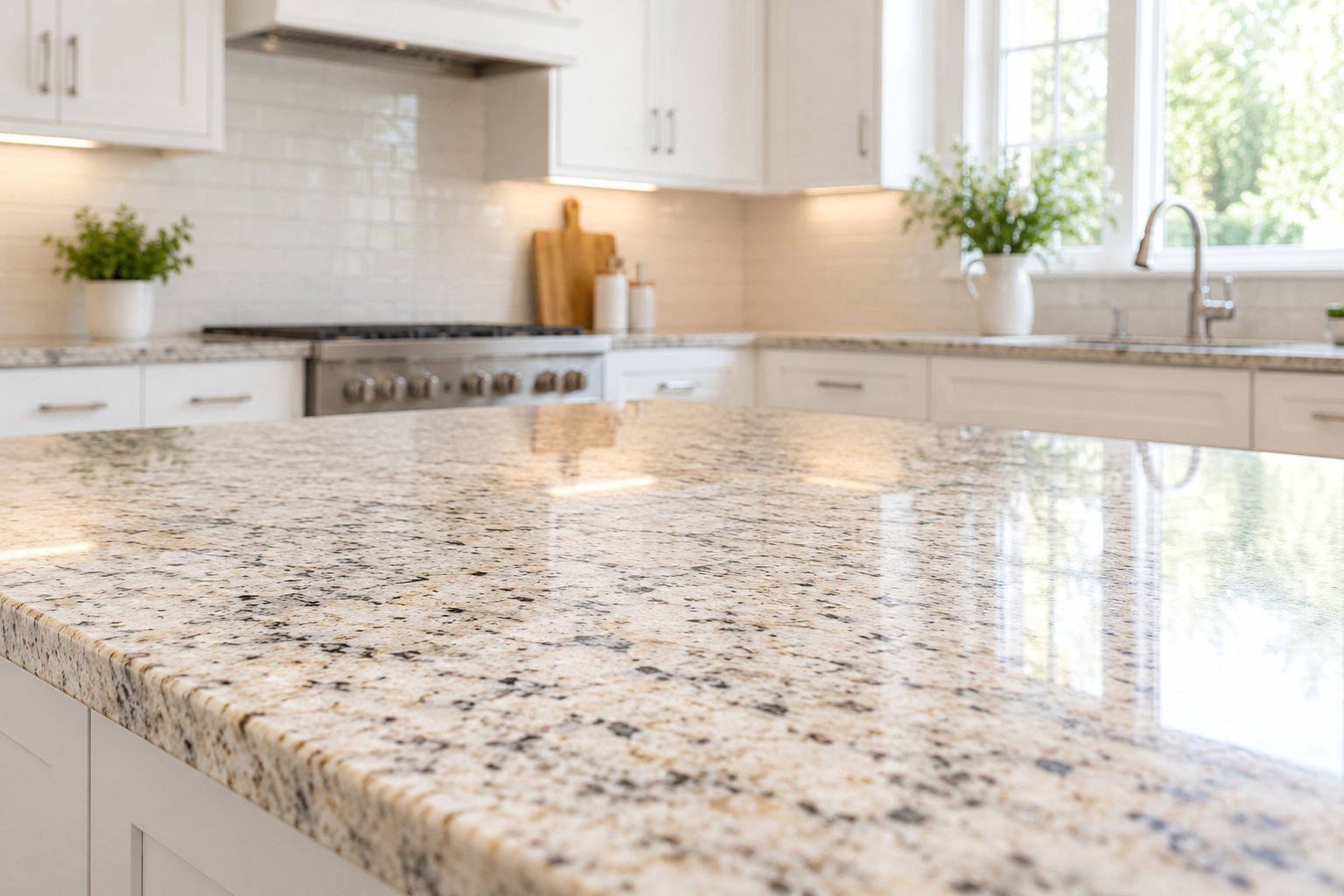
A light granite countertop and a white quartz countertop offer different routes to a bright kitchen. Granite is natural stone with visible variation; engineered quartz is manufactured and can be available in a more consistent white. Before choosing, compare the specific surfaces for appearance, liquid absorption, care and the heat and sunlight conditions in your kitchen. Neither a colour name nor a single owner’s experience predicts the performance of every slab.
If you want a perfectly plain white surface, look carefully at the actual material rather than a label. “White granite” is a commercial colour family, not a promise of a featureless white slab. Even a light background can contain darker flecks, veins or patches. A plain white quartz design may better match that visual goal, but its manufacturer will still have instructions about hot cookware, cleaning and suitable exposure.

Understand the name and choose the actual surface
Granite sold under a white trade name can look cream, grey or warm white in different lighting. The density and scale of markings can vary across slabs offered under the same name. Bring a cabinet sample and consider the stone under the kitchen’s planned light. View the full slab, not just a small chip, and ask where seams and prominent markings will fall in the finished counter. The sample-versus-slab guide explains why that step matters.
Pitaya is sold as a light granite trade name. Its appearance may suit someone looking for a light surface with a natural pattern, but the name does not establish the absorption or treatment of a particular slab. Ask the supplier about existing resin or other treatment, inspect the exact slab and discuss whether a compatible sealer is useful after a representative test. A sealer improves resistance to some spills; it does not make stone stain-proof.
Names such as Alaska White, Colonial White or Viscount White can be useful starting points for a showroom search. Their visual character and performance should be checked on the actual lot rather than treated as a fixed ranking. A sample that looks right in a showroom can look warmer or busier beside your cabinets. If a seller describes a stone as particularly resistant or particularly absorbent, ask for information that applies to the slab and finish being offered.
Compare stain care without relying on colour alone
Some households report years of easy care with light granite; others are concerned about spills and visible marks. These experiences are useful questions to take to a supplier, not a guarantee that every white slab behaves the same way. Absorption varies with the material, finish and existing treatment. A pale colour alone does not prove that a stone will absorb more than every darker stone.
Ask whether the slab is factory resin-treated or has already received a sealer. On clean, dry representative material, an appropriate water-drop screen can reveal visible darkening, but it is a field observation rather than a laboratory absorption result. Ask the fabricator to explain the test, the treatment history and the care plan for the finished surface. Oil and water can behave differently, so a water screen does not prove that the countertop will resist every stain.
If an impregnating sealer is appropriate, use a product approved for the actual stone and intended surface, and follow its instructions. Test a representative area for changes in appearance before treating the finished countertop. The need to reseal depends on the material, use and product; do not assume a fixed schedule applies to every slab. The sealing guide sets out the decision in more detail, and the stain-removal guide covers what to do if a mark appears.
Engineered quartz is generally chosen partly for its consistent appearance and straightforward routine care. The product maker’s instructions still matter: clean spills promptly, use approved cleaners and avoid assuming that a white surface is immune to stains. Ask for the warranty and care guide for the exact colour and collection, including any restrictions on chemicals or prolonged exposure to strong staining agents.
Heat and sunlight deserve separate checks
A countertop is exposed to more than spills. Engineered quartz contains a manufactured binder system, and its care instructions can limit exposure to high heat. Use a trivet or hot pad for cookware, follow the specific manufacturer’s instructions and avoid treating any quartz surface as heat-proof. The same precaution is sensible for natural stone: a hot pan can create a local temperature shock, and the surrounding joints or other materials may have different limits.
If a counter sits in direct sun, ask whether the exact quartz product is approved for that exposure and whether the warranty has relevant restrictions. Some products and applications have limits on UV exposure or colour change; it would be misleading to claim that every white quartz countertop will yellow. For either material, confirm whether the proposed product is suitable for the location, including a sunroom or outdoor installation if that is the plan.
A kitchen’s seam layout, sink opening and edge details also affect the finished result. Discuss these with the fabricator when comparing samples. A white quartz sample and a large granite slab may look similar in isolation but behave differently visually when repeated across a long run or joined at a corner. Approve the layout before fabrication rather than choosing from a name alone.
Decide which appearance you can live with
If a uniform white is essential, ask the quartz supplier for a full-size view and compare the actual production batch. Manufactured materials also have design variations, so a catalogue photograph is not the final approval. Consider the edge and backsplash beside the sample, under both daylight and the kitchen’s evening lighting.
If you prefer natural variation, inspect multiple light granite slabs and identify the particular one you want reserved. Decide whether darker flecks or a stronger patch can be placed away from the most visible part of the counter. Ask how the fabricator handles seams, including whether two adjoining sections come from compatible slabs. Keep photographs or a signed layout with the order.
For buyers open to a third material, solid-surface products such as Corian are a separate category from both granite and engineered quartz. They can offer a different appearance and repair approach. Compare the exact product’s care, heat and installation instructions rather than treating all white countertops as interchangeable. The broader granite-versus-quartz comparison covers the underlying material differences.
Ask about the whole installation
A countertop quote should state the chosen material, thickness, finish, edge, sink cutout, seams and installation. Confirm whether the supplier or fabricator is responsible for any proposed treatment, what is included in aftercare and how damage or staining claims are handled. Ask for written care instructions before the order is placed, not after the counter is installed.
For Pitaya or another light granite, ask whether resin was applied at the factory and whether the fabricator intends to add an impregnator. Existing treatment can affect the result of another product. If a supplier promises that a slab will never stain, request the terms in writing and compare them with the care guide: no sealer should be described as protection against every spill or type of damage.
For white quartz, identify the exact manufacturer and collection, then read the product’s instructions on cleaners, hot cookware and sunlight. Ask the fabricator how to protect seams and what to do if a surface develops a mark. A finish that is comfortable to maintain every day may be a better fit than a sample selected only for its appearance.
Check the final layout
Ask the fabricator to show how the approved material will be cut around the sink and where visible seams will fall. If the project needs more than one slab, review them together under the same lighting. Record the selected pieces and what happens if one is damaged or unavailable before cutting. A written approval connects the showroom choice to the installed counter. It also gives you a clear reference when discussing a substitute or a visible difference.
Six checks before ordering
- Record the full trade name, supplier and exact slab or quartz product.
- View the full surface with the cabinet finish and planned lighting.
- Ask about resin, other existing treatments and any proposed sealer.
- Review the care guidance for spills, cleaners, hot cookware and sunlight.
- Approve the slab layout, seam positions, edge and sink cutout.
- Keep the written quote, warranty and aftercare instructions together.
Choose the material whose real appearance and care requirements fit your household. For natural stone, the particular slab matters at least as much as its colour category.
Sources
Reddit discussion · r/CounterTops · 34 comments
Questions & discussion
Share a question or a useful experience about this guide. Comments appear immediately. Your name and comment are public. Email is optional and stays private; reply emails are not enabled yet. Comment privacy.