
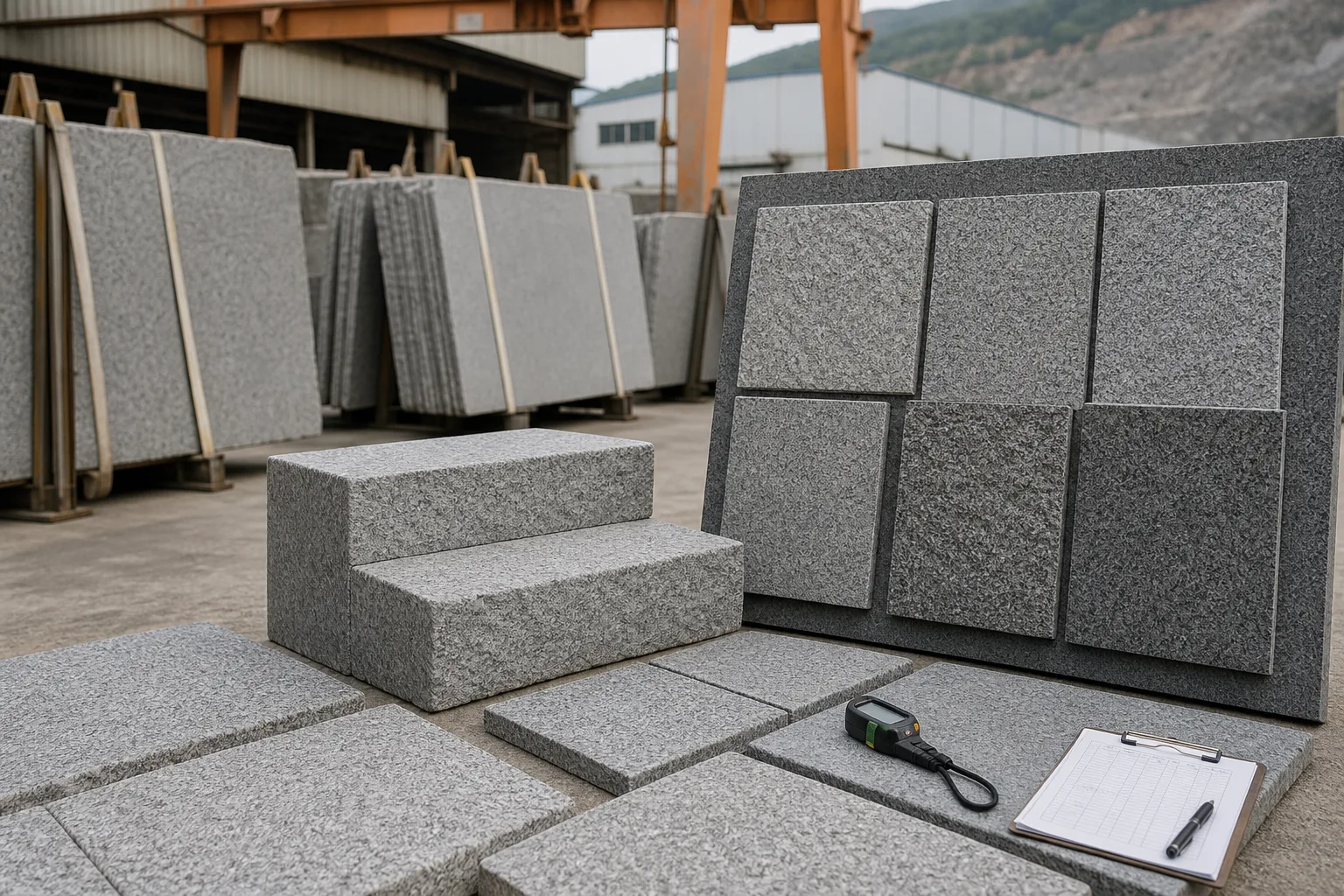
Bush hammered granite is primarily specified when a project needs a visibly textured, low-sheen stone surface for paving, steps, landscape elements or architectural cladding. Its field of small impact pits can provide more mechanical texture than a polished or honed face, but the finish must not be treated as automatic proof of slip resistance. Buyers should approve a physical sample, define the required texture and obtain application-relevant test results for the actual stone and finish.
What bush hammered granite is
A finish, not a separate stone variety
Bush hammering is a mechanical finishing process that creates small, closely spaced pits by repeated impact. The Natural Stone Institute glossary describes the process as producing textured surfaces with evenly spaced pits using a hand or pneumatic hammer. Modern factories may use powered heads and production lines, but the purchasing principle remains the same: the tool pattern, number of passes and stone response determine the final face.
The finish does not establish geological identity. In scientific usage, granite is a crystalline igneous rock associated with quartz and feldspar. In the dimension-stone trade, “commercial granite” can cover a broader group of hard, crystalline rocks, including some gneisses, granodiorites, syenites and related materials. Buyers should therefore keep the granite category, the individual stone identity and the specified surface finish as separate fields in project documents.
Appearance after finishing
The finished surface is matt, granular and visibly stippled. It usually suppresses reflections and can make a color appear lighter or less saturated than the same stone in a polished finish. Coarse crystals, veins, dark mineral clusters and natural movement remain present, although fine details may be less prominent.
Texture is not standardized by the words “bush hammered” alone. One producer may supply a shallow, dense pattern while another supplies deeper, more widely spaced pits. Hand-finished borders, machine-finished fields and different tool conditions can also create visible changes. A named finish should consequently be accompanied by an approved control sample or mock-up.
Trade names and codes
A trade name, color description or alphanumeric code is a commercial identifier, not independent proof of quarry source or mineral composition. Similar names may be used for visually related materials, while a familiar code may cover different production lots or sources over time. For example, a request involving G603 granite should still define the accepted appearance, source declaration, finish and performance documents. Do not approve stone from a name or digital photograph alone.
Performance and practical limitations
Slip resistance requires evidence
A bush hammered face has more surface relief than a polished face and is commonly investigated for pedestrian applications. However, traction depends on more than visible roughness. Water, oils, dust, cleaning residues, footwear, wear, slope, drainage and installation conditions can all affect walking safety.
The Natural Stone Institute advises matching tests to the intended use and lists slip resistance, absorption, compressive strength, flexural strength and abrasion resistance among the evaluations available for natural stone. Its guidance also notes that flooring and paving require different evidence from vertical cladding. See the institute's overview of ASTM standards for natural stone.
Require the test report to identify the stone, finish, test method, wet or dry condition, specimen age and laboratory. Avoid accepting an unsupported “anti-slip” label or a coefficient copied from a different stone or finish. ASTM C1028 may appear in older documents, but ASTM identifies it as a historical standard. The project designer should specify a currently accepted method and acceptance criterion for the relevant jurisdiction and use.
Cleaning and maintenance
The pits and open texture can retain soil more readily than a smooth surface. This makes bush hammered granite less convenient for food-preparation counters and other areas where quick wipe-down cleaning is important. Maintenance planning should consider joint layout, drainage, nearby planting, winter treatments, pollution exposure and the equipment used to clean the surface.
Use cleaning products confirmed as suitable for the specific stone and any applied treatment. Test cleaners and sealers on an inconspicuous sample because they may alter color or leave residue in the texture. Whether an impregnating treatment is appropriate depends on absorption, exposure and maintenance requirements; it should not be assumed necessary for every granite.
Stone properties still control durability
Bush hammering changes the face but does not replace material qualification. ASTM C615/C615M covers granite dimension stone for uses including cladding, paving, curbs, landscape features and monuments, and addresses properties such as absorption, density, compressive strength, modulus of rupture, abrasion resistance and flexural strength. The ASTM C615/C615M specification page also directs users to broader selection and installation guidance.
Do not assume that every commercially named granite meets a standard or is appropriate for freeze-thaw exposure, vehicle loading, thin cladding or pool environments. Test data should be current, traceable to the proposed material and reviewed by the project's qualified designer.
Best uses and applications to assess carefully
| Application | General fit | Key purchasing question |
|---|---|---|
| Exterior pedestrian paving | Common candidate | Has the actual finish been tested under the specified wet or contaminated condition? |
| Steps and stair treads | Common candidate | Are tread geometry, nosing, drainage, edge finish and visibility defined? |
| Plazas and landscape paths | Common candidate | Can the surface be cleaned with the planned maintenance equipment? |
| Pool surrounds | Conditional | Are wet traction, drainage, bare-foot comfort and chemical exposure addressed? |
| Ramps | Conditional | Has the designer evaluated slope, accessibility rules, drainage and test results? |
| Exterior wall cladding | Useful for visual texture | Are anchoring, panel thickness, weight, joints and finish consistency engineered? |
| Interior public floors | Project dependent | Will roughness hinder cleaning, carts or transitions to adjacent materials? |
| Kitchen countertops | Usually not preferred | Is the owner prepared for a coarse surface that is harder to wipe and work on? |
Typical candidates can be explored through the applications database and product formats. Suitability is always assembly-specific: substrate, bedding, joints, drainage, panel support and installation quality can be as important as the stone itself.
Bush hammered versus other granite finishes
Polished granite
Polishing creates a reflective face that shows color and crystal detail strongly. It is easier to wipe than a deeply textured surface and is widely used for slabs and kitchen countertops. It is a genuinely different finish from bush hammering and should not be used as the sole visual approval sample for a textured order.
Honed granite
Honing produces a smoother matt or low-sheen surface without the regular impact pits of bush hammering. It can suit interior surfaces where reduced reflection is wanted but cleaning remains important. Honed and bush hammered samples of the same stone can differ substantially in apparent color.
Flamed granite
Flaming uses thermal treatment to create a textured face, while bush hammering relies on mechanical impact. The resulting appearance, roughness and exposed crystal pattern differ. Not every stone responds to thermal processing in the same way, so flamed and bush hammered finishes are not interchangeable without samples and performance review.
Industry references commonly list bush hammered among the less typical countertop finishes and more often associate it with other building surfaces. Marble.com's granite finish overview provides a useful general comparison, but project specifications should rely on physical samples and technical requirements rather than consumer finish descriptions.
How to specify the finish
A procurement description should be detailed enough that the supplier, inspector and installer are evaluating the same product. “Grey granite, bush hammered” is not sufficient for a commercial order.
- Stone identity: agreed trade name, known aliases, supplier reference, declared quarry or block source where available, and approved color range.
- Geological or petrographic description: when required by the project, recorded separately from the commercial name.
- Control sample: physical sample large enough to show color, grain, natural variation and tool pattern.
- Finish character: shallow or deep texture, pit density, acceptable tool marks, directional effects and target sheen.
- Finished dimensions: length, width and thickness with project-defined tolerances.
- Edges: sawn, eased, chamfered, textured or otherwise finished, including treatment of visible returns and nosings.
- Performance evidence: named standards, required test conditions, acceptance criteria and report traceability.
- Mock-up: installed or dry-laid approval area for projects where color blend, joints and lighting are important.
- Packaging: face protection, crate construction, piece identification and replacement-piece strategy.
The approved sample should be retained and labeled. Photographs are useful records but cannot fully communicate pit depth, tactile roughness or sheen.
Inspection checklist for commercial orders
| Inspection point | What to verify | Common risk |
|---|---|---|
| Material identity | Labels, purchase order, sample reference and available source documents agree | Substitution under a similar trade name |
| Color range | Pieces are blended within the approved natural variation | Unexpected light, dark or mineral-rich groups |
| Texture | Pit spacing, depth, sheen and coverage match the control sample | Different machines, worn tools or incomplete passes |
| Unfinished areas | Corners, edges and recesses have the specified treatment | Smooth bands or inconsistent hand finishing |
| Dimensions | Finished size, thickness, squareness and edge geometry meet the order | Installation difficulties and irregular joints |
| Stone condition | Check for cracks, open defects, spalls, repairs and damage beyond agreed limits | Breakage during installation or service |
| Dry and wet appearance | Review representative pieces under agreed conditions | Staining, residue or unexpected color change becoming visible later |
| Packing | Pieces are dry, separated, secured and traceably marked | Abrasion, edge damage, moisture retention or mixed lots |
Inspection must use the purchase specification and approved sample as its acceptance basis. This checklist is not a substitute for engineering review, laboratory testing or a project-specific quality plan. Further procurement controls are covered in the granite quality-control guide.
Price factors and sourcing from China
What changes the quotation
No dependable price can be inferred from the finish name. Cost varies with the selected stone, current block or slab availability, order quantity, dimensions, thickness, edge work, texture intensity, machine setup, yield, rejection allowance, packaging and inland logistics. Large modules, tight visual ranges, deep textures and extensive hand finishing may increase processing or selection requirements.
Compare quotations only after normalizing the scope. Confirm whether prices include samples, testing, shop drawings, surface treatment, crates, documentation, replacement pieces, inland transport and port charges. Currency, delivery term, destination costs, duties and taxes should be stated separately. The China granite price guide explains the broader quotation structure without presenting a universal material rate.
China sourcing controls
Chinese factories and trading companies commercially list bush hammered granite in paving, tile, step and cut-to-size formats. Marketplace listings on StoneContact demonstrate market availability, but they do not independently verify quarry ownership, production capacity, test results or delivered quality.
Ask each potential supplier to identify whether it is the quarry operator, processor, exporter or intermediary for the proposed order. Verify the production site, material traceability, sample-to-production controls, equipment available for the required format and responsibility for corrective work. A supplier's ability to show one sample does not prove repeatability across a full project.
- Issue a written specification and request representative finished samples.
- Approve the stone range and bush hammered texture as separate decisions.
- Request traceable test reports where the application requires them.
- Confirm a pre-production piece or mock-up before volume processing.
- Define in-process and pre-shipment inspection criteria.
- Require crate lists and piece marks that match drawings or installation zones.
- Check import classification, origin documentation and current destination requirements with a customs professional.
For broader due diligence, consult Import Granite from China, China Granite Suppliers and the China stone industry reference. These controls reduce ambiguity, but they cannot guarantee a supplier's performance or the suitability of a stone for a specific project.
Frequently asked questions
Is bush hammered granite slip resistant?
Its textured face may provide more mechanical grip than a polished surface, but the finish name does not prove slip resistance. Require test results for the actual stone and finish under the wet, dry or contaminated condition relevant to the project.
Can bush hammered granite be used outdoors?
It is commonly considered for exterior paving, steps, plazas, landscape work and cladding. Suitability still depends on stone properties, climate, drainage, loading, dimensions, installation design and project-specific testing.
Is bush hammered granite suitable for kitchen countertops?
It is generally less practical than polished or honed granite because the coarse pits make wiping, food preparation and detailed cleaning more difficult. A physical sample should be evaluated before specifying it for a work surface.
What should be approved before ordering from China?
Approve the material range, physical finish sample, dimensions, edges, applicable test evidence, packing method and inspection criteria. Also verify the supplier's role and do not assume that a trade code proves a particular quarry source.