
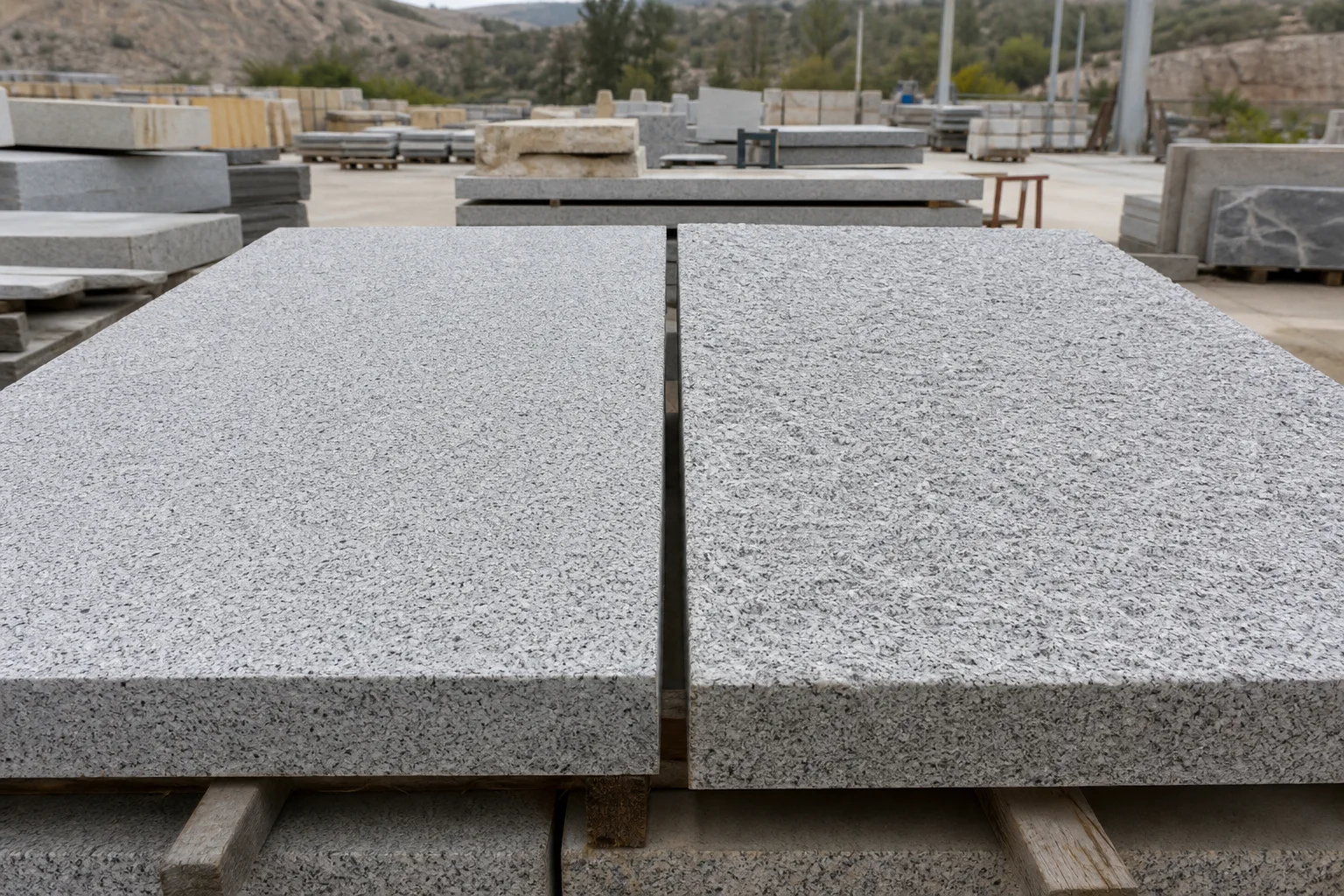
For flamed vs bush hammered granite, the practical difference is the method and character of the surface texture: flaming is a thermal treatment, while bush hammering creates a mechanically impacted, pitted texture. Both are commonly considered for exterior paving, steps and landscape work, but neither finish name establishes slip resistance, durability or approval for a particular project. The defensible choice must be based on the identified stone and production lot, a declared finish process, representative samples, project-required test evidence and documented acceptance conditions.
Decision in brief
When flamed granite may fit the intended appearance
In common stone-trade usage, a flamed finish is made by applying intense heat to the stone surface, producing a rough and somewhat irregular texture. Its appearance depends on mineral composition, grain structure, initial surface preparation and processing controls. A trade description of flamed and bush-hammered granite illustrates this process distinction, but it is not a project specification or evidence that any supplied lot will perform in a stated way (StoneContact finish comparison).
Flamed granite may be shortlisted when the designer wants a thermally textured face with visible grain-level variation. It should not be selected from a finish label alone. Request the supplier’s definition of the process, the direction and number of passes if controlled, any subsequent brushing or treatment, and an actual sample from the proposed material.
When bush-hammered granite may fit the intended appearance
A bush-hammered finish is produced by repeated mechanical impact from a pointed tool or roller, creating closely distributed pits. Tool geometry, impact depth, pass pattern and any later brushing can materially change the visual result and surface profile. Review the broader bush-hammered granite finish reference before writing the finish schedule.
Bush hammering may suit a design that calls for a visibly worked, granular or regularly pitted surface. It can also obscure or mute some natural color and pattern compared with a smoother finish. The sample approval should therefore cover color expression as well as texture.
The core limitation
Texture is only one decision input. A rough-looking surface does not automatically satisfy a slip-resistance requirement, and a finish commonly used outdoors is not automatically durable in every climate, assembly or traffic condition. Drainage, slope, contamination, wear, maintenance, footwear, installation and moisture can all affect service conditions. Engineering and installation decisions should be made by the project’s qualified professionals.
Separate stone identity, trade name and finish
“Granite” may be used as a geological description, a dimension-stone classification or a broad commercial category. A trade name is not, by itself, proof of geological identity, quarry source or consistent physical properties. Likewise, “flamed” and “bush-hammered” describe surface-finishing concepts rather than stone varieties.
Keep these fields separate in the purchase and approval record:
- Stone identity: declared commercial name, geological description if documented, quarry or block source if verified, and country or region of origin where traceability is required.
- Production identity: block, slab, crate, bundle, batch or lot references used by the supplier and buyer.
- Finish declaration: process name plus enough manufacturing detail to reproduce the approved texture.
- Product geometry: unit dimensions, thickness, edge treatment, tolerances, orientation and intended installation system.
- Application: pedestrian paving, vehicular paving, stair tread, coping, walling, facade or landscape element.
- Evidence: sample IDs, dated photographs, test reports, inspection records and acceptance decisions.
This separation prevents an approved finish on one stone or lot from being treated as approval of another. It also helps distinguish natural variation from process variation when production is inspected.
Specify performance independently of appearance
Material specification
ASTM C615/C615M-23 covers material characteristics, physical requirements and sampling for granite dimension stone used in building and structural applications. Its public catalogue scope includes finished or shaped granite and identifies uses such as paving and landscape features. It also lists properties addressed by the specification, including absorption, density, strength and abrasion resistance (ASTM C615/C615M-23 catalogue). The public catalogue does not establish that a particular stone, finish or lot complies, and it does not replace review of the full standard and project documents.
The stone specification should therefore identify the required property references, edition dates, sampling basis, reporting units and acceptance criteria chosen by the responsible specifier. Do not substitute a generic supplier data sheet from another quarry, stone, finish or production period without confirming its relevance.
Slip resistance and exterior conditions
The Natural Stone Institute advises that required testing should be reviewed for the intended application and that testing should be performed when necessary data are unavailable. Its overview also notes that the required properties depend on the performance demands placed on the stone (Natural Stone Institute ASTM standards overview).
For walking surfaces, record the test method and project criterion rather than writing only “non-slip” or “slip-resistant.” Testing should represent the relevant stone, finish and specimen condition as required by the project. The project team must also define whether evaluation is needed under dry, wet, contaminated, weathered or other service conditions. See the separate guide to granite slip resistance for the questions that should be resolved before relying on a result.
Application-specific review
Exterior paving and stair systems require more than a surface selection. The responsible professionals should review expected loads, unit size and thickness, support conditions, drainage, joints, edge geometry, climate exposure and installation materials. Vertical cladding has a different performance profile from a pedestrian walking surface, even when the visible finish is identical.
Compare actual same-lot samples
A flamed reference sample and a bush-hammered reference sample should be made from the same identified stone lot whenever the purpose is to compare finishes. Comparing different stones introduces additional variables in grain size, mineral contrast, background color and natural structure.
Use the following approval checklist:
- Assign a unique ID to each sample and link it to the stone and production lot.
- Obtain a written supplier declaration for each finish process, including any secondary brushing, washing, chemical treatment or coating.
- Use comparable sample dimensions, thicknesses, edge treatments and face orientations.
- Inspect both samples under recorded lighting and viewing distances.
- Review them in relevant dry and damp conditions without treating a visual check as a slip test.
- Record texture uniformity, color change, exposed crystals, pits, tool marks, edge damage and local variation.
- Identify the approved range of variation rather than approving only one idealized sample.
- Retain controlled samples for production comparison and receiving inspection.
Small samples may not show the distribution of color, grain or tooling across full-size units. For significant orders, use larger panels or a project mockup after the initial sample review. The samples and mockups sourcing guide explains how to define sample status and avoid confusing a marketing sample with a contractual control sample.
Paired finish specification and approval record
Copy the blank record below and complete it with dated project evidence. Result cells are intentionally blank because no stone samples, production lots, test reports or project criteria were examined for this comparison.
| Comparison field | Flamed declaration/reference | Bush-hammered declaration/reference | Lot / conditions / evidence | Project owner / unresolved |
|---|---|---|---|---|
| Stone and lot identification | ||||
| Supplier finish process declaration | ||||
| Actual sample IDs (blank) | ||||
| Viewing / moisture conditions | ||||
| Project-required test references | ||||
| Acceptance and limitations |
The record should remain paired: enter the flamed and bush-hammered declarations side by side, with shared lot information and viewing conditions. If the samples come from different lots, disclose that limitation rather than presenting the comparison as controlled. Unresolved items should have a named project owner, such as the architect, landscape architect, engineer, testing laboratory, contractor or buyer.
Inspection, price factors and China sourcing
Production and receiving inspection
Inspection should compare production with the approved control samples and written finish declarations. Useful checks include sample and lot traceability, general texture range, untreated strips, repeated tool patterns, excessive local depressions, chipped arrises, thickness, dimensions, squareness, warpage, contamination and packing condition. Acceptance limits must come from the purchase specification; they should not be invented during inspection.
Texture can change how edges and dimensional readings are taken, so the specification should state the relevant measuring locations and reference planes. If appearance blending is important, define how units will be laid out or grouped before packing. General planning points are covered in the granite quality-control guide.
Price factors
No universal price ranking between flamed and bush-hammered granite is reliable. Cost can vary with stone response, tool wear, processing speed, finish depth, unit size, edge work, breakage risk, rework, inspection level, sample and mockup requirements, packing, order volume and factory scheduling. Freight, duties, taxes and installation are separate commercial inputs.
Request quotations against the same stone, lot assumptions, dimensions, tolerances, quantities, finish definitions, quality requirements and delivery terms. Otherwise, an apparent finish-price difference may reflect a different product scope.
China sourcing context and next action
When sourcing from China, do not assume that two factories use “flamed” or “bush-hammered” to describe identical textures. Obtain process declarations and physical samples from each proposed production source. Confirm whether the exporter is the fabricator, a trading company or another contracting party, and keep the approved sample IDs connected to the purchase order, packing list and inspection documents.
The next practical action is to request two same-lot samples with written finish declarations, then complete the paired record with the project’s application, test references, viewing conditions and acceptance limits. Do not release production solely from catalogue photographs or finish names.
Frequently asked questions
Is flamed or bush-hammered granite better for exterior paving?
Neither finish is universally better. Flamed granite provides a thermally produced texture, while bush-hammered granite provides a mechanically pitted texture. Selection should consider the intended appearance, actual stone response, project-required tests, drainage, traffic, climate, installation and maintenance.
Is bush-hammered granite more slip-resistant than flamed granite?
The finish names alone cannot establish a ranking. Texture depth and uniformity vary by stone, equipment and processing controls, while in-service conditions also affect traction. Use the project’s specified test method and representative specimens rather than a visual assumption.
Can samples from different granite lots be used to compare finishes?
They can illustrate broad appearance options, but they do not provide a controlled finish comparison. Same-lot samples are preferable because different lots may vary in grain, mineral contrast, color and natural structure. Any lot difference should be recorded as a limitation.
What should a China supplier provide before exterior granite production?
Request traceable stone and lot identification, written finish-process declarations, actual sample IDs, product dimensions and tolerances, relevant test reports, packing requirements and agreed acceptance criteria. Keep the approved samples linked to the purchase and inspection documents.
Find the next finish reference
Use the finish selector to find reading pages for the use, exposure, slip priority, appearance and care level of your project.
Questions & discussion
Share a question or a useful experience about this guide. Comments appear immediately. Your name and comment are public. Email is optional and stays private; reply emails are not enabled yet. Comment privacy.