
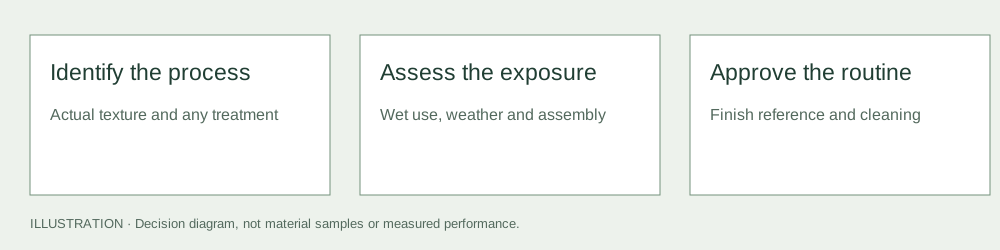
For exterior work, choose between flamed and honed granite only after identifying the surface people will use and the evidence the project requires. Flaming introduces a thermally processed texture; honing produces a lower-sheen ground face. Those descriptions do not establish wet grip, weathering performance or an acceptable colour range for an unidentified lot.
Compare both finishes on the same offered material where possible. If the supplier changes the stone along with the finish, treat that as a new material approval. This page provides a decision process, not a universal slip rating or a claim that either finish stays suitable in every exterior condition.
Describe the actual surface
The Natural Stone Institute’s stone glossary provides reference terminology for honed and thermal finishes. Use a retained sample to settle how those terms apply to the order. Processing consistency, any subsequent brushing and treatment need to be documented rather than hidden inside a general finish name.
Look at the face, arrises and visible edges together. A textured face with differently finished edges can change the installed reading. Review representative pieces rather than approving the single most attractive sample and assuming the full order will look identical.
Compare the exterior decisions
| Decision | Flamed proposal | Honed proposal | Evidence to obtain |
|---|---|---|---|
| Surface character | Review the actual thermal texture and any later brushing | Review the actual degree of honing and sheen | Finish control sample and declared process |
| Apparent colour | Processing may change how the stone reads | The ground face may give a different tonal impression | Dry and agreed wet views of the same material |
| Slip suitability | Texture is not a test result | Low sheen is not a test result | Relevant assessment of the proposed finished system |
| Weather exposure | Identify the material, treatments and exposure evidence | Make the same exposure review | Lot-linked reports where required by the project |
| Cleaning | Check that the proposed method cleans the texture without residue | Check marking and residue on the actual face | Maintenance trial and handover instructions |
| Fabrication and edges | Inspect texture consistency and edge condition | Inspect evenness and visible processing marks | Agreed acceptance references and measurements |
No numerical advantage is established by this comparison. The choice is whether a particular proposed surface, maintained as specified, meets the use and appearance requirements.
Slip resistance comes from the use conditions
Identify wet areas, contamination, footwear, gradients and transitions before selecting the finish. The Health and Safety Executive’s flooring guidance connects surface suitability to activity and foreseeable contamination. A rough appearance is not a substitute for the appropriate project assessment.
Ask which stone, finish and treatment were assessed, under which method and conditions. Avoid applying a result from another finish or stone to this order. Use slip-resistance guidance for the questions to record, then have the responsible project team settle acceptance requirements.
For patios, stairs and pool coping, assess drainage, transitions and support along with the face. If the evidence is missing or the proposed finish is unsuitable, obtain an alternative before production rather than assuming a later surface treatment will solve the issue.
Weathering and colour need separate approval
Do not infer freeze-related performance, staining resistance or colour stability from the finish label. Ask for relevant material evidence, including the specimen identity and report date where testing is required. Treat the stone, treatments, support and environment as the proposed assembly.
Approve the appearance under agreed lighting and moisture conditions, and record what difference between dry and wet views is accepted. The G603 and G654 records illustrate why a trade code does not supply missing property data. Do not borrow numbers from another supplier’s similarly named stone.
Choose a maintenance routine the owner can use
Review how the proposed cleaning method reaches the surface and removes residue. Do not assume that the rougher face always needs more maintenance or that the smoother face never shows marks; inspect the actual sample and planned cleaning process.
The Natural Stone Institute’s care guidance is a starting point for identifying compatible methods. Record any resin, sealer or enhancer before adding a treatment. A finish change, a build-up of residue or a persistent moisture problem should be assessed rather than met with increasingly aggressive cleaning.
Put finish approval and receiving checks together
Keep the stone and lot declaration, retained finish samples, drawings, edge details, relevant test evidence and care instructions with the order. Work through Samples & approval before accepting a substitution.
At receipt, compare identified production pieces with the agreed finish and appearance references. Photograph texture, edges and any findings in context, and use Inspection & receiving to retain the evidence. For another textured option, read the existing flamed-versus-bush-hammered guide. This article has not tested either proposed surface or approved an exterior installation.
Questions & discussion
Share a question or a useful experience about this guide. Comments appear immediately. Your name and comment are public. Email is optional and stays private; reply emails are not enabled yet. Comment privacy.