
1. The showroom test that matters after three years
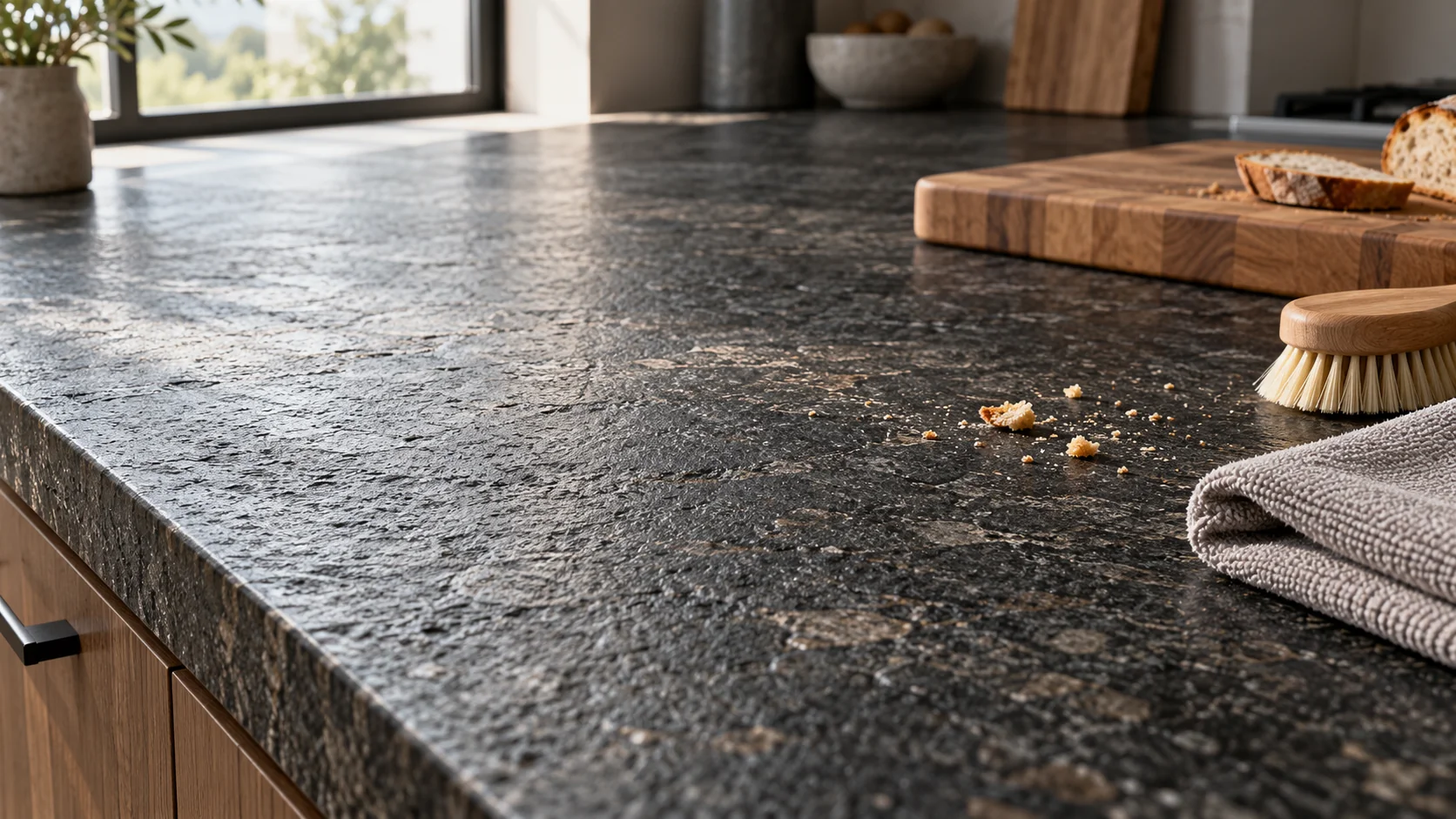
Run your hand across a leathered granite sample and the texture can be the attraction. Try wiping cooking oil off it and you may have a different buying question: will cleaning this surface fit the way you cook?
One renter described three years of struggling with greasy recesses, crumbs and a waxy feel. Other owners reported much shallower textures and different experiences. The practical issue is whether your chosen texture can be cleaned with a routine you can sustain.
The practical lesson is to ask for a representative offcut and permission to test it with oil and the proposed cleaning routine. A finish that feels appealing when dry still needs to pass your cleanup test.
2. Check the relief, not just the finish name
MSI describes leathering as the use of diamond-tipped brushes to produce a dimpled texture; it describes honed granite as flat and matte. MSI’s finish guide establishes the basic distinction, but “leathered” does not specify an acceptable depth for your kitchen.
Tool choice matters. Tenax explains that lower-grit brushes remove more material and create deeper structure, while higher grits refine the texture, including on dense granite. That supports asking about the brush sequence rather than assuming a particular trade name guarantees a particular feel. It does not establish why any individual slab has deep pits. Tenax brush specifications.
Inspect several areas of the actual slab under light from the side. On a sample, gently pass a cloth across and along the texture: does it glide, snag or leave fibres? Look for isolated cavities as well as the overall relief. Ask the fabricator which recesses are natural, which are filled and what processing and treatments the sample received. Do not accept “all leathered granite does that” as a substitute for inspecting the material you will receive.
If a sample catches your cleaning cloth or leaves visible residue after an ordinary cleanup, choose another texture or finish. Judge the sample by its cleanup performance; a photograph alone cannot establish whether that counter is defective or cheaply processed.
3. Work out the cleaning cost before choosing
The cost is time and effort, not just a bottle of cleaner. A cloth must reach the low areas to remove a greasy film; crumbs need to come out rather than move from one recess to another. For a household that fries frequently or uses a large area for food preparation, a disappointing sample test matters more than it might on a lightly used drinks counter.
Compare leathered, honed and polished samples of the same stone, with their intended treatments. With the seller’s permission, apply a small, comparable amount of cooking oil to each offcut, leave it for the same agreed period, then clean with an approved product. Compare the passes required, residue in recesses, appearance after drying and whether the cloth snags. Keep food used for testing separate from food you intend to eat.
A smooth finish removes the particular problem of reaching a pronounced relief. It does not guarantee invisible fingerprints, no oil staining or a fixed sealing interval. Ask for material-specific absorption information and compare fingerprints on the finished samples rather than relying on a universal honed-versus-leathered ranking. See the polished finish guide for the broader choice.
4. Already installed: what survives the cleaner debate?
“Non-acidic” alone does not establish compatibility with a stone, its treatment or a food-contact use. Nor does removing grease establish disinfection. Common recommendations conflict across four approaches; the defensible advice is narrower than these individual experiences suggest.
| Suggested approach | What the evidence supports | Boundary for your counter |
|---|---|---|
| Rubbing alcohol | Some users report success, but compatibility still depends on the installed treatment and the exact product. | No homemade alcohol mixture or concentration is recommended here; obtain a specific compatible product and its directions. |
| Dish soap and a soft brush | The Natural Stone Institute permits mild liquid dish soap, followed by thorough rinsing; too much can leave film. Dawn also lists granite in its hard-surface guidance. | Product variants differ. Use a compatible formulation and gentle tools, rinse and dry; this is cleaning, not a disinfectant claim. |
| General-purpose cleaner, including “409” | Formula 409’s Multi-Surface Cleaner FAQ says it is not for granite and points to a separate Stone and Steel product. | A brand name or an installer’s anecdote cannot override the exact product’s restrictions. |
| Daily cleaner plus scouring powder | Bar Keepers Friend warns against original powder on natural stone; its Granite & Stone product is a different formulation, described for smooth, polished stone. | Do not transfer that permission to powder or assume the stone product is validated for a leathered finish. |
Sources: Natural Stone Institute care guidance, Dawn hard-surface guidance, Formula 409 product FAQ, BKF powder restrictions, BKF stone-cleaner scope.
An alkaline degreaser with a drill brush is a more aggressive suggestion. Avoid escalating to it on an unidentified treatment.
For disinfection, first remove visible soil. Then use a disinfectant whose current label covers the surface and intended use, with compatibility confirmed for the existing treatment. Follow its wet contact time and food-contact rinse directions; never mix cleaners. Clorox publishes instructions for sealed granite, with restrictions for unsealed, damaged or heavily worn stone. That is conditional manufacturer guidance, not permission for every leathered counter. If your counter’s condition or treatment is unknown, ask the fabricator or owner to identify it and provide a compatible procedure. Clorox granite guidance.
Texture alone also does not establish a hygiene ranking. A laboratory study of two granites found that the rougher sample had fewer adhering bacteria under its test conditions. It did not compare leathered and honed kitchen counters. Its experimental chemical treatments are not household cleaning instructions. We therefore make no claim that leathered granite is either the most hygienic choice or inherently unsafe. Amzil et al., 2020.
5. Can sealing fix the waxy feel?
Two explanations deserve investigation: accumulated surface residue and residue from an applied treatment. Neither can be identified by touch alone, and a waxy feel does not prove that more sealer is needed.
Start with a small area using the known-compatible routine, rinse well and dry. Does the film diminish? Does it recur after a particular cleaner? Ask when the counter was last treated and with what. These observations help a professional distinguish possibilities; they do not identify a coating or justify stripping it yourself.
LATICRETE documents haze after some penetrating sealers and tacky film after an enhancing sealer. This confirms that treatment residue is a real possibility, but its remedies are product-specific. Do not copy a solvent-removal procedure onto an unknown installation. LATICRETE troubleshooting.
An impregnating sealer increases stain resistance by acting as a repellent; it does not fill the leathered relief or remove the cleaning work it creates. Reapplication should depend on the stone, existing product, use and manufacturer’s assessment, rather than an automatic annual or two-to-three-year rule. Resolve residue first, then assess whether treatment is needed. See the sealing guide.
6. If you cannot replace it, change the working surface
A removable food-preparation board can give you a manageable working area without altering the counter. Choose one intended for that use, stable on the surface and easy to lift for cleaning. Remove it after use so that trapped spills and the counter beneath can be cleaned and dried. A cover is an additional surface to maintain, not a cure for contamination underneath.
For loose, dry crumbs, one practical sequence is to lift them first with a clean, soft brush or a dedicated clean vacuum attachment, then wet-clean the remaining film. Keep gritty attachments from dragging over the finish.
Custom glass or plastic covers need suitable edges, support and heat limits. Loose mats can conceal spills. Adhesive films may leave residue or change appearance, so they are not automatically reversible simply because they are sold as removable.
Renters should exclude grinding, epoxy filling and polyurethane coating from a do-it-yourself workaround: these alter the owner’s property and can create deposit or restoration disputes. Lease terms and local rules vary. Owners considering permanent resurfacing need a fabricator’s assessment of the complete system, repair options and intended use. Require documentation for the exact coating system’s intended food-contact use and a written explanation of whether and how it can be removed.
7. Put the texture where its maintenance fits
For a household doing frequent greasy preparation, the main working run deserves the strictest sample test. A decorative fireplace surround, occasional-use bar or vanity has a different soil pattern. These may be more forgiving locations for a texture you enjoy, but they still need suitable cleaning and application-specific detailing. Bathroom soap residue, drinks spills and fireplace heat do not disappear because the surface is leathered.
Choose the location by its expected workload and cleaning routine. If you have already chosen leathered stone, consider a removable preparation board or a smoother finish on the busiest run. Discuss changes before fabrication, including how adjacent finishes, edges and joints will look.
8. Put the decision into the order
- Test oil cleanup on a representative, permission-to-test offcut with the intended treatment.
- Feel the actual texture in several places and check whether your cloth catches.
- Get exact permitted cleaners, tools and any compatible disinfection procedure in writing.
- Record the sealer or enhancer, expected appearance, care instructions and conditions for reassessment.
- Match the finish to the busiest preparation area, or plan a removable working surface.
- Retain an agreed sample and specify the finish, acceptable texture range, fills, inspection and remedy if the delivered finish differs.
The useful question is whether you can clean the particular surface you are buying with a routine you are prepared to repeat. Settle that with a sample before it becomes an installed countertop.
Sources
- Reddit discussion · r/CleaningTips · 184 comments
- MSI’s finish guide
- Tenax brush specifications
- Natural Stone Institute care guidance
- Dawn hard-surface guidance
- Formula 409 product FAQ
- BKF powder restrictions
- BKF stone-cleaner scope
- Clorox granite guidance
- Amzil et al., 2020
- LATICRETE troubleshooting
Questions & discussion
Share a question or a useful experience about this guide. Comments appear immediately. Your name and comment are public. Email is optional and stays private; reply emails are not enabled yet. Comment privacy.