
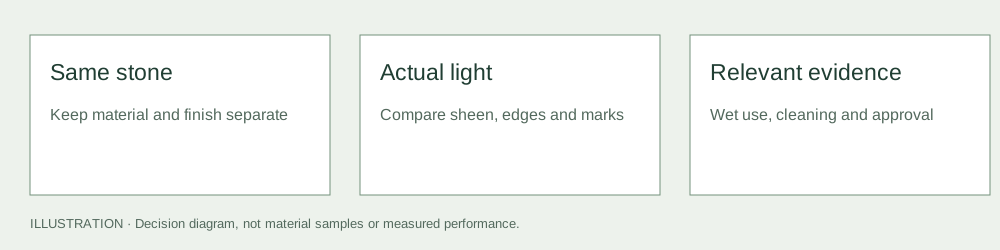
Choose polished granite when a reflective surface is part of the approved appearance; choose honed granite when a lower-sheen surface better suits the room or design. Then test that preference against ordinary marks, the planned cleaning regime and the actual use. Honed is not a synonym for slip-safe, and polished is not a promise that every mark will wipe away.
Approve both finishes on the same offered stone wherever possible. Comparing a pale honed sample with a different dark polished stone confuses material and finish. Keep the sample IDs and processing descriptions with the purchase specification so production can be compared with the same references.
What the finish changes in the room
A polished face gives clearer reflected images and may make some colours and mineral contrasts appear stronger. A honed face scatters reflections and usually gives a quieter visual reading. These are appearance descriptions, not numerical gloss grades. The degree of honing can differ between processors; ask what the supplier actually means and approve a physical reference.
Inspect the samples in the intended lighting, including side light near windows or lamps. View them from normal standing positions and at the angles that make seams and fabrication marks visible. A showroom light can flatter a surface that behaves quite differently beside the installed sink.
Use the polished finish reference for the reflective option and the Finishes group to place the choice alongside textured alternatives. The purpose is to describe a finish the factory and purchaser can recognise, rather than choose a label and leave the result open.
Compare the practical differences
| Choice | Polished | Honed | Approval question |
|---|---|---|---|
| Reflections | More mirror-like reflection | Lower sheen, with the degree set by the sample | Do lighting and visible reflections suit the room? |
| Apparent colour | May give a deeper-looking contrast | May look softer or paler on the same stone | Does the approved range use this exact finish? |
| Marks and dust | Reflections or streaks may be conspicuous | Fingerprints, oil or uneven wetting may stand out | Which marks matter on the actual sample? |
| Care | Remove residue without scratching or leaving a film | Use a compatible routine without trying to polish it accidentally | What cleaner and cloth will the owner use? |
| Slip | Cannot infer suitability from sheen | Cannot infer suitability from the word honed | What test and use condition does the project require? |
| Exterior work | Assess wet use, exposure and the whole assembly | The same assessment is needed | Has the actual proposed finish been evaluated? |
| Cost | Depends on the stone, processing and fabrication | Depends on the stone, finish consistency and rework | Are both quotations for the same complete scope? |
This table gives no universal winner or price premium. A relatively simple finish can still need careful selection where an entire floor must look even. Conversely, a complex edge or cutout can dominate a countertop quotation whichever face finish is chosen.
Slip: specify evidence for the actual use
For flooring, steps or exterior areas, the important question is whether the finished surface suits the activity and foreseeable contamination. The UK’s Health and Safety Executive flooring guidance links suitability to use and contamination rather than appearance alone. Local project requirements and the responsible specifier determine the appropriate assessment.
Ask for a report identifying the stone, finish, treatment, test method and relevant conditions. A dry sample, a marketing phrase or a result for another finish does not establish performance when wet. Maintenance also belongs in the specification: a treatment or residue left after cleaning may change the surface being walked on.
For patios or stairs, assess drainage, transitions and the installation as well as the face. If neither proposed smooth finish meets the project’s requirements, investigate a different finish or material rather than treating the less glossy option as an automatic solution.
Marks, sealing and daily care
Start with the owner’s real habits: standing water around a tap, cooking oils, frequent wiping or a preference for an unbroken matt appearance. Examine a representative trial sample using compatible products, with the supplier’s agreement. Do not damage a showroom sample to conduct an improvised test.
The Natural Stone Institute’s care guidance starts with identifying the stone and choosing suitable cleaning. A finish description does not tell you whether a coating, resin, enhancer or previous sealer is present. Document those treatments before deciding whether to add another one.
Read sealing and the water-drop screening explanation together. A screen may help identify moisture darkening; it does not provide a laboratory absorption percentage, guarantee stain resistance or prove that a sealer will leave the desired sheen. Test treatment compatibility on the actual finish and follow the selected product’s instructions.
Do not clean a honed face with an abrasive method intended to increase shine, or try to remove a persistent polished dull patch by escalating household chemicals. Use stain-removal guidance to distinguish a deposit or absorbed stain from a changed surface. Restoration of sheen is a separate task from cleaning.
Outdoor suitability and finish consistency
Neither polished nor honed describes a complete exterior specification. Consider water, weather, footwear, traffic, support and any treatment. Ask whether the stone’s reports and the finish approval apply to that exposure. Do not turn an indoor countertop sample into approval for exterior walking surfaces.
For repeated pieces, compare the face, visible edges and transitions together. An edge finished differently from the face may be conspicuous after installation. Record the acceptable variation rather than insisting that production match a single small photograph under every light.
Put the finish into the order
Keep these items together: stone and lot reference, finish control sample, agreed viewing conditions, permitted repairs and treatments, dimensions, visible edges, relevant slip assessment and cleaning handover. Approve any substitution in stone or processing through Samples & approval.
Ask the fabricator to price both options against the same drawings and selection range, including any refinishing or replacement responsibility. During inspection, compare the delivered pieces with the retained sample before deciding that a difference is a defect. This page has not tested either finish or examined the offered lot; the signed references and project evidence must settle the purchase.
Find the next finish reference
Use the finish selector to find reading pages for the use, exposure, slip priority, appearance and care level of your project.
Questions & discussion
Share a question or a useful experience about this guide. Comments appear immediately. Your name and comment are public. Email is optional and stays private; reply emails are not enabled yet. Comment privacy.