
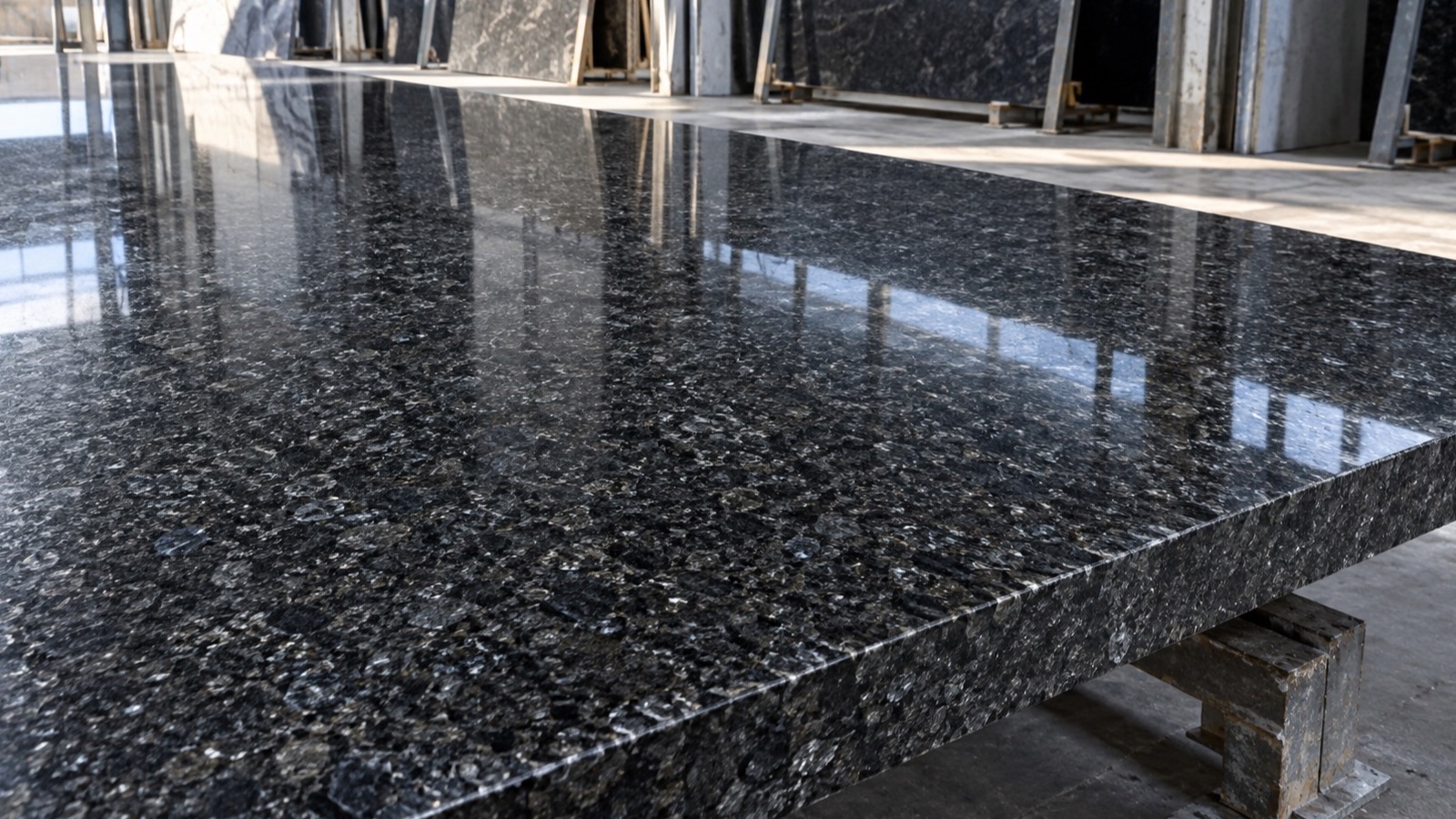
A polished granite finish is produced by progressively refining the stone face until it develops a smooth, reflective appearance. Polishing usually deepens perceived color, sharpens mineral contrast and makes veining or crystalline movement easier to see. It is widely used for countertops, interior wall panels and decorative floors. It should not be assumed to be appropriate for every walking surface or exposure.
What polishing changes
The process removes saw texture through a sequence of abrasives. The final appearance depends on the stone’s mineral composition, grain, fabrication equipment, abrasive sequence and any resin treatment. Two materials described as polished can have different gloss and visual depth. Even one batch can show variation where mineral clusters accept polish differently.
A finish sample should therefore be made from the actual stone range. View it in both diffuse and directional light. Record a control sample or an agreed gloss measurement if uniform reflection is critical. Avoid approving a polished finish solely from a screen image, which cannot reproduce scale, color or reflection reliably.
Appearance and design effects
Polishing tends to make dark granite appear darker and saturated colors richer. It can reveal fissures, pits, mesh shadowing, fill and directional marks that are less visible on a matte surface. Book matching or vein alignment may be relevant for strongly directional slabs, while fine-grained grey stones are often evaluated for overall tone and spotting.
Lighting placement matters. Point sources can expose waviness or localized dull areas. Large floors and wall runs should be inspected from the normal viewing position, not only at arm’s length. Define whether minor natural pits and filled features are acceptable before production.
Performance and limitations
A polished face is relatively smooth and easy to wipe, but “polished” is not a slip-resistance rating. Water, oils, footwear, cleaning residue, joint layout and surface wear affect walking conditions. For floors, the project team should specify an applicable test and service condition rather than relying on finish terminology. Exterior pedestrian areas often use a textured finish, subject to project requirements.
Polishing also does not establish stain resistance, strength or weathering performance. Those properties depend on the stone and exposure. The USGS notes that finish is one of several normal dimension-stone requirements alongside durability and strength.
Good uses for polished granite
Typical uses include kitchen and vanity tops, reception desks, fireplace surrounds, interior wall panels, elevator surrounds and selected interior floors. For counters, coordinate surface finish with edge polish, cut-outs, seams, backsplash pieces and any drain grooves. For walls, confirm panel support, anchors or adhesive system with the designer. For floors, assess traffic, contamination and maintenance.
Exterior polished cladding may be possible with appropriate material selection and engineered attachment, but reflection, weathering, runoff and long-term finish change should be considered. A supplier’s ability to polish a sample does not prove the complete assembly is suitable.
Care, sealing and restoration
The Natural Stone Institute recommends cleaners suitable for natural stone and warns that abrasive creams can scratch some surfaces. Hydrofluoric acid attacks silicate minerals and should not be used. An impregnating treatment may increase stain resistance for some stones but does not create a stain-proof film. Confirm compatibility with resin-treated material and test for color change.
Use trivets, wipe spills and prevent gritty debris from being dragged across the face. Deep scratches, chips and uneven gloss usually require professional repair and repolishing. Maintenance instructions should name acceptable products rather than say only “use neutral cleaner.”
Turn the selection into a measurable specification
A trade name, photograph or sample is a starting point, not a complete order. Record the approved material name, quarry or block reference when available, surface finish, nominal and minimum thickness, face dimensions, edge work, dimensional tolerances, visual range, repair policy, quantity, spare allowance, packing and labeling. State which measurements will be checked, how many pieces form the inspection sample and what happens when a result falls outside the agreed limit.
Natural stone varies. A sensible approval defines an acceptable range rather than asking production to match one small photograph. Review multiple full-size samples or a dry layout when appearance continuity matters. Keep the signed sample and dated photographs available to the factory and destination inspector. For performance-sensitive work, ask for recent reports from representative material and identify the test method; a generic claim that granite is “strong” does not establish suitability for a particular assembly.
| Control | Record before production | Verify before shipment |
|---|---|---|
| Identity | Trade name, source and approved range | Labels and production match approvals |
| Geometry | Dimensions, thickness and tolerances | Measurements across a defined sample |
| Finish | Process, sheen or texture reference | Consistency under normal lighting |
| Fabrication | Edges, cut-outs, repairs and reinforcement | Workmanship and critical locations |
| Packing | Crate design, sequence and marks | Dry stone, protection and count |
Buying and approval checklist
- Ask the seller to distinguish quarry origin, processing location and shipment origin.
- Approve representative samples and retain a signed control sample.
- Put measurable tolerances and visual criteria on the purchase order.
- Confirm test methods and report dates for performance claims that affect the project.
- Inspect a first piece before full production and a defined sample before shipment.
- Match packing, crate marks and piece labels to the installation sequence.
- Keep a reasonable spare allowance for natural variation, cutting and future repair.
These controls do not remove variation or project risk. They create a record that lets the buyer, fabricator, installer and inspector evaluate the same requirements. Local building codes, engineering requirements and installation-system instructions remain controlling for the finished work.
Frequently asked questions
What should buyers verify before ordering polished granite finish?
Verify the exact material and source, current representative samples, finish, dimensions and tolerances, relevant test evidence, repairs, packing, inspection plan and complete commercial terms.
Does a trade name or country guarantee performance?
No. Natural stone properties and factory controls vary. Evaluate the actual material, batch, finish, thickness and installation conditions with project-specific evidence.
How should natural variation be approved?
Review multiple representative pieces or full slabs, define an acceptable range, retain signed samples and record how veins, mineral clusters, fissures, fills and repairs will be judged.