
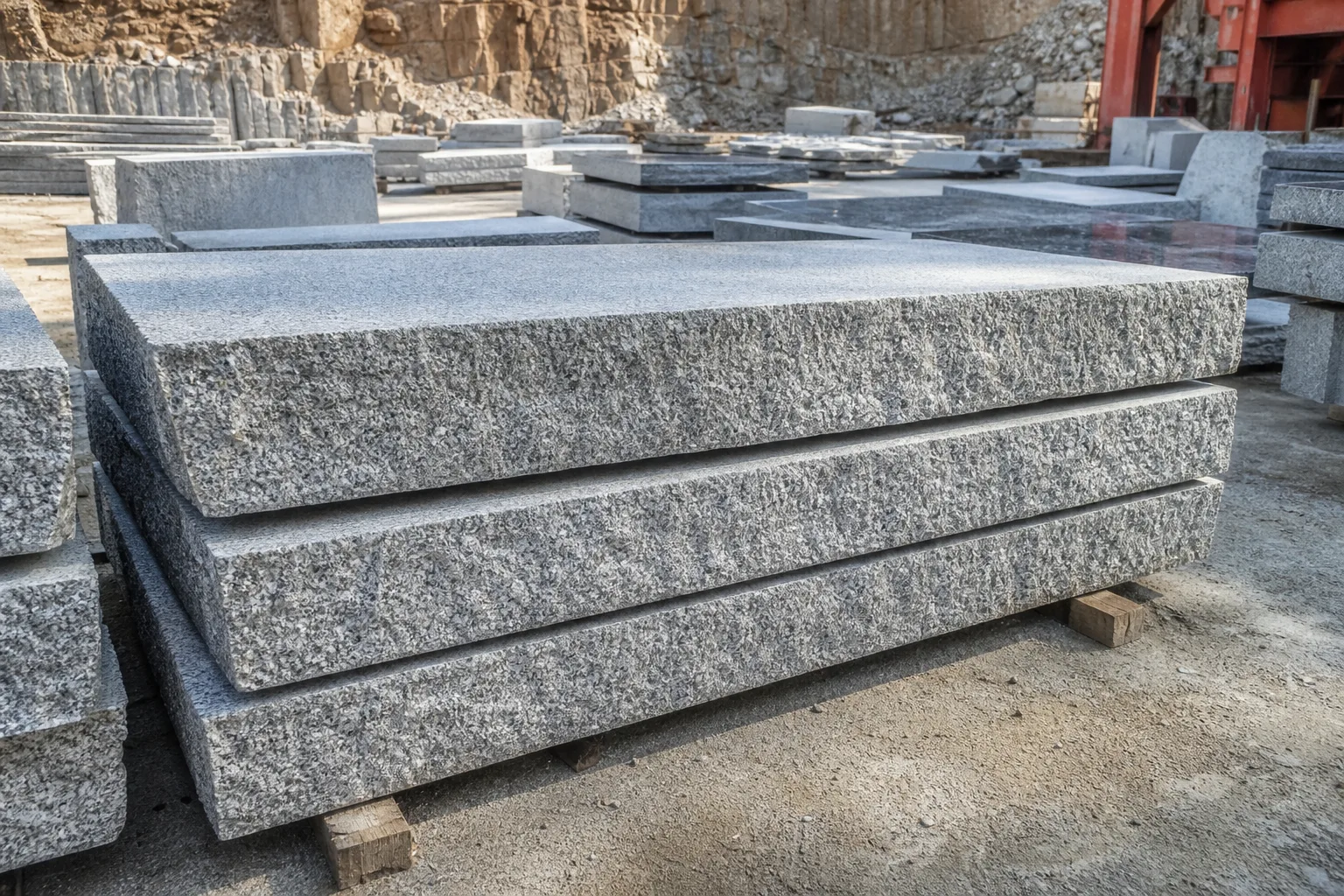
Split face granite is granite dimension stone with a face broken to an approximate plane, leaving irregular projections, recesses and visible mineral texture. It is primarily a finish for exterior or interior walls, building bases, columns, retaining features and landscape masonry. It can also be considered for selected paving, steps or wall caps, but a rough appearance alone does not establish slip resistance, structural suitability or weathering performance. Commercial buyers should specify the stone and finish separately, approve representative range samples, and require test data appropriate to the application.
What split face means
A fractured finish, not a stone variety
Split face describes surface processing rather than geological identity. The Natural Stone Institute defines split-faced stone as stone whose face has been broken to an approximate plane and describes a split-stone finish as a rough face formed by splitting. The resulting relief is less controlled than a bush-hammered finish and substantially rougher than a polished finish. It should not automatically be treated as equivalent to natural cleft, pitched, rock face, mushroom, chiseled or quarry-face work; suppliers may use these trade terms inconsistently. Natural Stone Institute glossary
Production commonly begins with sawn strips, slabs, blocks or veneer pieces that are mechanically or manually split. The stone's grain, rift, mineral distribution and any directional fabric affect where it breaks. The finished face may therefore vary in relief, shadow and exposed color even when the pieces come from one material lot.
Expected visual character
- Low reflectance: the fractured surface scatters light rather than producing gloss.
- Strong shadows: projections and recesses become more visible under side lighting.
- Natural variation: each split is different, so an exact copy of one sample is unrealistic.
- Potential color shift: a fractured surface can appear lighter, grayer or less saturated than the same stone when wet or polished.
- Irregular face plane: nominal product thickness does not necessarily describe the maximum overall depth at high points.
Granite identity and trade names
Commercial granite is a broad category
In scientific geology, granite has a defined mineral composition and texture. In the dimension-stone trade, “granite” is broader and may include related crystalline igneous rocks and some metamorphic rocks sold for similar uses. The U.S. Geological Survey notes that dimension stone is selected not only by rock type, but also by size, shape, color, pattern, surface finish, durability and strength. Buyers should therefore avoid treating the word granite as a complete technical specification. USGS dimension stone overview
Likewise, a trade name or code is not proof of quarry origin, mineralogy or performance. Chinese export catalogues may use regional names, color descriptions and codes such as G603 or G654. These identifiers can be useful for initial searches, but their interpretation may vary between sellers or over time. A purchase specification should include an approved physical sample, current quarry or block source declaration where required, photographs of available production material and traceable test reports. See the separate database entry for G603 granite, while recognizing that approval of a named sample does not approve every product offered under the same code.
Best applications and important limits
| Application | General fit | Points to specify or verify |
|---|---|---|
| Exterior wall cladding | Common use | Panel or unit dimensions, maximum face projection, anchorage or masonry system, drainage, joints, corners and structural design |
| Interior feature walls | Common use | Relief range, lighting, cleanability, exposed edges, substrate capacity and attachment method |
| Building bases and columns | Common use | Corner returns, coursing, cap details, splash-zone exposure and coordination with doors or glazing |
| Retaining and landscape walls | Common use | Unit depth, bedding faces, drainage, freeze-thaw exposure and engineering requirements |
| Paving and steps | Conditional | Walking-surface flatness, drainage, wet slip testing, abrasion, nosing geometry and accessibility requirements |
| Countertops and work surfaces | Usually unsuitable | Deep relief interferes with cleaning, food preparation and placement of objects |
The finish is especially effective where the design needs depth and shadow rather than a uniform planar surface. Natural Stone Institute project documentation includes split-face granite used as exterior architectural cladding, demonstrating a recognized vertical application rather than establishing universal suitability for every granite or wall system. Natural Stone Institute commercial exterior example
Slip resistance must be evaluated separately
A textured surface may be selected for areas where traction is a concern, but “split face” is not a slip-resistance value. Relief, mineral composition, contamination, wear, water, cleaning products and test procedure can all influence results. The Natural Stone Institute notes that stone density and finish affect frictional behavior. For a walking surface, request testing on production-representative specimens in the specified finish and confirm the test method and acceptance criterion with the project's architect, code consultant or other responsible professional. Do not transfer a result from a polished, flamed or bush-hammered specimen to a split-face product. Natural Stone Institute friction guidance
Performance and specification requirements
Specify measurable properties
ASTM C615/C615M-23 covers granite dimension stone for general building and structural purposes, including material that is sawed, cut, split or otherwise finished. Its scope includes cladding, paving, landscape features, retaining walls and other defined uses. The standard addresses properties such as absorption, density, compressive strength, modulus of rupture, abrasion resistance and flexural strength. A statement that stone “meets ASTM” is incomplete unless the applicable standard, edition, test methods, reported values and tested material are identified. ASTM C615/C615M-23
Project requirements should be selected by the design professional rather than copied indiscriminately. Typical laboratory methods considered for dimension stone include ASTM C97 for absorption and bulk specific gravity, ASTM C170 for compressive strength, ASTM C99 for modulus of rupture, ASTM C880 for flexural strength and ASTM C1353 for abrasion resistance. Anchorage or complete cladding systems may require separate engineering and testing. The Natural Stone Institute advises obtaining appropriate testing when reliable data are unavailable and avoiding an intended use when required performance has not been demonstrated. Natural Stone Institute ASTM reference
Finish-specific details belong in the purchase documents
- Stone trade name plus a clear material or quarry reference where available.
- Approved control sample and a broader range showing acceptable color and texture.
- Nominal length, height and bed thickness, with stated tolerances.
- Minimum and maximum face projection measured from the reference plane.
- Sawn, calibrated or natural back and the permitted back tolerance.
- Edge condition: sawn, split, pitched, concealed or otherwise dressed.
- Corner treatment, including full returns, bonded corners or separate corner units.
- Permitted chips, fissures, repairs, discoloration, oxidation marks and tool marks.
- Dry-stack, open-joint or mortared-joint intent, including target joint width.
- Required laboratory reports, report age and relationship to the current source.
Samples, mock-ups and inspection
Approve a range, not one ideal piece
A single hand sample cannot represent the full variability of fractured granite. Before production, review multiple pieces covering expected color, grain, relief and edge character. For a large or visually sensitive elevation, a mock-up is more informative because it shows coursing, joints, corners, lighting and accumulated projection. The Natural Stone Institute's supplier-to-buyer guidance identifies test data, range samples and mock-ups as items that should be defined during purchasing. Natural Stone Supplier-to-Buyer Manual
Practical pre-shipment checklist
- Confirm that crate labels, packing lists and inspection records use the purchase-order material name.
- Compare random production pieces with the approved range in dry, neutral light.
- Measure length, height, back thickness and maximum face projection separately.
- Check whether high projections interfere with joints, corners, copings, windows or adjacent finishes.
- Dry-lay a representative area to assess color blending, coursing and joint consistency.
- Inspect backs and edges for fractures that could reduce attachment or bedding area.
- Verify corner quantities, handed pieces, special shapes and replacement allowance.
- Review crate support, moisture protection, piece separation and identification.
- Match laboratory reports to the declared stone source and required test methods.
- Record nonconformities before shipment and define the disposition in writing.
Inspection acceptance should be tied to written tolerances and approved samples. It should not depend only on whether the product looks “natural,” because that term does not define allowable projections, dimensional variation or defects. More general procedures are covered in the granite quality-control guide.
What affects the price
No single market rate can represent all split face granite. Quotations depend on both the underlying material and the difficulty of delivering a controlled fractured finish. Relevant factors include:
- Stone availability and block quality: consistent raw material may have a different yield from stone containing variable grain, veins or natural fractures.
- Finished dimensions: long, tall, thick or tightly calibrated units can require more selective production.
- Relief specification: limiting the projection range may increase sorting, dressing or rejection.
- Edge and corner work: matched returns, pitched edges and special profiles add processing and layout requirements.
- Quantity and repetition: a standard module differs from a project containing many cut sizes and individually marked pieces.
- Testing and inspection: current laboratory work, mock-ups, production inspection and reporting should be priced explicitly.
- Packing and logistics: irregular faces require careful separation and support; crate weight, inland haulage, port charges and destination delivery also matter.
- Import costs: classification, duties, taxes and compliance obligations depend on the product and destination at the time of entry.
For quotation comparison, normalize the scope rather than comparing only a price per square meter or square foot. Check whether each offer includes the same thickness, relief range, edge treatment, corners, tests, packing, inspection basis and freight term. See granite price factors in China for a broader purchasing framework.
Sourcing split face granite from China
Chinese online stone marketplaces list split-face granite wall cladding under color descriptions and codes such as G654 and G302. These listings establish that such products are marketed by China-based sellers; they do not independently verify geological identity, available quantity, current quarry source, factory capability, test compliance or delivery performance. StoneContact China product listings
When requesting quotations, send a finish sheet rather than relying on the phrase “split face.” Include drawings, piece schedule, target relief, back condition, dimensional tolerances, corner details, joint concept, sample requirements, test methods, packing instructions and inspection hold points. Ask the bidder to identify exceptions instead of assuming complete compliance.
A practical sourcing sequence is:
- Shortlist the stone by physical sample and intended application.
- Clarify whether the exporter is the quarry, fabricator, trading company or a combination.
- Approve a signed control sample and representative range before mass production.
- Confirm raw-material continuity for the required quantity.
- Order project-relevant testing where current, traceable results are unavailable.
- Approve the mock-up and written tolerances before releasing full production.
- Inspect during production when corrective work remains possible, not only after packing.
- Review packing lists, shipping documents and product identification before dispatch.
These controls apply whether sourcing through the Xiamen stone industry, companies in Fujian or another production region. They do not guarantee a result, but they reduce ambiguity between buyer and seller. Buyers beginning the process can also consult Import Granite from China and China Granite Suppliers.
Selection summary: choose split face granite when a pronounced, non-reflective stone texture is central to the design and the project can accommodate natural relief. Do not select it by photograph alone, use it as a substitute for slip testing, or assume a familiar trade code identifies one uniform geological source. The reliable basis is a coordinated package of samples, specifications, test reports, mock-ups and inspection criteria.
Frequently asked questions
What is split face granite?
It is granite dimension stone whose visible face has been fractured to an approximate plane. The term identifies the surface finish, not a particular granite variety, quarry or geological origin.
Is split face granite suitable for exterior walls?
It is commonly specified for exterior walls, building bases and landscape masonry. Suitability still depends on the stone's tested properties, unit dimensions, attachment or bedding system, drainage details and local structural requirements.
Is split face granite slip-resistant?
A rough texture alone is not proof of slip resistance. Walking surfaces should be tested in the actual production finish using the method and acceptance criteria selected for the project.
How should buyers inspect split face granite?
Inspection should compare production with an approved finish range and check color, relief, maximum projection, back thickness, dimensions, edges, corners, fractures, quantity, identification and packing. A dry-laid mock-up is advisable for visually sensitive work.
Why can split face granite quotations vary widely?
Cost is affected by the stone, dimensions, thickness, relief tolerance, production yield, edge and corner work, number of special pieces, testing, sorting, inspection, packing, freight terms and destination import costs.