
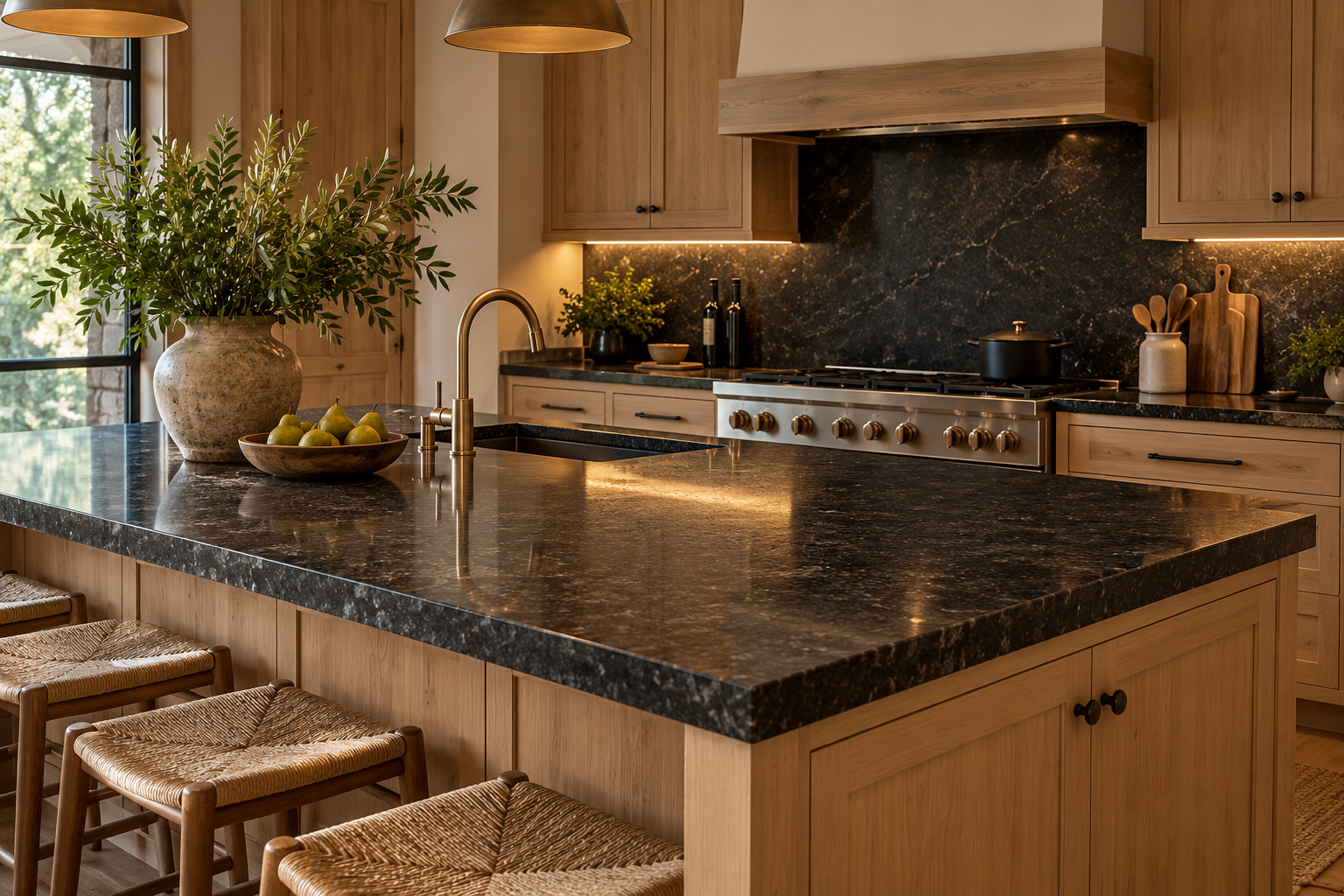
Absolute Black granite can give light wood cabinets a crisp, dark counter. The practical question is whether you like the way the chosen finish looks during everyday use: fingerprints, wiping marks and dust can be visible against a dark surface even when the stone itself is sound. Compare full-size samples in your own lighting, ask about the slab’s origin and treatment, and agree a care plan before ordering.
The trade name is not a performance certificate. Natural stone sold under similar names can differ by source and lot, and the finish changes both appearance and cleaning experience. Do not assume that every dark countertop needs the same treatment or that a sealer makes it impervious to every spill.
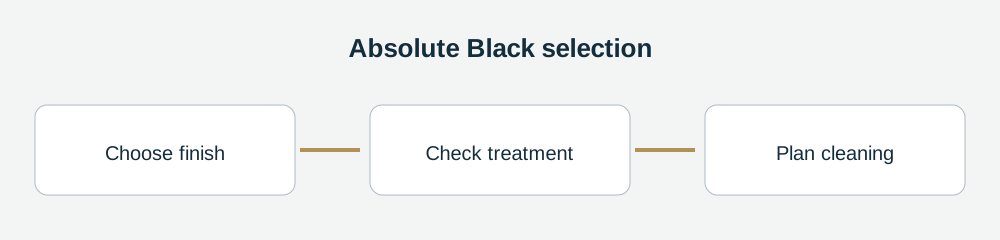
Decide how much visible marking bothers you
A dark counter makes a strong contrast with pale cabinets, but everyday fingerprints, water marks, crumbs and streaks may be easy to see under certain light. Some people appreciate being able to spot and wipe them; others prefer a patterned surface that makes small marks less obvious between cleans. Consider your household’s cooking habits and cleaning routine rather than deciding solely from a pristine showroom display.
Take a sample home if possible. Put it near the sink or where daylight crosses the counter, then view it under the kitchen’s evening lights too. Handle it as you normally would, wipe it using the supplier’s approved method and see whether the resulting appearance is acceptable. This is an appearance check, not a durability test or proof that the selected slab will resist every stain.
Dark materials can also make the work area feel visually heavier. Ask to see a full slab beside the cabinet finish and flooring. If you like the contrast but want a softer room, consider how wall colour, lighting and other finishes will balance the black. Personal taste and the room’s proportions matter more than a rule that a dark counter always works or never works with light wood.
Choose the finish before judging the stone
Polished stone has a reflective surface. That shine can make fingerprints and streaks visible, while the relatively smooth surface may be straightforward to wipe. View the reflection of windows and overhead lighting on the sample; a finish that looks elegant under diffuse showroom light can look different at home.
Honed stone has a matte appearance. Some owners find handprints, oil marks or uneven wiping more noticeable on a dark honed surface. Others prefer the subdued look enough to accept that maintenance. Do not generalise from one sample to every stone or cleaning product: ask for the actual finish, a care demonstration and a representative sample.
Leathered stone has a textured surface and a less uniformly reflective appearance. Texture can alter how marks show and how a cloth moves across the surface. It can also make some residue less obvious, so cleaning still matters even when the surface looks uniform. A leathered sample of another black stone is not a substitute for the exact Absolute Black slab and finish you intend to buy.
The site’s polished-versus-honed comparison and leathered care guide explain the general trade-offs. Confirm the terminology with your fabricator, since finishes can differ between suppliers. Ask whether treatment changes the colour or sheen and whether the sample represents the final production finish.
Ask whether the slab has been treated
Some black stone can be enhanced or otherwise treated to change its appearance. An undisclosed treatment makes it harder to understand the product and choose suitable care. Ask the supplier to identify the quarry origin where documented, disclose dyes, resins, colour enhancers or other treatments, and put those details in the order. This is a purchasing safeguard, not a claim that most black slabs are treated or counterfeit.
Inspect the full slab and its cut edge where available, not only a small polished face. Ask the fabricator to explain visible differences between the face and edge and whether they are consistent with the stone and finishing process. A colour difference by itself does not prove deception. If origin or treatment is important to the purchase, request the relevant paperwork and agree how the supplied slab will be identified before fabrication.
Compare the slab to the approved sample in similar light. Record the lot or slab reference and retain photographs with the quotation. Check any visible repairs, fissures or filled areas and ask how they will be handled in the finished layout. A reputable supplier should be able to explain the product being sold and the limits of the documentation available.
Sealing and everyday cleaning
There is disagreement about whether particular Absolute Black countertops benefit from a sealer. Some dense or previously treated surfaces may absorb little and gain little from another application; another slab or finish can behave differently. Base the decision on the actual surface, its treatment history and the fabricator’s recommendation. The sealing guide explains how a water-drop screen and a representative product trial can inform the choice without turning a simple observation into a laboratory result.
If a suitable impregnator is recommended, follow its instructions and test the appearance on representative material. Too much or an incompatible product can leave residue. A sealer does not make stone stain-proof or replace prompt cleaning. Do not add a new coating simply because a calendar says it is time; ask what the selected product and the observed surface require.
For routine care, use the stone supplier’s recommended cleaner and a soft cloth. Remove spills promptly and avoid abrasive pads or strong cleaners unless the stone professional explicitly recommends them for a particular problem. A final wipe with a clean, damp, well-wrung cloth can help remove cleaning residue; dry the surface if the manufacturer’s instructions call for it. If a mark remains, identify it before applying a stronger product. Water deposits, staining and surface damage need different remedies.
Plan the kitchen and the quote together
Dark counters and light wood can create a clean contrast. Bring a cabinet door sample when viewing slabs and check it against wall, floor and splashback choices. If the contrast feels too sharp, compare the room with warmer lighting or another finish sample. This is a design decision, so judge it in the room rather than treating a single combination as a universal recommendation.
For a large kitchen, ask the fabricator to measure the usable slab area, seam locations, sink and appliance openings and the edge profile. A simple eased edge and a built-up edge have different visual effects and fabrication requirements. Ask to see a sample and include the chosen detail in the written quote. Confirm support requirements for overhangs or a heavy island with the installer rather than assuming the slab can span any distance.
Compare complete quotations on the same basis: material and finish, template, fabrication, installation, seams, cutouts, edge, transport and any treatment. Ask what happens if the selected slab is unavailable and whether a replacement requires your approval. Prices are project- and market-specific; a broad comparison with another stone cannot tell you the cost of your kitchen.
If the maintenance or appearance is not right, view other dark stones and finishes as separate products. Their names, patterns and prices should be checked individually. A different material may hide marks in a different way, but no alternative is automatically cheaper or maintenance-free. Compare a full slab and its care instructions by the same method.
Review service and installation
Before placing the order, ask who will template the kitchen and who will install the stone. Check whether the written warranty covers fabrication and installation as well as the supplied slab. Record the approved finish and edge on the same document as the slab identifier. If the original slab becomes unavailable, agree that a replacement must be viewed before it is cut. Keep the care instructions and treatment disclosure with the final paperwork so future maintenance is based on the actual countertop.
Seven checks before placing the order
- Choose the exact finish after viewing and handling a representative sample.
- Decide whether visible streaks, fingerprints and dust fit your cleaning routine.
- Request origin documentation where available and written disclosure of treatments.
- Inspect and reserve the actual slab, including its face, edges and any repairs.
- Agree whether a sealer is useful and which cleaning products are appropriate.
- Approve the layout, edge, support, seams and the way the stone pairs with the room.
- Compare a complete written quotation and warranty with your budget.
The best-looking black surface is the one whose appearance you still enjoy after it has been used and cleaned, not only when it is new in a showroom.
Sources
Reddit discussion · r/CounterTops · 48 comments
Questions & discussion
Share a question or a useful experience about this guide. Comments appear immediately. Your name and comment are public. Email is optional and stays private; reply emails are not enabled yet. Comment privacy.