
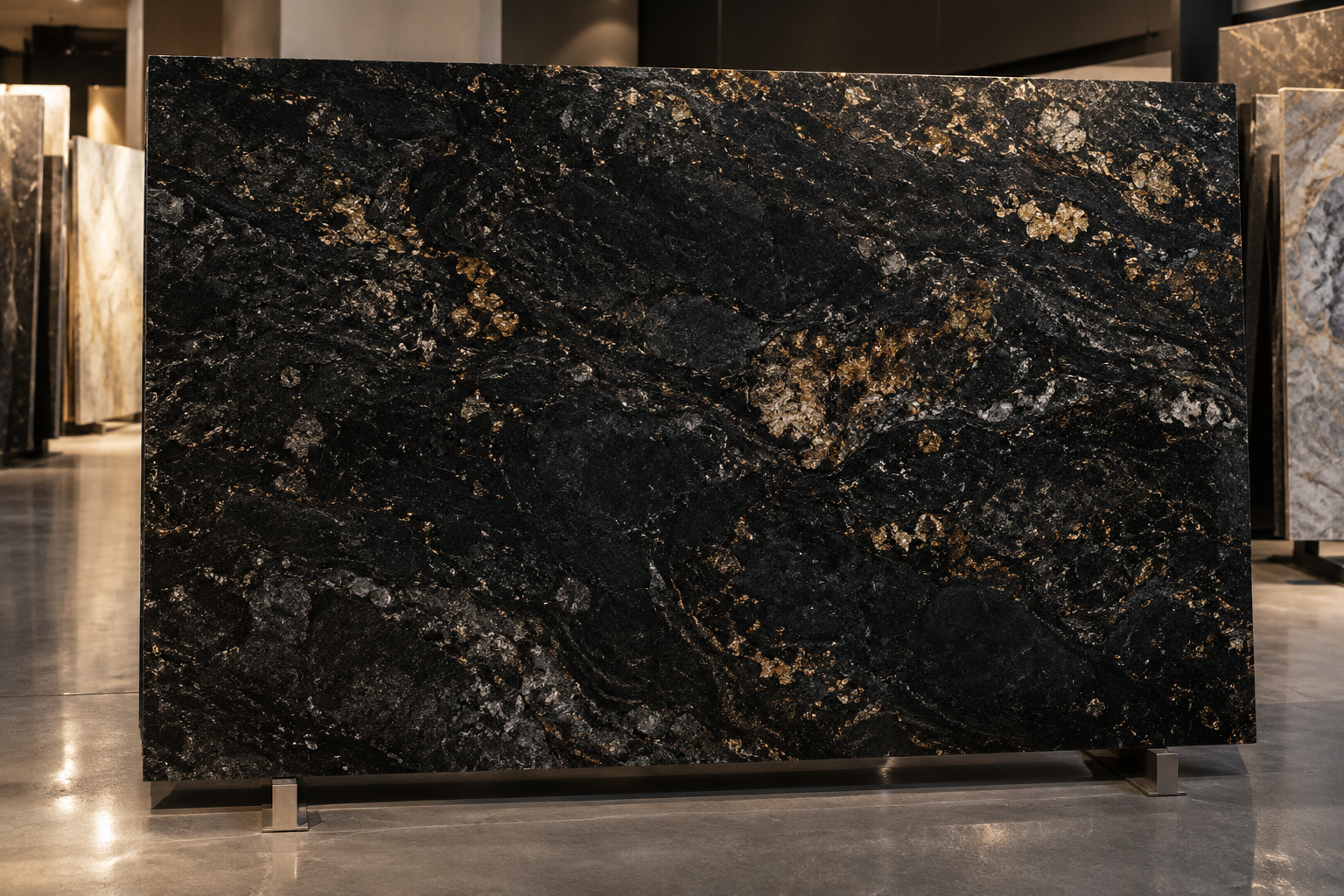
Black Galaxy is sold as a dark natural stone with small gold-coloured flecks. If you like its starry appearance, inspect the actual full slabs and ask about origin, treatment, finish and fabrication before comparing quotations. The distribution and appearance of the flecks matter across the finished counter, not only on the small sample that caught your eye.
The Prakasam district administration identifies Chimakurthi in Andhra Pradesh as the source area, near Ongole. Ask the seller what origin documents are available for the specific lot; a supplier’s office or processing location alone does not establish quarry origin. Black Galaxy and Absolute Black are distinct trade names, so confirm which stone is actually on the order.
Look at the whole slab
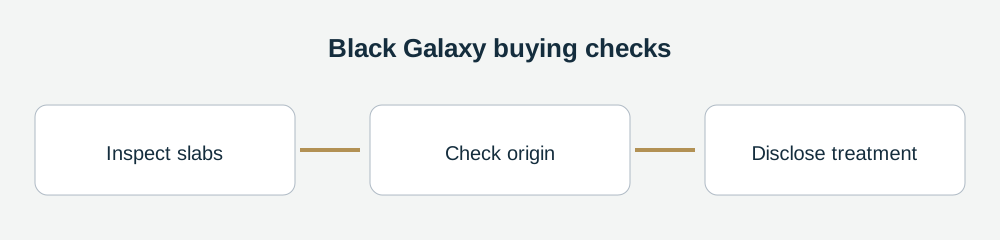
A small sample can show background colour, surface finish and a few flecks, but it cannot show the full distribution of marks, natural variation or repairs. View the actual slab in person when possible. Otherwise request clear photographs of the whole face, identification labels and close views of any areas the seller wants to disclose. Ask for a scale or dimensions so you can understand the size of features in relation to the countertop.
Look at the background and the gold-coloured flecks under similar lighting across all slabs being considered. Some buyers want a more evenly distributed appearance; others prefer visible variation. Neither preference is a universal grade. Move around the slab if you can: the appearance of reflective flecks changes with viewing angle and light. Compare it with a cabinet sample and the floor or wall finishes that will surround the finished installation.
If a kitchen needs more than one slab, inspect both together. Ask the fabricator how the counter pieces will be placed, where the seams will fall and whether the visible faces will look compatible. Agree the layout before cutting. Keep photographs and the slab or bundle identifiers with the purchase order. The sample-versus-slab guide describes the distinction between approving a small reference and approving production material.
Check the slab for visible fissures, repairs, colour variation and areas of resin or fill. Natural features are not automatically defects, but you should understand what you are buying and whether a feature will sit at a sink opening or exposed edge. Ask the supplier and fabricator to explain the proposed placement and any repair. Do not rely on a photograph of a different slab as proof of the appearance of your order.
Treat grade names as supplier descriptions
A supplier may use terms such as standard or super to describe the look of the stone. Those labels are not, by themselves, a universal grading system. Ask that seller to define its terms and identify the actual slabs included. If a particular density of gold-coloured flecks or a uniform dark background matters to you, put that requirement in the approved sample and written order rather than relying on a short grade label.
Ask whether the finish shown in the sample is the finish you will receive. Polished stone presents a reflective face and may make the flecks prominent. Honed and textured finishes change the reflection and can alter how the same slab looks and cleans. Compare the options on the actual material when available; one finish is not automatically the best choice for every kitchen.
The polished-versus-honed guide and leathered finish guide explain common finish distinctions. Ask the fabricator how the edge will be finished and whether that appearance matches the face. Check the sample with the expected lighting and ask for the cleaning instructions for the particular finish.
Ask for origin and treatment disclosure
Natural stone can be processed or treated before it reaches a customer. Ask the supplier to disclose any dye, colour enhancer, resin, filler or other treatment on the actual slab, and explain whether additional treatment is proposed after fabrication. A disclosed repair or treatment is information to evaluate, not automatic proof of a defect. An unexplained treatment, however, makes it difficult to assess care and compare the material with the approved sample.
Request available documents connecting the selected slabs to their declared origin and supplier. Inspect the full face and cut edges where available, and ask the fabricator about apparent differences. A different appearance on a cut edge can have more than one explanation; do not treat it alone as a definitive test for dye. If origin and treatment are conditions of purchase, state them in writing and agree what evidence will be provided.
Do not assume that every dark stone is dyed or that every Black Galaxy slab sold without a particular document is inauthentic. Instead, verify the material you are offered, keep the supplier’s disclosures and approve the specific lot. If the seller cannot answer a material question that matters to you, resolve it before the slab is cut.
Plan the cutting and installation
Give the fabricator a drawing showing the counter dimensions, sink and appliance openings, backsplash if any, overhangs and visible edges. Ask for a template and a proposed slab layout. Confirm seam positions and the relationship between fleck patterns across adjoining sections. A seam may be necessary for transport or installation even if you would prefer an uninterrupted surface.
Discuss the edge profile and the treatment of sink openings. A simple edge can look clean against a dark face; a more elaborate built-up edge requires additional fabrication and may create a different visual result. Ask to see a sample of the edge and joint workmanship. Confirm the support needed for an island or overhang with the fabricator and installer, based on the actual project.
Material allowance depends on slab size, cutout positions, pattern matching and the fabrication plan. Ask the fabricator to calculate the required material and explain what offcuts, if any, will be retained. If you want spare material for future work, agree the quantity, ownership and storage explicitly. A generic percentage cannot substitute for a layout based on the actual slabs.
Check dimensions and thickness tolerances against the project specification and ask how the finished pieces will be inspected. Confirm who is responsible for measurement, transport, installation, any agreed treatment and remedying damage. Request the installation warranty and contact details in writing. A quotation is easiest to compare when it describes the same finished work and the same approved material.
Care, sealing and normal use
Ask whether the stone has already been treated and whether an additional impregnator would be useful for the selected finish and application. Some natural stone benefits from a compatible sealer, while a dense or previously treated surface may gain little from another application. The sealing guide explains how a representative water-drop screen and product trial can inform the decision. A screen is not a guarantee against oil or every other staining agent.
A sealer can improve resistance to penetration but does not make a countertop stain-proof. Follow the product and fabricator instructions, and test the proposed treatment on representative material for changes in appearance or residue. There is no universal resealing interval that can be selected from the trade name alone. Ask how to judge whether the treatment remains useful and which cleaner is appropriate.
For routine care, wipe spills promptly and use a soft cloth and the cleaner recommended for the surface. Avoid abrasive pads and aggressive chemicals unless a qualified stone professional recommends a specific treatment for a specific problem. If a mark appears, identify whether it is residue, a stain or surface damage before attempting a remedy. The stain-removal guide helps distinguish these questions.
Use trivets for hot cookware and follow the fabricator’s care guidance. If the stone is intended outdoors or in a location with unusual weather exposure, ask the supplier and project professional to confirm that the actual material, finish and installation are suitable. A countertop name does not prove suitability for every environment.
For a backsplash, take a sample of the selected slab to compare with possible wall finishes in the room. The dark background and reflective flecks may become more or less prominent depending on lighting and adjacent colours. Choose the relationship you prefer after seeing the materials together; an unread example cannot establish a universally best pairing.
Seven checks before ordering
- Identify the exact slab and ask the supplier to define any grade label.
- Inspect full slabs together and approve their layout and seam positions.
- Request available origin documentation and written disclosure of treatments.
- Confirm finish, dimensions, thickness tolerance and any disclosed repairs.
- Have the fabricator calculate material requirements and agree on any spare pieces.
- Review fabrication details, support, installation responsibility and warranty.
- Ask which cleaning and sealing products are appropriate for the actual surface.
Keep the approved slab identification, layout and care information together. They are more useful for this purchase than an attractive photograph or an undefined grade name alone.
Sources
Can anybody give me the information about Black Galaxy Granite? - Quora
Questions & discussion
Share a question or a useful experience about this guide. Comments appear immediately. Your name and comment are public. Email is optional and stays private; reply emails are not enabled yet. Comment privacy.