
An edge chip does not automatically mean rejection. Record it, hold the affected piece out of installation, and compare depth, location, final finish and the agreed acceptance criteria. Accept only when the responsible project reviewer confirms compliance; consider an approved repair trial where appropriate, or replacement/rejection when the required result cannot be achieved. A photograph alone cannot establish structural safety or who caused the damage. Keep the trade name, geological identity and batch reference separate, and approve by physical sample range rather than catalogue appearance.
The case
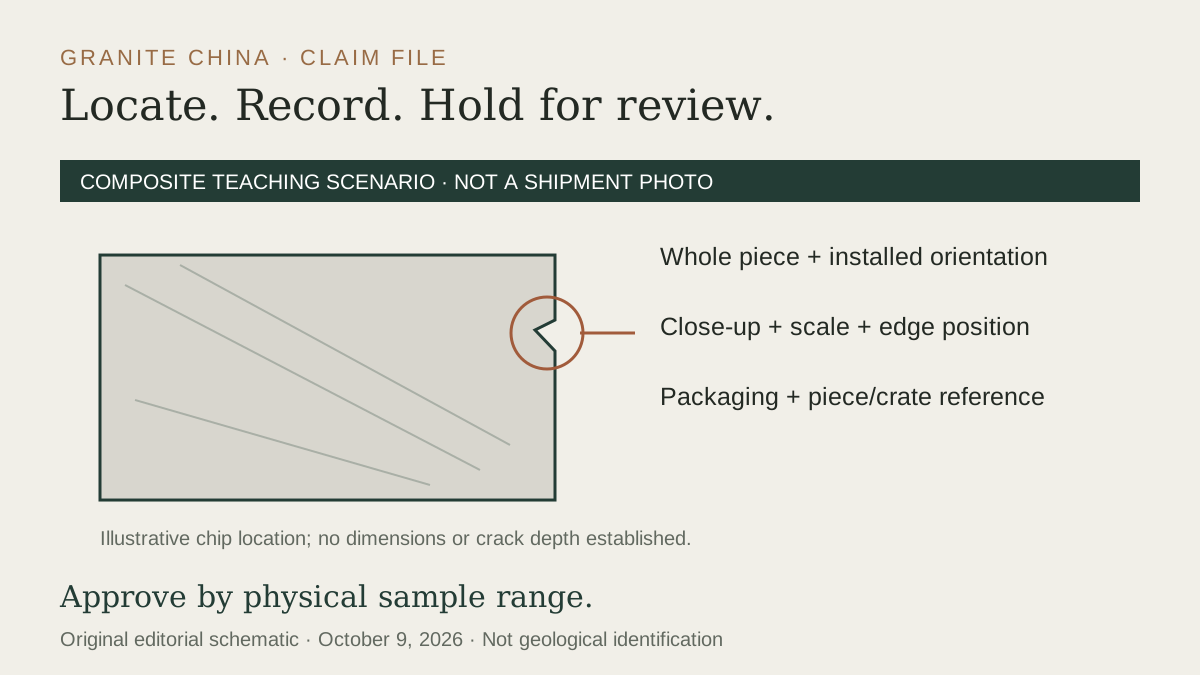
Composite example based on typical receiving scenarios; not an actual inspected shipment. A crate contains cut-to-size panels sold under a supplier’s granite trade name. During unpacking, an inspector notices a missing fragment on a planned exposed edge. The final finish is polished; the purchase documents require approval of visible repairs. No repair trial has been approved. These are invented teaching conditions.
The commercial description is not a geological determination. The chip’s depth, any continuing crack, contractual compliance and cause remain unconfirmed.
Use this photo-recording checklist:
- Show the whole crate and whole piece so the defect can be located.
- Add a close-up with a scale beside the damage; keep its plane and units clear.
- Show the edge, corner, seam or cutout relationship and intended installed orientation.
- Record packaging, protective material and affected-piece markings before alteration.
- Link capture time, piece ID and crate ID to the inspection log.
Photos do not prove when damage occurred. Preserve originals and record subsequent handling.
The 4-factor decision
This original matrix gives qualitative review lines, not universal chip-size allowances. Enter the project’s actual criteria before deciding.
| Factor | Decision line | What must be checked |
|---|---|---|
| Depth | Hold if the missing material’s extent or a continuing crack is uncertain. | Qualified assessment of integrity; a surface image cannot establish depth. |
| Location | Escalate exposed edges, joints, cutouts or load-related details. | Installed position, drawings and functional requirements. |
| Final finish | Consider a trial only if the repaired color, sheen and profile could meet approval. | Compare under the final finish and agreed viewing conditions. |
| Agreed criteria | Accept only against the signed specification and approved repair policy. | Exact allowance, approval authority and sample references; leave unknown limits blank. |
Suspected cracking or a functional/structural concern calls for isolation and qualified fabrication/project assessment, not a remote safety verdict. Batch variation may affect appearance matching; a trade name cannot settle geological identity or repair suitability. Approve by physical sample range.
Repair vs refinish vs reject
Repair: Consider a written, approved trial when qualified assessment supports the piece’s intended use. Review the trial against the approved physical sample range and a repair sample. A patch may differ in color, gloss, contour or visibility; an “invisible repair” is not promised.
Refinish or redress: Ask whether reworking the edge or surface would still meet the drawing, dimensions, edge profile and final finish. A cosmetic improvement is not permission to remove material or change the supplied specification. This article gives no cutting, grinding or chemical-application instructions.
Replace or reject: Seek the agreed disposition when integrity/function is unresolved, a critical exposed edge cannot meet approval, or the proposed remedy fails the approved criteria. Do not install pending approval. Technical acceptance, claim entitlement and responsibility are separate questions governed by the actual agreement and evidence, not this matrix.
The Natural Stone Institute’s granite guidance discusses referring defective pieces to the specifying authority and conditions for patching without impairing integrity or appearance (2022 edition, accessed October 9, 2026). It is guidance, not an automatic term of your order. No repair outcome is established here.
Building a claim file that works
Keep these records together; confirm reporting requirements from your actual agreement rather than an invented deadline.
| Record | Supports | Does not establish alone |
|---|---|---|
| PO, drawings, approved samples and repair policy | Agreed identity, finish and acceptance basis | Delivered compliance |
| Packing list, crate/piece IDs and batch records | Traceability and quantities | Cause of damage |
| Original photos and packaging observations | Visible condition and context | Hidden integrity or liability |
| Dimensions, damage map and observation method | Recorded extent and location | Unmeasured depth or capacity |
| Receipt/handling timeline and correspondence | Sequence, notice and proposed remedy | Legal responsibility |
| Repair trial, written disposition and reinspection | Authorized action and observed result | Guaranteed long-term performance |
Receiving Inspection Record — copy and complete
Receipt time / inspector: ____________________
PO / drawing / crate / piece ID: _____________
Trade name / supplier code: __________________
Geological identity / supporting record: _____
Batch / approved physical sample range: ______
Dimensions / units / method: _________________
Final finish / edge profile: _________________
Damage location / observed extent / unknowns: _
Photo IDs / packaging / handling timeline: ____
Agreed acceptance criteria / clause: __________
Hold / proposed disposition: _________________
Written approval / repair sample reference: ___
Reinspection / unresolved items: _____________
Limits
No shipment was inspected, stone identified, strength measured or repair tested. This is an editorial inspection framework, not engineering certification or legal advice. Verify material identity, batch variation, contract criteria and qualified review before releasing a held piece.
Over to you
You’re the inspector: accept, repair, or reject? Vote on the composite teaching case, then see how other readers voted. “Repair” means request an approved trial, not start work without permission. Reader preferences cannot authorize a real delivery decision.
Loading live voting status…
Reader ballots
Anonymous, self-selected reader ballots, not an inspection verdict or a representative survey. One stored choice per browser cookie; different browsers or cleared cookies can create repeat ballots. This cookie is used only for voting. No name or email is requested.
Next steps
Read next: Granite Quality Control: Inspection Checklist for Importers · Common Granite Defects: Identification, Acceptance and Claims.
Copy the inspection record above to document your next delivery check.
Printable working records
Use these blank records to document your own order and observations: Granite Sample Approval Record · Granite Specification Enquiry Record · Granite Receiving Inspection Record. They can be filled in the browser or printed for handwritten notes.
Questions & discussion
Share a question or a useful experience about this guide. Comments appear immediately. Your name and comment are public. Email is optional and stays private; reply emails are not enabled yet. Comment privacy.