
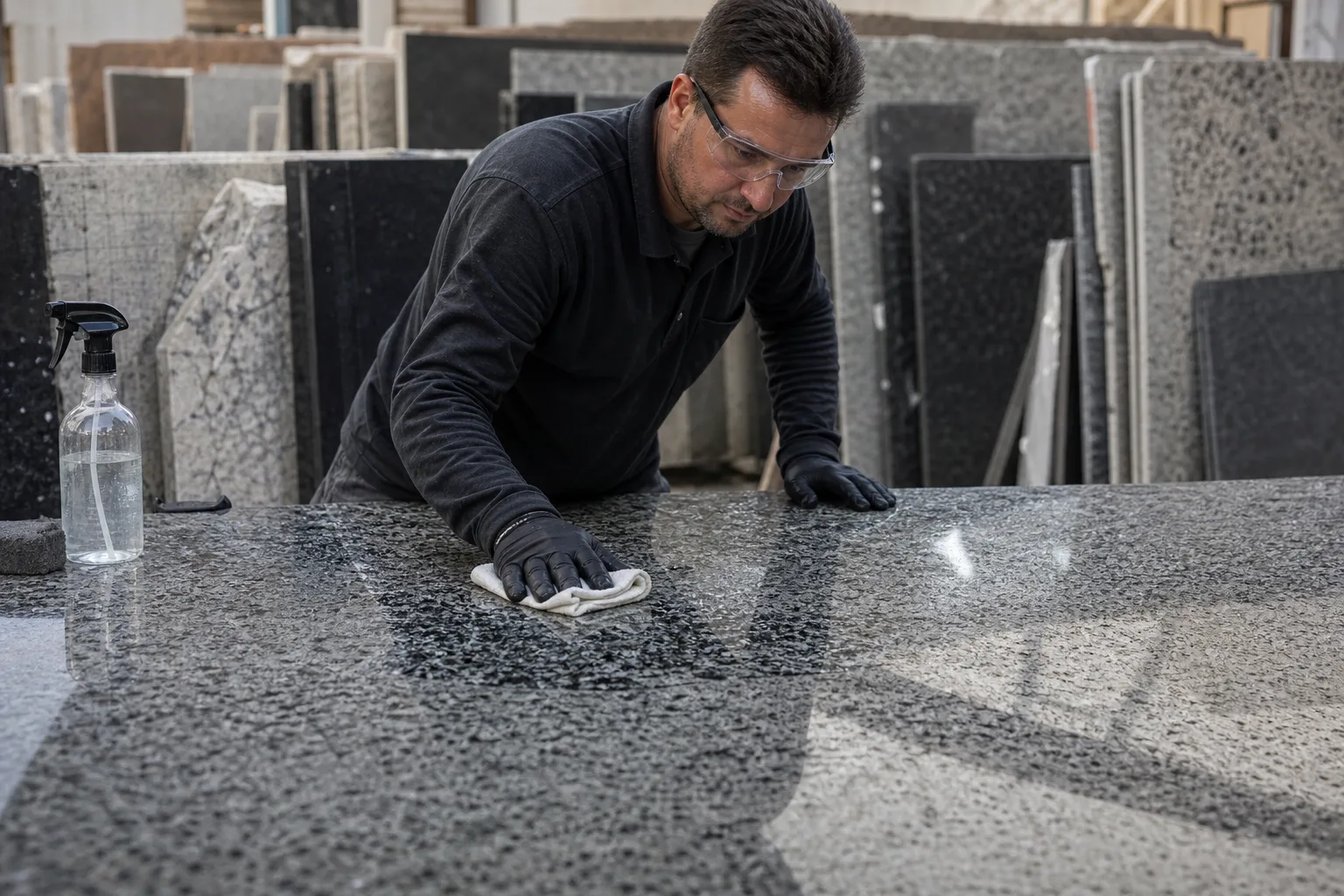
To clean granite safely, remove loose grit, blot spills rather than spreading them, and wash the surface with warm water and a small amount of pH-neutral stone cleaner or mild liquid dishwashing detergent. Use a soft cloth or clean mop, rinse away cleaner residue and dry the stone. Do not assume that vinegar, acidic bathroom cleaner, scouring powder or general-purpose rust remover is suitable. Persistent discoloration should be identified as a stain, mineral deposit, sealer problem or surface damage before treatment.
A safe routine for cleaning granite
Basic equipment
- A clean microfiber cloth, soft sponge or non-treated dust mop
- Warm, clean water
- A pH-neutral cleaner labeled for natural stone, or a small amount of mild liquid dishwashing detergent
- A second cloth for rinsing
- A clean absorbent towel for drying
- A soft-bristle brush for textured finishes, used only when needed
Step-by-step method
- Remove particles first. Dust, sand and grit can act as abrasives when dragged across the surface. Sweep or dust-mop floors and wipe loose material from counters before wet cleaning.
- Blot fresh spills. Absorb liquid with a white cloth or paper towel. Avoid wiping a large circle around the spill because this increases the affected area.
- Apply a diluted cleaner. Follow the cleaner manufacturer's stated concentration. Too much detergent can leave a film that appears as haze or streaking.
- Wipe without aggressive abrasion. Use overlapping passes and allow the cleaner time to loosen ordinary soil. Scrubbing harder is not a substitute for identifying the deposit.
- Rinse thoroughly. Remove detergent and suspended dirt with clean water. Change floor-cleaning water when it becomes cloudy.
- Dry the surface. Drying reduces streaks and standing-water marks, particularly around sinks and on dark polished stone.
This routine follows the Natural Stone Institute's general recommendation to use a neutral cleaner, stone soap or mild dishwashing detergent, followed by thorough rinsing and drying.[1]
Confirm what material and finish you are cleaning
Geological identity
Geological granite is an igneous, silicate-rich rock. In a purchasing or maintenance record, however, the word granite should not be the only material identification. Commercial stone names may be applied inconsistently, and visually similar slabs can differ in mineral composition, absorption, factory treatment and response to chemicals. Record the supplier's material designation, approved sample, slab or lot reference, finish and any applied resin or sealer.
The Natural Stone Institute distinguishes siliceous stones from calcium-carbonate-rich stones and notes that composition affects cleaner selection. Although siliceous stone is generally more resistant to common kitchen acids than calcareous stone, acidic cleaners are still not recommended as a default because accessory minerals and surface treatments may react differently.[1] See the broader granite material reference and granite versus marble comparison when the stone's identity is uncertain.
Trade names are not cleaning specifications
A color name, code or translated trade name does not establish porosity, chemical resistance or sealing requirements. For imported material, link the name to physical samples and production records rather than assuming that identically named products from different sellers are interchangeable. If replacement pieces may be required, retain photographs under controlled lighting and document the shipment or slab references.
Adjust the method for the finish and application
Finish changes surface texture, visibility of residue and ease of access to low areas. It does not justify harsh chemistry. Test an unfamiliar cleaner on a spare piece or inconspicuous location and inspect it after the surface has dried.
| Surface or application | Routine approach | Points to inspect |
|---|---|---|
| Polished countertop | Soft cloth, diluted neutral cleaner, clean-water rinse and immediate drying | Streaks, oily film, rings, dull patches and residue around joints |
| Honed surface | Same neutral method, using even passes across the full area | Uneven darkening, fingerprints and local changes in sheen |
| Leathered or textured counter | Soft cloth plus a soft-bristle brush where dirt remains in recesses | Debris in low points, cleaner trapped in texture and uneven sealer residue |
| Bush-hammered, flamed or split-face stone | Remove loose grit, use controlled low-aggression brushing, rinse completely | Embedded soil, biological growth, drainage and adjacent joint condition |
| Interior granite floor | Frequent dry dust-mopping followed by damp cleaning as required | Entrance grit, mop film, worn traffic paths and slip conditions |
| Exterior paving or facade | Begin with clean water and the least aggressive compatible method | Runoff, efflorescence, joint failure, staining source and nearby metals |
Polished granite is generally smoother and easier to wipe, while textured finishes can retain particles in surface recesses. A soft brush may therefore be useful on leathered material.[2] Review the separate references for polished granite, bush-hammered granite and split-face stone.
Application conditions matter as much as finish. A kitchen countertop is exposed to oils and food spills; flooring receives abrasive traffic; and patios, driveways and facades are affected by drainage, weathering and environmental deposits. Cleaning instructions should be written for the installed use, not copied from a generic slab data sheet.
Diagnose stains, deposits and surface damage
Cleaning removes material on the surface. A stain has entered pores or micro-openings, while etching, scratching, coating failure and excess sealer are changes to the surface itself. These conditions can look similar, so diagnosis should precede stronger treatment.
Common observations
- Dark mark that gradually fades: often moisture within the stone. Allow it to dry before deciding that it is permanently stained. Persistent dark spots require further investigation; see granite dark spots: water or stain.
- Dark mark that remains after drying: may be oil or another absorbed substance. Identify the likely source before selecting a solvent or poultice.
- White crust near water: may be a surface mineral deposit. Do not automatically apply acidic limescale remover.
- Cloudy or smeared appearance: may result from excess detergent, cleaner residue, polish or improperly removed sealer. Rinse first; if the problem followed sealing, consult the sealer haze and discoloration guide.
- Dull patch with no removable residue: may be abrasion, chemical attack or a change in finish rather than a stain. Professional refinishing may be required.
- Orange or brown mark near metal: may be iron-related staining. General-purpose rust removers can contain acids that damage silicate minerals, so use only a stone-compatible treatment selected for the identified stain.
When a poultice may be appropriate
A poultice combines an absorbent white material with a cleaning liquid selected for the stain type. It is intended to draw staining material out of the stone rather than simply scrub the surface. The Natural Stone Institute notes that poultice treatment may need to be repeated and that some stains cannot be removed completely.[3]
Do not improvise with an unknown chemical combination. Protect adjacent finishes, follow product safety directions and test the complete treatment on a spare sample where possible. Deep rust, widespread oil staining, paint stripping, unexplained color change and damage to resin-filled areas are appropriate reasons to consult a stone restoration specialist.
Cleaners and practices to avoid
- Hydrofluoric acid or products that may contain it: the Natural Stone Institute states that HF attacks silicates and can damage granite and quartzite.[1]
- Routine use of vinegar, lemon juice or acidic bathroom cleaners: these may affect susceptible minerals, joints, sealers or adjacent materials even when the principal stone is siliceous.
- Scouring powders, abrasive creams and aggressive pads: they can alter sheen or leave visible scratch patterns.
- Unverified rust and toilet-bowl cleaners: their chemistry may be unsuitable for stone.
- Excess detergent: a concentrated solution can create a film that attracts soil and produces streaks.
- Mixing cleaning chemicals: in particular, never mix bleach and ammonia because the combination produces a dangerous gas.
- Pressure washing without a trial: excessive pressure can damage joints, dislodge weak mineral grains or create an uneven appearance.
- Applying polish to conceal dirt or damage: clean and diagnose the surface before adding another product layer.
Cleaner labels, safety data and written compatibility statements take priority over informal recipes. Where sanitation is required, distinguish cleaning from disinfection and select a product whose label permits the intended natural-stone and food-contact use.
Sealing, specifications and maintenance records
Sealing is not automatically required for every granite. An impregnating treatment generally acts as a repellent and increases stain resistance; it does not make stone stain-proof or replace prompt cleaning. The Natural Stone Institute states that many granite counters can benefit from sealing while also noting that many do not require it.[4]
A fixed annual resealing rule is therefore not a reliable specification. Need and interval depend on the stone, finish, existing factory treatment, product, exposure and maintenance history. Follow the sealer manufacturer's written instructions and confirm suitability for food-preparation areas where applicable. The granite sealing guide and water-drop test guide explain the limits of field observations.
Minimum maintenance information to request
- Stone trade name and supplier material code
- Finish name and approved finish sample
- Disclosure of resin, enhancer, wax, impregnator or other factory-applied treatment
- Cleaner and sealer product names, technical data and safety documents
- Application, curing and reapplication instructions
- Restrictions for food-contact, exterior, freeze-thaw or wet-area use
- A spare treated sample for compatibility testing
Inspection and China sourcing context
For granite sourced from China, cleaning performance should be addressed before shipment rather than left as a post-installation question. A factory or exporter listing does not establish geological identity, finish consistency, treatment history or maintenance suitability. Verify these points against the purchase specification, approved samples and production evidence. Use the broader China granite import guide and granite quality-control reference when preparing an order.
Pre-shipment and receiving checklist
- Confirm that the production finish matches the signed sample in texture and sheen.
- Ask whether slabs or cut pieces were resin-treated, color-enhanced, waxed or sealed.
- Inspect representative pieces after they are clean and completely dry; wet surfaces can conceal haze and color variation.
- Check for residue, oil marks, rust transfer, adhesive contamination and uneven treatment near edges or repairs.
- Review the stone under consistent lighting. Guidance on approval conditions is available in granite color approval and lighting.
- Compare samples with actual slabs or finished pieces, recognizing the limits described in sample versus slab approval.
- Retain spare pieces from the production lot for cleaner, sealer and stain-removal trials.
- Record accepted variation and defects before packing; consult the granite defects reference and third-party inspection guide.
Price factors linked to maintenance
Cleaning and maintenance can influence total procurement cost even when they do not appear as separate quotation lines. Relevant factors include finish complexity, factory treatment, mockup production, compatibility testing, inspection scope, protective packing, spare material and replacement risk. Textured finishes may require more cleaning labor than polished surfaces, while undocumented coatings or enhancers can create troubleshooting costs after installation.
Do not infer capability from a low price or a broad product catalog. Ask suppliers to quote the same written material, finish, treatment, inspection and packing requirements. For purchasing structure, see China granite suppliers, factory versus trading company, samples and mockups and granite price factors in China.
Frequently asked questions
What is the safest everyday cleaner for granite?
Use warm water with a small amount of pH-neutral natural-stone cleaner or mild liquid dishwashing detergent. Wipe with a soft cloth, rinse away residue and dry the surface. Follow the cleaner manufacturer's stated dilution.
Can vinegar be used to clean granite?
Vinegar is not recommended as a routine granite cleaner. Although geological granite is silicate-rich, accessory minerals, applied sealers, resin treatments, joints and nearby materials may respond differently to acid.
Does every granite surface need to be sealed?
No. Sealing need varies with the specific stone, finish, factory treatment and exposure. An impregnating sealer can improve stain resistance but does not make granite stain-proof. Confirm the requirement with documented product guidance and a representative test area.
Why does granite look darker after cleaning?
Temporary darkening may be moisture within the stone and can fade as the surface dries. A mark that remains may be an absorbed stain, uneven sealer, resin-related discoloration or another condition requiring diagnosis.
How should textured granite be cleaned?
First remove loose grit, then use diluted neutral cleaner with a soft cloth or soft-bristle brush to reach recesses. Rinse thoroughly so cleaner and suspended dirt do not remain in the texture.
Questions & discussion
Share a question or a useful experience about this guide. Comments appear immediately. Your name and comment are public. Email is optional and stays private; reply emails are not enabled yet. Comment privacy.