
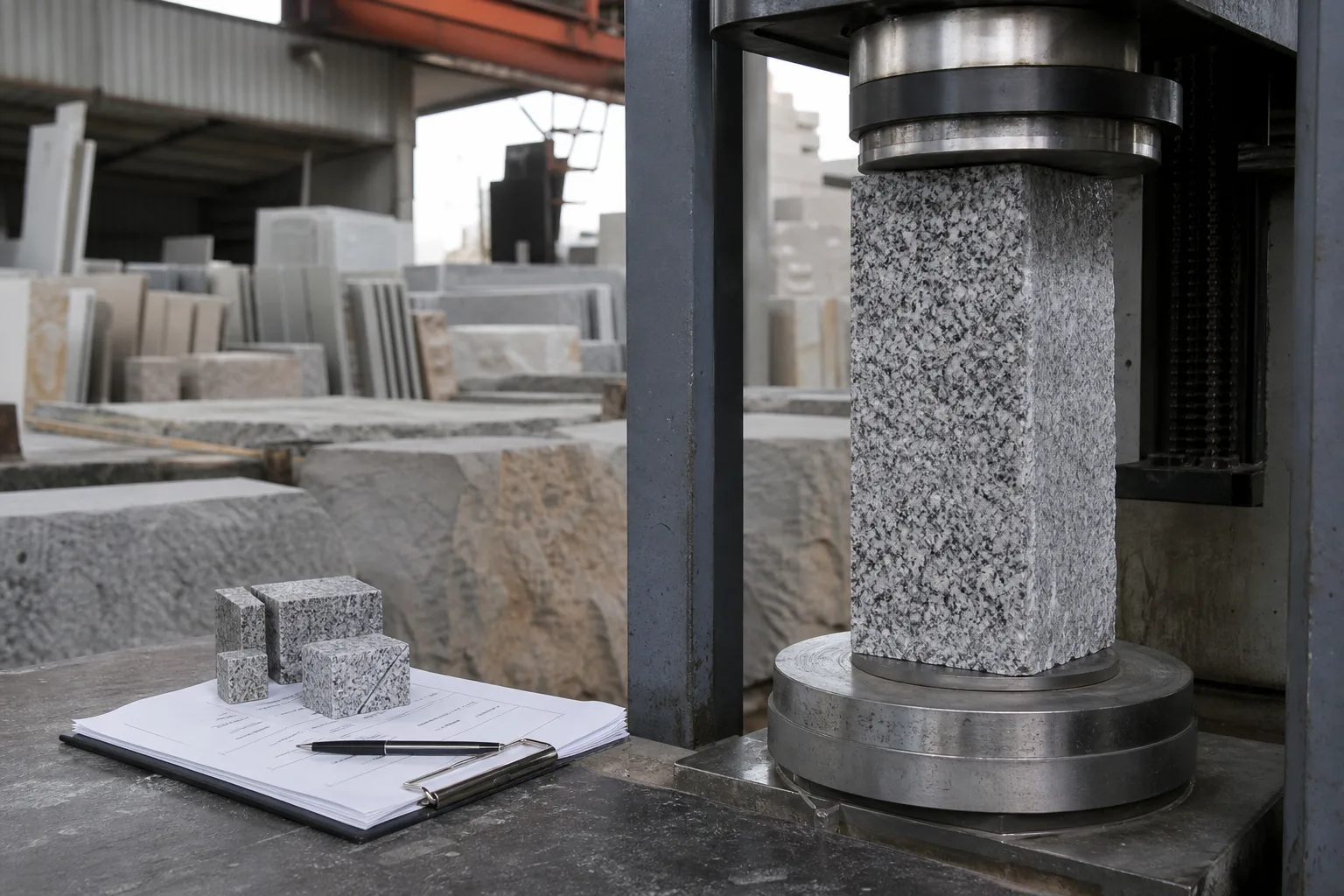
Granite compressive strength is the maximum compressive stress a prepared stone specimen can withstand before failure, normally reported in megapascals (MPa) or pounds per square inch (psi). It is an important material-selection value for load-bearing units, paving, stairs and other dimension-stone products, but it is not a universal number for all granite. A defensible specification identifies the exact stone, source or production lot, test method, specimen condition and acceptance criteria rather than relying on a trade name or an unsourced value.
Key numbers
| Indicator | Reference value or method | Standard and limit |
|---|---|---|
| Common strength range | No universal range stated in this guide | Use identified-lot ASTM C170/C170M results |
| Historical ASTM C615 minimum benchmark | 131 MPa / 19,000 psi | NSI 2009 factsheet; confirm the current adopted specification |
Dry and wet conditioning can change results; retain the report conditions described below. The historical benchmark is not a verified current-edition acceptance requirement.
What compressive strength tells you
Basic meaning and calculation
In a compression test, a prepared specimen is placed between loading surfaces and subjected to an increasing axial load until it fails. Compressive strength is calculated by dividing the failure load by the loaded cross-sectional area. ASTM C170/C170M-24a covers the sampling, preparation and determination of compressive strength for dimension stone. ASTM describes the method as useful for identifying strength differences among dimension stones and as one element in comparing stones of the same type. ([store.astm.org](https://store.astm.org/c0170_c0170m-24a.html))
A higher result indicates that the tested specimen resisted a greater direct compressive stress. It does not, by itself, establish that a slab, tile, stair tread, facade panel or granite pillar is adequately designed. Product geometry, unsupported span, restraint, joints, anchors, installation materials, impact, weather exposure and safety factors can govern performance.
Compressive strength is not flexural strength
Compression loads push material together. Flexural loads bend a unit and create both tension and compression. Thin slabs, projecting treads, countertop overhangs and mechanically anchored facade panels may therefore be governed more directly by flexural strength, anchor testing or engineered system performance than by compressive strength. The Natural Stone Institute lists ASTM C170 for compression, ASTM C880 for flexural strength and ASTM C1354 for individual stone anchorages as separate tests. ([naturalstoneinstitute.org](https://www.naturalstoneinstitute.org/stoneprofessionals/astm/))
- Compression: relevant to direct bearing and crushing resistance.
- Flexure: relevant where stone spans, bends or projects beyond support.
- Abrasion: relevant to stone exposed to foot or vehicle traffic.
- Water absorption: useful when assessing moisture-related exposure and material variability.
- Anchorage performance: relevant to connections in mechanically fixed stone assemblies.
Geological granite, commercial granite and trade names
Geological identity
In geological usage, granite is a coarse-grained igneous rock principally associated with quartz and feldspar. USGS references describe granite as a light or speckled, coarse-grained igneous rock composed of quartz, feldspar and mica, while more detailed classification distinguishes granite by mineral proportions and fabric. ([pubs.usgs.gov](https://pubs.usgs.gov/gip/acidrain/glossary.html?utm_source=openai))
The dimension-stone trade uses “granite” more broadly. Some gneiss, gabbro, diabase and other hard crystalline stones may be sold within the commercial granite category because they are processed and used in similar ways. A Natural Stone Institute publication explicitly notes this difference between scientific classification and commercial naming. ([naturalstoneinstitute.org](https://www.naturalstoneinstitute.org/default/assets/file/bsm/2009/2009_bsi_spring.pdf))
Why strength varies
Mineral composition alone does not determine the strength of a supplied product. Grain size, grain boundaries, foliation, microcracks, veins, weathering, alteration and discontinuities can influence how individual specimens fail. Variability may occur between deposits, quarry faces, blocks and even different orientations within one block.
A trade name is consequently an identification aid, not a strength certificate. Similar names may be used by different sellers, and a code such as G603 may cover market descriptions that do not prove one quarry, petrographic identity or test population. Match every report to the approved sample and purchase documents using photographs, color range, source declaration, report date and batch references where available.
Standards and useful reference values
ASTM C170 and ASTM C615
ASTM C170/C170M-24a is the current ASTM test method identified during this review for compressive strength of dimension stone. ASTM C615/C615M-23 is the active material specification for granite dimension stone and covers granite selected for general building and structural purposes, including cladding, paving, landscape features, structural components, retaining walls and monuments. The specification addresses several physical properties rather than compression alone. ([store.astm.org](https://store.astm.org/c0170_c0170m-24a.html))
A Natural Stone Institute factsheet published in 2009 reproduces an ASTM C615 minimum compressive-strength value of 19,000 psi (131 MPa). This is a useful historical and commonly referenced benchmark, but it should not be copied into a contract without checking the current purchased edition of ASTM C615/C615M and applicable project requirements. Standards, referenced methods and jurisdictional requirements can change. ([naturalstoneinstitute.org](https://www.naturalstoneinstitute.org/default/assets/file/bsm/2009/2009_bsi_spring.pdf))
How to read a laboratory report
Do not accept a single strength number detached from its report. Ask the supplier or laboratory to provide a complete document and review the following information:
- stone name, sample identification and declared quarry or block reference;
- test method and edition, such as ASTM C170/C170M-24a;
- laboratory identity and report date;
- specimen dimensions and preparation;
- moisture or conditioning status stated by the report;
- loading orientation where the stone has visible directionality;
- individual specimen results, average result and units;
- photographs or traceable sample records when project risk warrants them;
- any departures, exclusions or qualifications recorded by the laboratory.
Confirm that SI and inch-pound values have not been mixed during calculations. ASTM states that its SI and inch-pound systems are to be used independently because values in the two systems are not necessarily exact equivalents. ([store.astm.org](https://store.astm.org/c0170_c0170m-24a.html))
Applications, finishes and design limits
Where compression data matters
Compression data can support material screening for bearing blocks, cubic elements, columns, curbs, pavers, steps and heavily loaded flooring. For driveways and patios, however, subgrade preparation, bedding, drainage, unit thickness, dimensions and traffic loads also affect performance. For flooring, abrasion and slip-related considerations may be more operationally important than an exceptionally high compression result.
Kitchen countertops are not normally selected by compressive strength alone. Cracks around sink and cooktop cutouts, unsupported overhangs, narrow rails and poor cabinet support are bending and fabrication concerns. Exterior facades require project-specific engineering of panel thickness, anchors, wind loads, joints and substrate conditions.
Finish is a separate specification
Polished, honed, leathered, flamed, bush-hammered, sandblasted, sawn and split-face surfaces are all encountered in the granite market. Polished finishes are generally associated with a reflective surface, while honed finishes are matte and leathered or mechanically textured finishes have more pronounced surface relief. ([marble.com](https://marble.com/articles/granite-finishes))
The finish name does not establish granite compressive strength. Specify finish and mechanical properties separately. Aggressive texturing can also affect finished thickness, visual consistency, cleanability and edge appearance, so approve a production-representative sample or mockup. For pedestrian areas, evaluate the finished surface in the intended wet or dry service conditions rather than assuming that “textured” automatically means suitable.
Specification and inspection checklist
The following table separates documents that can be checked before production from characteristics that should be verified on finished goods.
| Control point | What to specify or inspect | Why it matters |
|---|---|---|
| Material identity | Trade name, geological description if available, declared quarry origin, approved sample and range | Reduces substitution and name ambiguity |
| Compression test | Required method and edition, units, minimum value, report age and sample traceability | Makes the acceptance value auditable |
| Complementary tests | Absorption, density, flexural strength, abrasion or anchorage tests as required by the application | Avoids selecting stone on one property alone |
| Dimensions | Length, width, thickness, squareness, flatness, edge profile and permitted tolerances | Controls installation fit and load distribution |
| Finish | Named process plus an approved physical sample | Finish terminology can be interpreted differently |
| Visible quality | Limits for cracks, open seams, chips, resin, mesh, patches, rust-prone inclusions and unacceptable color variation | Separates natural variation from prohibited defects |
| Lot control | Bundle, crate, block or production-lot identification | Supports traceability if testing or replacement is needed |
| Packing | Crate construction, separators, moisture protection, labeling and loading plan | Limits transit damage and identification errors |
Practical acceptance sequence
- Define the application and governing project requirements.
- Approve the stone range and finish using representative samples.
- Request complete test reports before placing a production order.
- Check that the tested material corresponds to the offered stone and source.
- Record dimensional, visual and packaging criteria in the purchase specification.
- Use pre-shipment inspection or independent testing when project risk justifies it.
- Retain approved samples and inspection records through delivery and installation.
China sourcing context and price factors
Separate origin from processing location
China-based processors and exporters offer a broad range of domestic and imported granite in slabs, tiles and cut-to-size products. Marketplace directories demonstrate the breadth of listings but do not independently prove quarry ownership, factory capability, test validity, inventory or certification. StoneContact’s China directory, for example, includes both Chinese stones and materials such as Zimbabwe Black offered by China-based suppliers. Treat a directory as a discovery tool, not technical verification. ([stonecontact.com](https://www.stonecontact.com/p/granite-tiles-slabs/china-supplier?utm_source=openai))
Ask separately for the stone’s geological or quarry origin, the country where blocks or slabs were processed, and the legal country-of-origin information required for the destination market. “Supplied from China” does not necessarily mean “quarried in China.” Do not infer a supplier’s ability to meet ASTM requirements from a website listing, membership badge or generic test sheet.
Testing and price
Granite prices cannot be determined from compressive strength alone. Cost may be influenced by block yield, color selection, defect limits, slab or unit size, thickness, finish, edge work, cutouts, reinforcement, matching, order quantity, testing, inspection, packing and logistics. Tight visual ranges and project-specific testing can add cost because they require more selective production and documentation.
For comparable quotations, send each bidder the same schedule of stone, dimensions, finish, tolerances, testing and inspection requirements. State whether test costs, samples, mockups, export packing, inland transport and loading are included. When compression is a contractual criterion, define how nonconforming results will be handled before production begins. This is more reliable than requesting “high-strength granite” without a method or acceptance value.
Stone properties
density and weight · water absorption · slip resistance · water-drop screening · freeze thaw · sizes and tolerances
Frequently asked questions
What is a good compressive strength for granite?
A Natural Stone Institute factsheet reproducing an earlier ASTM C615 requirement lists 19,000 psi, or 131 MPa, as a minimum benchmark. Confirm the value against the current project specification and current edition of ASTM C615/C615M rather than treating it as universal.
Which standard is used to test granite compressive strength?
ASTM C170/C170M is the ASTM test method for compressive strength of dimension stone. As of this review, the active edition identified by ASTM is C170/C170M-24a.
Does a polished or bush-hammered finish change the required strength?
A finish describes the processed surface and does not replace mechanical-property testing. Specify the finish, remaining thickness and strength requirements separately, and approve a representative sample for appearance and texture.
Is compressive strength enough to approve granite for a facade or countertop?
No. Facades may require flexural, anchorage and system engineering data. Countertops depend heavily on support, spans, cutouts and fabrication quality. Water absorption, abrasion, dimensions and visible defects may also be relevant.
How should buyers verify compressive strength when sourcing from China?
Request a complete laboratory report tied to the offered stone, declared source and traceable sample. Check the method edition, units, specimen information, individual results and report date. Use independent sampling or pre-shipment inspection when project risk warrants it.
Questions & discussion
Share a question or a useful experience about this guide. Comments appear immediately. Your name and comment are public. Email is optional and stays private; reply emails are not enabled yet. Comment privacy.