
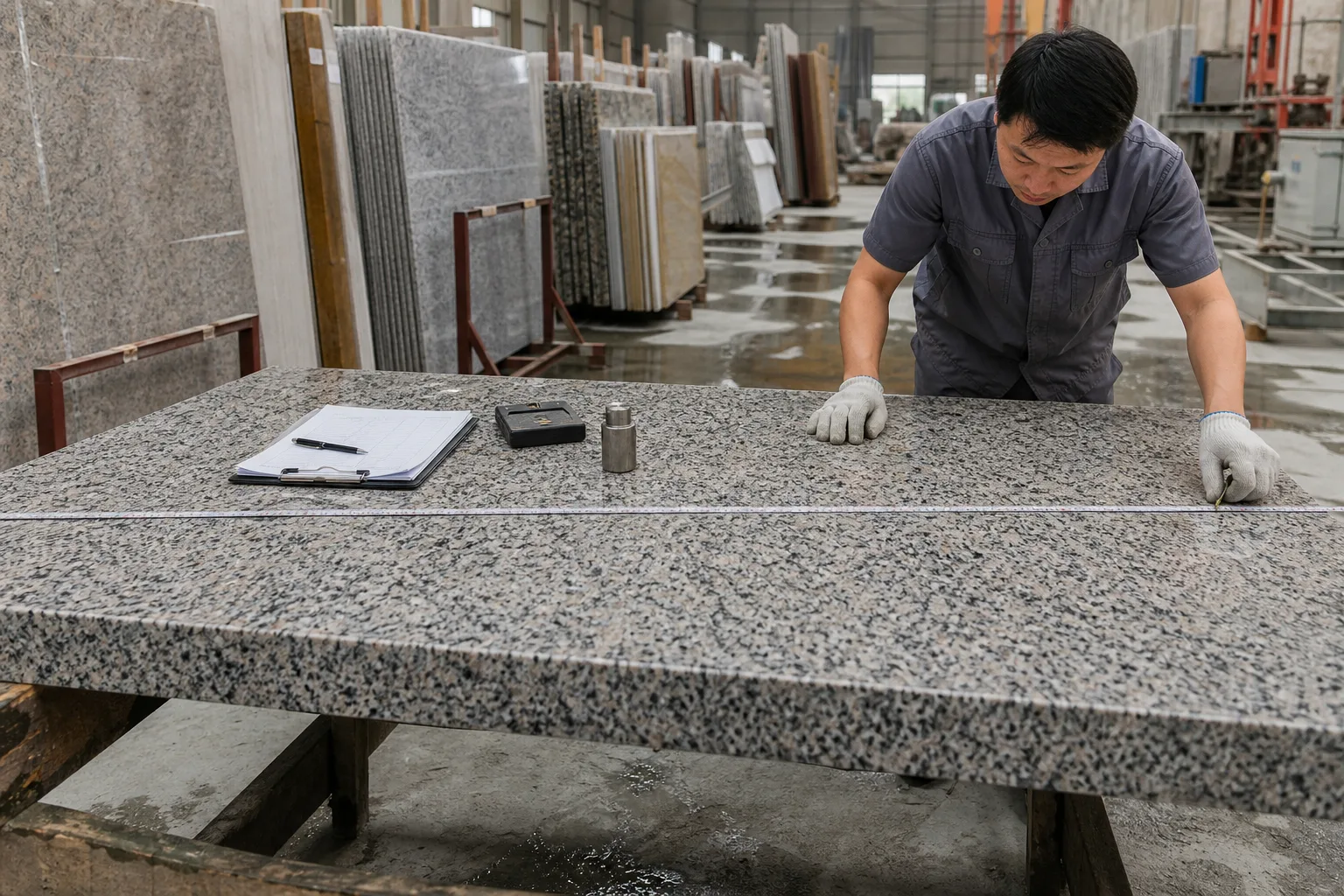
Granite density and weight should be calculated from the selected stone's tested density, finished dimensions and quantity. For preliminary planning, this guide uses a clearly stated assumption of 2,700 kg/m³, equivalent to 2.70 g/cm³. At that assumed density, 20 mm granite weighs about 54 kg/m², while 30 mm granite weighs about 81 kg/m². These are estimating figures, not test results for every material. Procurement, structural design, lifting and shipping decisions should use a report applicable to the specified stone and production source.
Density by stone
| Stone | Density (kg/m³) | Density (g/cm³) | Evidence to use |
|---|---|---|---|
| G603 | Not established | Not established | Use a report tied to the offered source and lot; the trade name is not a density certificate. |
| G654 | Not established | Not established | Use a report tied to the offered source and lot; the trade name is not a density certificate. |
| G682 | Not established | Not established | Use a report tied to the offered source and lot; the trade name is not a density certificate. |
The cited stone references do not establish reliable numerical ranges for these labels. Density can vary between sources and batches; use the accepted test report for contractual calculations. The calculator therefore uses a custom density rather than assigning an unsupported value to a named stone.
Stone weight calculator
Weight (kg) = length (m) × width (m) × thickness (mm) ÷ 1,000 × density (kg/m³).
The starting density of 2,700 kg/m³ is a planning assumption, not a test value for a named stone. Results estimate net stone weight from the entered density. Actual shipping weight depends on weighing, cutouts and packaging. Inputs stay in your browser and are not collected or transmitted by this tool.
What granite density means
Density is mass divided by volume
Density describes how much mass is contained in a unit volume. It is commonly stated in kilograms per cubic metre (kg/m³), grams per cubic centimetre (g/cm³), or pounds per cubic foot (lb/ft³). The direct relationship is:
Weight in kilograms = length in metres × width in metres × thickness in metres × density in kg/m³
For a rectangular product, this formula gives the net theoretical stone weight before allowing for holes, sink cutouts, edge profiling, repairs or packaging. Irregular pieces can be estimated by dividing the shape into measurable sections or by using its digital cutting area.
Density and bulk specific gravity are related but not interchangeable labels
Specifications and laboratory reports may refer to density, apparent density or bulk specific gravity. The requested property and test method should therefore be written into the purchase specification rather than reduced to the phrase “standard granite density.” ASTM C97/C97M covers determination of absorption and bulk specific gravity for dimension stone other than slate. As of September 27, 2026, ASTM lists C97/C97M-26 as the active edition. See the ASTM C97/C97M standard summary.
Do not infer density from color, grain size or a trade name. Two stones sold under similar names can have different mineral composition, pore structure and test values. Conversely, a modest difference in density may have little relevance to appearance but can affect large-area dead loads and shipment calculations.
Geological identity and commercial granite names
Commercial granite is broader than geological granite
A geological granite is identified by mineral composition and texture. The dimension-stone trade uses “granite” more broadly for several hard crystalline stones that are processed and used in similar ways. The Natural Stone Institute explains that commercial groups may include rock types that do not match the strict scientific definition of granite. Its discussion includes gabbro, gneiss, basalt and other stones within the commercial granite group. See Scientific versus Commercial Definition.
This distinction matters because a commercial category is not a density certificate. A black stone marketed as granite may be geologically different from a light-colored true granite, and its weight must still be calculated from its own declared or tested density.
Trade names do not establish quarry origin
Stone names can vary by market, language and exporter. A name used in China may refer to a domestic material, an imported block processed in China, or a visually similar substitute. A purchase order should separate:
- Commercial trade name and any reference code;
- Supplier-declared geological description, where available;
- Declared quarry country and region;
- Country of block extraction and country of processing;
- Approved sample, slab photographs or mockup reference;
- Test report identity and the material represented by that report.
Origin and geological statements should remain supplier-declared unless supported by suitable documentation. A marketplace listing, photograph or color match alone is not proof of quarry source.
Granite weight calculations by thickness
Reference weight per square metre
The following table uses an assumed density of 2,700 kg/m³. Replace 2,700 with the tested or contractually accepted density when preparing final schedules.
| Finished thickness | Calculation at 2,700 kg/m³ | Estimated net weight | Typical product context |
|---|---|---|---|
| 10 mm | 2,700 × 0.010 | 27 kg/m² | Thin tile or facing, subject to system design |
| 12 mm | 2,700 × 0.012 | 32.4 kg/m² | Tile and thin cut-to-size work |
| 15 mm | 2,700 × 0.015 | 40.5 kg/m² | Tile or lightweight fabricated pieces |
| 18 mm | 2,700 × 0.018 | 48.6 kg/m² | Specified flooring or wall units |
| 20 mm | 2,700 × 0.020 | 54 kg/m² | Slabs, countertops and cut-to-size panels |
| 25 mm | 2,700 × 0.025 | 67.5 kg/m² | Paving, steps or custom components |
| 30 mm | 2,700 × 0.030 | 81 kg/m² | Slabs, countertops, steps and paving |
| 40 mm | 2,700 × 0.040 | 108 kg/m² | Heavy paving, treads and architectural work |
| 50 mm | 2,700 × 0.050 | 135 kg/m² | Heavy steps, coping and landscape units |
At the same assumption, 20 mm stone is approximately 11.1 lb/ft² and 30 mm stone is approximately 16.6 lb/ft². Keep one unit system throughout a contractual calculation to avoid rounding and conversion errors.
Worked slab example
A nominal 3.2 × 1.8 m slab has an area of 5.76 m². At 20 mm thickness and 2,700 kg/m³, its theoretical weight is:
3.2 × 1.8 × 0.020 × 2,700 = 311.04 kg
At 30 mm thickness, the same slab is approximately 466.56 kg. Actual dimensions, surface processing, edge trimming, resin, mesh and moisture can change the measured shipping weight. Large raw slabs also vary in outline, so a nominal rectangular calculation may overstate the stone area at missing corners while understating added packing weight.
From net product weight to shipment weight
Net stone weight is only one part of a shipment. Gross weight can include wooden or steel supports, A-frames, crates, separators, protective sheets, straps and other packing materials. Use the packing list to distinguish net, tare and gross weight. Do not calculate container capacity by dividing a stated payload by theoretical stone weight alone; equipment limits, axle restrictions, load distribution and carrier requirements also need confirmation.
How finishes and applications affect weight decisions
Finishes usually change surface condition, not the stone's core density
A polished finish, honed surface or light texturing normally removes only a limited surface layer relative to the full product thickness. It should not be treated as a different core density. More aggressive treatments, including bush-hammering and split-face finishing, can create greater dimensional variation or require a thicker starting piece. Orders should state whether thickness is measured to high points, low points or an agreed reference plane.
Finish can still influence cost and shipment efficiency through processing time, breakage allowance, packing separation and final thickness. It can also affect functional characteristics such as cleanability, appearance and surface texture, which must be evaluated separately from weight.
Application determines which weight matters
- Kitchen countertops: calculate each fabricated piece after cutouts, but use conservative uncut weights for shop handling and delivery planning.
- Flooring: assess stone dead load together with bedding, adhesive or mortar and substrate requirements.
- Facades: panel weight is an input to anchorage and structural engineering, not a substitute for system design.
- Stairs: include tread, riser, landing and any solid edge build-up in the quantity schedule.
- Driveways, patios and landscaping: thicker pavers, kerbs, pillars and solid units can create high piece weights even when their surface area is small.
Density does not establish suitability by itself. ASTM C615/C615M addresses granite dimension stone for building and structural purposes and identifies density alongside absorption, strength, abrasion and other physical requirements. The scope includes cladding, paving, landscape features, structural components and monuments. See ASTM C615/C615M-23. Application review may also require water absorption, flexural strength, compressive strength, abrasion or anchorage data; consult the related guides to water absorption, compressive strength and sizes and tolerances.
Specifications and inspection checklist
What to put in the specification
A useful specification separates the product description from the evidence required to verify it. At minimum, record the material reference, finish, finished sizes, thickness tolerance, edge work, quantity basis, intended application, test standard and required documentation. Do not request “ASTM granite” without identifying the relevant standard, edition and acceptance criteria.
If density affects structural loading or freight planning, state whether the accepted figure must come from a laboratory report, supplier declaration, measured shipment weight or another agreed source. A report should be checked for the named material, test method, laboratory, test date, specimen identification and units. A report for a different trade name or unrelated quarry should not automatically be applied to the order.
Pre-shipment density and weight checklist
- Confirm whether the order is slabs, tiles, panels, paving, steps or solid architectural pieces.
- Verify actual or permitted length, width and thickness against the approved schedule.
- Check whether textured surfaces alter the thickness measurement method.
- Recalculate theoretical net weight using the accepted density, not a generic online value.
- Deduct major openings or cutouts when calculating final installed dead load.
- Keep conservative piece weights for lifting and handling plans.
- Match any test report to the specified material and declared production source.
- Compare ordered quantity, packed quantity and packing-list area or volume.
- Separate net stone weight, packaging tare and gross shipment weight.
- Check crate labels, piece numbers and packing-list references before loading.
- Record visible repairs, cracks, excessive variation and dimensional nonconformities under the agreed inspection criteria.
Density inspection does not replace visual and dimensional quality control. A stone may meet a density requirement yet fail approved color range, finish consistency, flatness, edge quality or thickness tolerance. See the granite quality control guide, color variation guidance and defect reference.
China sourcing, logistics and price factors
Clarify whether China is the quarry source or processing location
China-based factories and trading companies may handle domestic stone, imported blocks or finished products obtained from other processors. The location of the seller does not establish geological origin or density. Ask for a consistent material code across the quotation, sample, test report, production schedule and packing list. Review the distinctions discussed in factory versus trading company and the broader guide to importing granite from China.
For an unfamiliar supplier or material, consider documented due diligence, an approved production sample and independent inspection according to the risks and value of the order. Relevant planning pages include supplier audits, samples and mockups, sample versus slab approval and third-party inspection. These steps do not guarantee performance, but they can define what evidence and acceptance records the buyer expects.
Density is a logistics input, not a simple price grade
Higher density does not automatically mean higher quality or price. Material availability, quarry yield, block size, pattern selection, surface finish, thickness, edge work, tolerances, repairs, packing, order quantity and commercial terms can all affect a quotation. Density mainly influences freight weight, handling equipment, crate design and the number of units that can be loaded within applicable limits.
When comparing quotations, use the same dimensions, finish, quality range, packing method, quantity basis and trade terms. A low unit price can be misleading if one quotation excludes strong export packing, testing, inspection or difficult fabrication. Review granite price factors in China, Incoterms, container loading and shipping cost components before converting a factory quotation into a landed comparison.
The practical rule is straightforward: use an assumed density only for an early estimate, identify it as an assumption, and replace it with material-specific evidence before final engineering, lifting or shipment approval.
Stone properties
compressive strength · water absorption · slip resistance · water-drop screening · freeze thaw · sizes and tolerances
Calculate your own order
Use the granite weight and container loading calculator with your dimensions, quantity and supported material density. It starts with no density value and can compare estimated stone plus packing mass with a cargo payload you enter.
Frequently asked questions
How much does 20 mm granite weigh per square metre?
Using 2,700 kg/m³ as a planning assumption, 20 mm granite weighs about 54 kg/m². Replace the assumed density with the selected stone's accepted test value for final calculations.
How much does a 30 mm granite slab weigh?
Multiply slab length by width, 0.030 m thickness and density. A 3.2 × 1.8 m slab at an assumed 2,700 kg/m³ weighs approximately 466.6 kg before packaging.
Does polished granite weigh more than honed or textured granite?
Finish normally has much less effect on weight than area and thickness. Aggressive texturing can alter the finished profile or required starting thickness, so the contractual measurement method should be specified.
Can granite density prove stone quality or quarry origin?
No. Density is one physical property and cannot by itself prove grade, durability, geological identity or quarry origin. Review the complete specification, test evidence, source documentation and production sample.
Questions & discussion
Share a question or a useful experience about this guide. Comments appear immediately. Your name and comment are public. Email is optional and stays private; reply emails are not enabled yet. Comment privacy.