
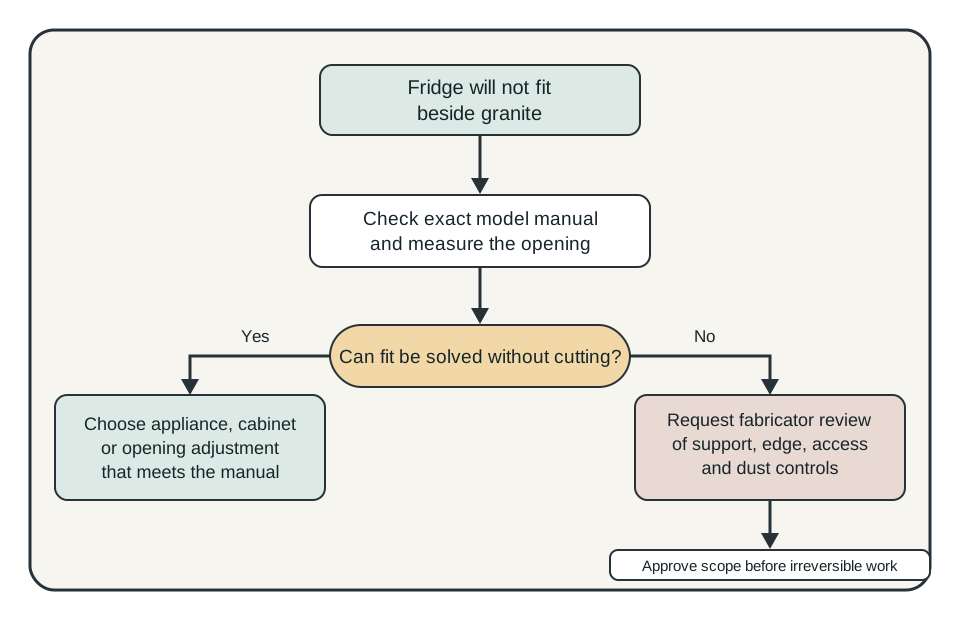
Suppose a new refrigerator catches on a granite overhang and the apparent shortage is about half an inch. Before treating the stone as the problem, verify what the exact appliance requires and whether the opening was measured under the correct installation conditions. Whirlpool says the model-specific owner’s manual or installation instructions should supply the refrigerator’s requirements (Whirlpool installation guidance). The decision sequence is to verify the fit, compare non-stone alternatives, assess the edge and dust risks, and only then compare DIY exposure with a fabricator’s scope.
Does the refrigerator require a granite cut?
In one homeowner’s case, the first question was whether the cut was needed at all. They asked whether the opening had been measured correctly and whether the refrigerator required the assumed side and ventilation clearances. The homeowner maintained that the measurements had been taken and that the combined shortage across the opening required the proposed trim, but did not provide the manufacturer’s clearance value in the available account. Other homeowners proposed avoiding the stone by exchanging the appliance for a smaller or counter-depth model, moving or spacing cabinetry, or changing an adjacent wall surface. The wall ideas were speculative and were not checked against construction requirements. It remained unresolved whether the reported shortage required granite alteration.
Locate the refrigerator model identifier, obtain the matching manual and compare the documented installation conditions with measurements of the opening. Record any requirements affecting clearance, door movement and grille airflow rather than substituting a generic online gap. Whirlpool’s guidance also says nearby heat sources, cabinet doors and an obstructed base grille can affect acceptable placement (Whirlpool installation guidance). If the model documentation is ambiguous, ask the manufacturer to interpret it before approving an irreversible alteration.
Is this installation a reasonable DIY candidate?
The dominant view was that the comparison involved more than a diamond blade. Homeowners counted cutting equipment, abrasives or polishing pads and scrap stone for practice. Several said buying or renting those items could approach the quoted small-job price before accounting for damage to the countertop. Self-described fabricators described installed alterations as carrying enough breakage exposure that some shops declined them or disclaimed responsibility. Those were personal accounts, not verified failure statistics or a general industry policy. Homeowners also focused on the edge, including built-up construction, reshaping, progressive polishing, chips, cracks and difficulty matching the existing finish. Claims about the stone variety, brittleness, mesh backing and the number of edge layers were guesses rather than confirmed facts. A concealed edge was said by some to reduce the visual finishing expectation, but others still regarded edge completion as necessary.
Inspect the proposed cut path for a shaped or built-up profile, seam, reinforcement, backing and the support that would remain. If an assessment determines that the cut requires the edge profile to be rebuilt, the linked Granite China repair guide recommends professional shop or site work and notes that profiling and finish blending may require specialist equipment. Treat uncertain construction as a reason for fabricator review, not as proof that the edge is simple. Concealment can lower the cosmetic expectation, but it does not establish structural stability.
The DIY disagreement remained genuine. Some participants reported completing similar work with rented wet-cutting equipment or an angle grinder fitted with a diamond blade. They described it as manageable when they already had suitable tools, practiced on scrap and worked slowly. A minority suggested that a refrigerator-hidden edge might not need a high-level visual finish. Opponents, including self-described fabricators, argued that an installed countertop should not become practice material and emphasized the possibility of losing the slab. Neither camp supplied a general success rate. Their disagreement turned on existing equipment, comparable practice material, finishing expectations and willingness to accept complete countertop loss.
A separate finishing dispute concerned the edge after it was hidden by an appliance. Some homeowners said a concealed cut could remain without a matching polish if it stayed dry. Others insisted that polishing and sealing were part of completing the work even when the refrigerator would block the view. The accounts did not resolve that disagreement for the actual stone. It also did not confirm the material identification, backing or built-up edge construction that several people inferred.
The DIY alternatives were not all proposals to alter the same exposed edge. A minority suggested removing the countertop and cutting the side next to the stove so that the new edge would be concealed. That proposal did not establish that removal, the other cut location or the resulting fit would work in this kitchen. The homeowner supplied no later outcome establishing which finishing approach or cut location was eventually chosen.
Compare the complete DIY exposure with a scope-based fabricator quote: equipment, abrasives, practice material, containment, cleanup, edge finishing and the financial consequence of replacing the countertop. The repair guide says relevant quotation factors include access, edge profile, finish, travel, dismantling, repolishing and correction of underlying support (Granite China repair guide). DIY is a poor economic choice if its counted costs approach the qualified fabricator’s quote or if countertop replacement would be unaffordable. Evaluate sealing only after stability and required finishing are resolved. The granite sealing guide says sealer cannot compensate for cracks, unsuitable substrates or incorrect installation.
Can the location and dust risks be controlled?
Homeowners disagreed about cutting in place or after removing the countertop. Removal was described as safer or more controllable for dust, but others warned that the countertop could be heavy, bonded to the cabinets and vulnerable to cracking during removal. Those favoring an in-place cut repeatedly mentioned wet cutting, plastic containment, exhaust, vacuum collection and respiratory protection. The available account did not establish which option suited this installation, or how the countertop was bonded. It also did not verify the stone variety or backing. The competing approaches therefore carried risks on both branches without establishing that either branch was safe for that countertop.
Make exposure control an approval gate rather than a cleanup assumption. OSHA and NIOSH identify silica exposure as a hazard during natural- and engineered-stone countertop manufacturing, finishing and on-site installation, and granite is among the natural materials that can contain crystalline silica (OSHA/NIOSH countertop alert). OSHA also explains that cutting, sawing, grinding or drilling stone can create respirable crystalline-silica particles (OSHA silica overview). Have a qualified contractor specify controls appropriate to the actual work and site. Reject uncontrolled dry cutting in an occupied kitchen.
How should you compare fabricator proposals?
Homeowners disagreed over whether the small-job estimate was reasonable. Some believed preparation, travel, cleanup and breakage exposure explained it; others thought the alteration should cost less. The amounts discussed were individual experiences and a southeastern US quote, not a current regional market survey. The homeowner later asked how to locate a countertop worker willing to accept a private small job after a recommended person was unavailable. Some homeowners informally suggested off-hours cash work, but the available account did not provide an actionable sourcing method or confirm that such an arrangement occurred.
Request scope-based proposals rather than comparing an isolated price. Give each fabricator the refrigerator model, opening measurements, photographs, proposed cut location, edge profile and access information. Ask the proposal to state whether work is in place or requires dismantling, what edge finish is included, how dust will be controlled and what breakage exclusions apply. The repair guide advises readers to “Obtain a scope-based quotation rather than relying on a generic per-chip figure” (Granite China repair guide). Compare proposals only after their assumptions and included work are visible.
The homeowner’s final choice—cutting the granite, exchanging the refrigerator or changing cabinetry or a wall—was not reported. Other homeowners’ successful DIY experiences do not establish that the same approach suits this kitchen.
Granite sealing guide · Granite chip and edge repair guide
Final decision checklist
Use this order before approving work:
- Obtain the exact refrigerator manual and confirm the required installation conditions against fresh opening measurements.
- Price the feasible non-stone alternatives before treating granite alteration as unavoidable.
- Have the cut path assessed for its edge profile, seams, reinforcement, backing and remaining support.
- Obtain scope-based fabricator proposals and compare them with the full DIY cost and countertop-loss exposure.
- Require an explicit silica-control plan for any work in or near an occupied area.
- Resolve structural stability and required edge finishing before considering an absorption-based sealer decision.
Whirlpool directs readers to the model-specific manual for refrigerator requirements, while OSHA states that dry-cutting stone generates dangerous crystalline silica dust (Whirlpool installation guidance; OSHA/NIOSH countertop alert). Choose a non-stone solution or defer the installation if a required appliance specification, structural condition or exposure control remains unresolved.
Sources
- Reddit discussion · r/CounterTops · 240 comments
- Whirlpool installation guidance
- OSHA/NIOSH countertop alert
- OSHA silica overview
Questions & discussion
Share a question or a useful experience about this guide. Comments appear immediately. Your name and comment are public. Email is optional and stays private; reply emails are not enabled yet. Comment privacy.