
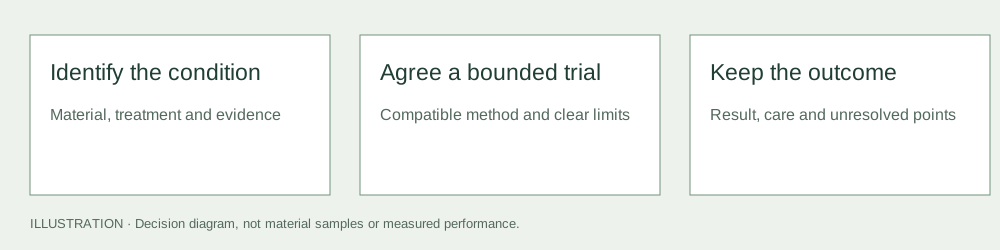
If a granite countertop has become cloudy, scratched, sticky or uneven after an epoxy treatment, identify the product and what was applied before choosing a remedy. A surface coating, resin used to fill stone, a seam adhesive and a penetrating sealer do different jobs. Calling all of them epoxy or sealer can lead to the wrong repair.
Avoid more coatings, aggressive solvents or abrasive trials while the product is unknown. Retain the container, batch information, invoice and installer instructions, and photograph the full surface and the affected areas. This guide has not examined the coating or established whether it is safe for food contact.
Determine what is on the stone
Ask the installer for the exact product, intended application, preparation, mixing and curing instructions, and any other layers beneath or above it. Record when it was applied and when the problem appeared. A material described as granite may also have factory resin, repairs or an earlier treatment that needs to be identified.
Use the stone-identification background and sealing guide to keep stone identity and treatment identity separate. A product meant to bond a seam is not automatically approved as a full-surface topcoat. A statement that something is clear epoxy does not settle either use.
Describe the problem without guessing the cause
| Observation | Information to collect | Question for the installer or specialist |
|---|---|---|
| Cloudy or milky areas | Dry appearance, lighting, application history | Is the change within the coating, residue or the stone beneath? |
| Sticky or soft surface | Exact products and application record | Has the material cured as intended, and what does the manufacturer require? |
| Scratches or loss of sheen | Overall and close views, cleaning history | Is repair possible without leaving a different surface finish? |
| Peeling or local separation | Edges, wet areas and preparation history | What is the adhesion condition and underlying cause? |
| Darkening or colour shift | Before/after references and treatment identity | Is the change reversible for this system? |
These observations cannot establish a chemical diagnosis from a photograph. Do not assume that a cosmetic defect proves danger or that an attractive surface proves correct curing and suitability.
What may be recoverable
A qualified restoration specialist and the product manufacturer should decide whether local treatment, controlled removal, refinishing or replacement is feasible. Recovery depends on the actual system, adhesion, the condition of the underlying stone, the finish and access to the work.
AKEMI’s AKEPOX 5000 page describes a particular professional resin product and its intended uses. That illustrates why an exact product identity matters; it does not justify applying that product’s claims to another coating. Nor does it establish that a full-surface coating can be stripped from your top without altering the finish.
Ask for a limited trial area and an agreed appearance target before committing to whole-surface restoration. Keep any trial approval and the resulting limitations in writing. Do not force a promise of original appearance where the specialist cannot support it.
Food-contact suitability: what remains unanswered
Food-contact suitability of an unidentified existing coating: Not established. A generic epoxy description, a dry-to-touch surface or an unrelated product certificate is insufficient to settle it.
Ask for documentation for the exact product and intended use, including application and curing conditions and the manufacturer’s limitations. If the documents do not settle whether the applied system is appropriate for the proposed contact, leave the question unanswered and ask the manufacturer or an appropriately qualified professional. Do not perform a taste, smell or improvised solvent test to decide food safety.
While that question is unresolved, avoid direct food preparation on the uncertain surface and use an appropriate separate food-preparation surface. This is a practical boundary, not a declaration that every epoxy-treated stone is unsafe or that a particular certification has been verified here.
Avoid turning restoration into a larger problem
Do not mix cleaning chemicals, use heat to accelerate an unknown cure or sand the surface as a diagnostic trial. The Natural Stone Institute’s care guidance emphasises compatible methods for the identified surface. Products that remove one film can also affect stone treatments, repairs or fittings.
If removal or stone grinding is proposed, require a competent method, protection of adjacent areas and the appropriate dust and chemical controls. OSHA’s silica overview is relevant where the work reaches or abrades stone; it is not a safe-work plan for a particular restoration.
Close the repair with usable records
Keep the product identification, original application details, trial findings, agreed finish, final care instructions and unresolved issues together. Compare the result under the agreed lighting after the manufacturer-specified process is complete.
For a different problem, consult sealer haze and discoloration and general stone repair. Do not copy those remedies onto a topical coating without checking that the cause and product are the same. This guide offers no universal removal chemical, cure time or assurance of recovered appearance.
Questions & discussion
Share a question or a useful experience about this guide. Comments appear immediately. Your name and comment are public. Email is optional and stays private; reply emails are not enabled yet. Comment privacy.