
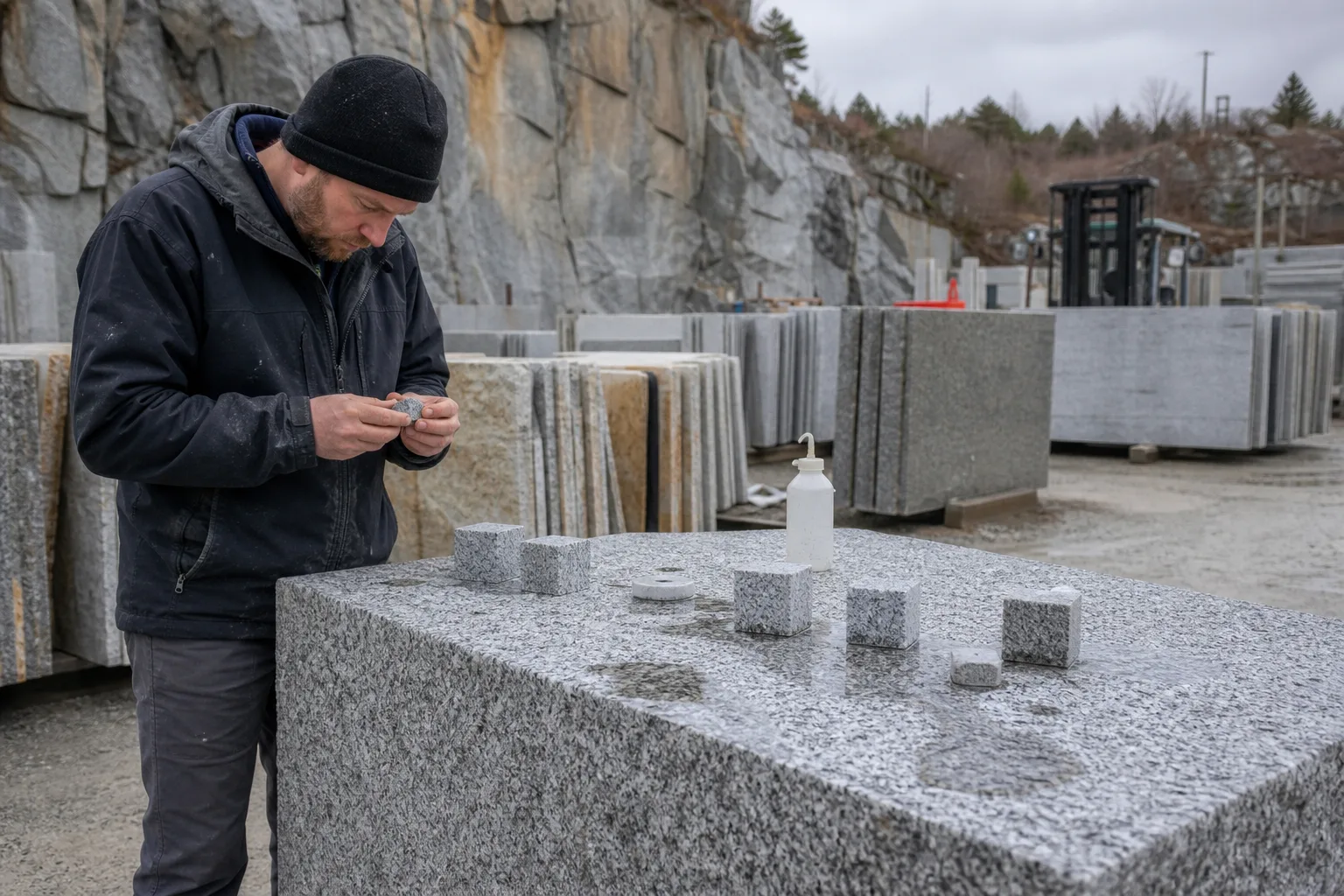
Granite generally has good potential for use in freeze-thaw climates, but no stone should be approved for exterior work solely because it is sold as granite. Granite freeze thaw resistance depends on the specific stone, its connected pores and fissures, degree of weathering, production condition, water exposure and installation design. For a defensible specification, identify the material, review representative absorption and strength results, define any required exposure test and acceptance criteria, and inspect the production lot before shipment.
Key numbers
| Indicator | Reference value or method | Standard and limit |
|---|---|---|
| Water uptake | ASTM C97/C97M | Use the project’s absorption limit; no universal frost pass value |
| Freeze-thaw exposure | Named protocol such as EN 12371 | Specify cycles, conditioning and retained properties; no common cycle count imposed |
What freeze-thaw resistance means for granite
Freeze-thaw deterioration becomes possible when water enters accessible pores, grain boundaries, veins or cracks and then freezes. Repeated wetting, freezing and thawing can enlarge existing weaknesses or reduce mechanical performance. The risk is therefore not determined by winter temperature alone. The stone must also become sufficiently wet, and the assembly must retain that moisture long enough for freezing to occur.
Granites are not uniform products. Two materials carrying similar color descriptions may differ in mineralogy, grain size, alteration, microcracking and water absorption. Even stone from one source may vary between quarry areas or production blocks. ASTM C1721 recognizes the need to classify dimension stone both commercially and geologically and to examine characteristics that may affect performance in the intended use.[1]
Conditions that increase exposure
- Horizontal paving, stair treads and coping where snow, rain or meltwater can remain on the surface.
- Low points, blocked drainage paths, poorly filled joints and saturated bedding layers.
- Thin units, narrow projections, sharp internal corners or pieces weakened by fabrication.
- Open fissures, altered mineral zones, edge cracks or repairs exposed to recurring moisture.
- Deicing salts or other contaminants acting together with wetting and temperature cycling.
A dense-looking polished sample is not, by itself, evidence of frost durability. Appearance can help identify visible defects, but laboratory data and assembly design address different parts of the risk.
Geological identity, trade names and finishes
Geological identity versus a commercial name
A trade name is useful for purchasing and visual approval, but it may not define one geological material or one quarry source. Names can be translated, abbreviated or reused in different markets. The purchase specification should therefore record the approved trade name together with supplier material code, declared source, geological description when available, reference sample and test-report identifiers.
For demanding exterior applications, petrographic examination can help document mineralogy, texture, alteration, veins and other features relevant to performance. It does not replace physical testing, and a report for one source or block should not automatically be assigned to visually similar material from another source.
Finish is a separate decision
Polished, honed, flamed, bush-hammered, split-face and sawn surfaces are finishes rather than geological identities. Polishing creates a reflective surface, honing produces a lower-sheen surface, and flamed or bush-hammered processing creates a more pronounced texture.[5] The finish affects appearance, cleanability, surface drainage and pedestrian use, but it should not be treated as a substitute for suitable stone or drainage design.
Where freeze-thaw exposure is critical, approve the actual finish, thickness and edge treatment. If testing is commissioned, specimens should represent the proposed material and, where technically relevant, the production condition. A result obtained from sound polished laboratory pieces may not answer every question about heavily textured paving units or fabricated components.
Applications and installation factors
Paving, patios and driveways
Exterior paving receives direct precipitation and may be exposed to standing meltwater. Specify positive drainage, suitable slopes, open or properly filled joints, compatible bedding and a base that does not hold water against the stone. Unit thickness, traffic loading and edge support must be designed for the application; freeze-thaw resistance does not compensate for an under-designed pavement.
Stairs, coping and landscape work
Stair treads, wall caps and coping often have exposed edges and horizontal surfaces. Drip details, overhangs, sealed penetrations and correctly formed slopes can reduce persistent saturation. Avoid uncontrolled notches and sharp internal corners that concentrate stress. Review finish and slip-resistance requirements separately from frost durability.
Facades and exterior cladding
For facades, evaluate the complete cladding system rather than the stone alone. Water management, cavity drainage, anchors, joints, sealants, panel dimensions and wind or structural loads all affect service performance. ASTM C615 covers granite dimension stone used for purposes including cladding, paving and landscape features and lists physical-property requirements such as absorption, density and several strength measures.[2] Project engineers must still establish application-specific design values and acceptance requirements.
Outdoor countertops
An outdoor countertop may see fewer saturation cycles than paving, but exposed sink cutouts, unsupported overhangs, seams and unprotected edges require attention. Confirm that water cannot collect around penetrations or behind the stone. A sealer may assist with maintenance for some materials, but it does not convert unsuitable stone or defective detailing into a freeze-thaw-resistant installation.
Specifications and testing
Absorption is a useful screening property because it measures water uptake under a defined procedure. ASTM C97/C97M is intended to determine absorption and bulk specific gravity and to assist comparisons among dimension stones.[3] A lower result may support a durability assessment, but absorption alone does not describe pore connectivity, fissures, alteration or the behavior of a finished assembly. Do not create an unsupported universal pass value for every application.
Natural-stone laboratories may offer freeze-thaw exposure using methods including ASTM C666, ASTM C1645 or EN 12371, alongside absorption, compressive strength, flexural strength and petrography services.[4] Some listed methods originated for materials other than dimension-stone products or may require project-specific adaptation. The specification must identify the exact procedure, specimen condition, number of cycles, observations, pre-test and post-test measurements, reporting format and acceptance rule.
| Specification item | Evidence to request | How to use it | Important limitation |
|---|---|---|---|
| Material identity | Trade name, material code, source declaration, approved sample and optional petrography | Confirm that orders, reports and inspected goods refer to the same stone | A similar color or name does not prove identical geology |
| Water absorption | Current ASTM C97/C97M report from representative specimens | Compare production material with the approved technical basis | Absorption is a screening property, not a complete frost rating |
| Baseline strength | Applicable ASTM C170, C880 or C99 results as required by the design | Establish relevant mechanical properties before exposure or installation | Laboratory strength is not a substitute for system engineering |
| Freeze-thaw exposure | Named protocol, specimen details, wetting regime, cycle count and pre/post results | Assess visible change, mass change or retained properties against project criteria | Results from different protocols may not be directly comparable |
| Production conformity | Lot references, block or bundle numbers, inspection records and retained sample | Link shipped goods to the approved material and reports | An old generic report may not represent the current lot |
| Installation system | Approved drawings, drainage details, joint design and installation method | Limit saturation and accommodate movement and loads | Good stone can still fail in a water-trapping assembly |
Write measurable acceptance criteria
A requirement such as “granite must be frost resistant” is difficult to enforce. State what constitutes failure: for example, visible cracking or spalling, unacceptable dimensional change, excessive mass loss, or a project-defined reduction in a relevant mechanical property. The responsible specifier should select the criteria based on the application, climate, safety consequences and test method. Avoid copying a criterion from an unrelated stone, thickness or exposure protocol without technical review.
Inspection and quality-control checklist
Inspection cannot prove decades of durability, but it can identify material substitutions, visible defects and production differences that invalidate the approval basis. Coordinate document review, sample approval and physical inspection rather than treating them as independent tasks.
Before ordering
- Record the trade name, supplier code, declared geological type and declared material source.
- Approve representative samples showing the acceptable range, not only one selected piece.
- Confirm that test reports identify the laboratory, method, edition, dates, specimen orientation and reported material.
- Check whether reports represent the proposed source, finish and thickness closely enough for the project.
- Define visual limits for open cracks, loose minerals, excessive fissures, repairs, rust-prone inclusions and edge damage.
- Approve dimensions, tolerances, finish reference, edge profile, anchoring work and packaging requirements.
During production and before loading
- Compare units or slabs with the signed control sample under consistent lighting.
- Record block, crate, pallet or bundle references where the factory maintains them.
- Inspect wet and dry surfaces when dark spots, repairs or fissures are difficult to distinguish.
- Check thickness, length, width, squareness, flatness and finish consistency using the agreed sampling plan.
- Examine corners, cutouts, anchor slots and textured surfaces for fabrication-related damage.
- Verify that pieces are dry enough for packing and separated, restrained and protected against edge impact.
- Photograph inspected lots and reconcile quantities with the packing list before container sealing.
If the inspected material differs materially from the tested or approved sample, obtain clarification and, where risk warrants it, repeat relevant tests. Do not resolve a source substitution only by accepting a new photograph.
China sourcing context and price factors
China-based stone companies may act as quarry-linked producers, independent fabricators, exporters, trading companies or combinations of these roles. A supplier's location does not establish the quarry origin of the stone, and granite processed in China may be domestically quarried or imported. Ask which entity controls raw-material selection, finishing, testing, packing and export documentation. Any claimed quarry ownership, exclusivity or in-house capability should be verified rather than inferred from a listing.
Documents to align with the purchase order
- Exact stone name and internal material code.
- Declared country and source of the raw stone where origin is contractually important.
- Approved range samples, mockup records and dated finish reference.
- Applicable test reports and a statement linking them to the offered material.
- Drawing revision, piece schedule, tolerances and defect criteria.
- Inspection point, sampling level, corrective-action process and rules for substitutions.
What affects cost
Freeze-thaw suitability does not have a single price premium. Cost may be affected by raw-block selection, rejection rate, slab or unit thickness, finish, cut-to-size complexity, testing, mockups, inspection, protective packing, quantity and shipping terms. Tighter color or defect limits can reduce usable yield. Project-specific exposure testing also adds lead time because specimens must be prepared, conditioned, cycled and evaluated.
Compare quotations on a common technical basis. A lower offer may exclude testing, special packing, dry-lay review, replacement allowance or third-party inspection. Conversely, a higher quotation is not evidence of better frost performance unless the material identity, reports and quality controls support that conclusion.
Procurement conclusion: approve granite for freeze-thaw exposure through traceable evidence, not reputation alone. Match the report to the stone, match the specimens to the intended product, establish measurable acceptance criteria, design drainage and inspect the production lot. Where failure could affect structural safety, accessibility or public areas, the final specification should be reviewed by the responsible architect, engineer or qualified stone consultant.
Stone properties
density and weight · compressive strength · water absorption · slip resistance · water-drop screening · sizes and tolerances
Frequently asked questions
Is all granite resistant to freeze-thaw weathering?
No. Granite is a broad commercial category, and individual stones differ in pore structure, fissures, mineral alteration and production condition. Approve the specific material using traceable identity, representative test data and project-specific exposure requirements.
Does low water absorption prove that granite is frost resistant?
Low absorption is useful evidence, but it is not conclusive by itself. It does not fully describe connected fissures, weak mineral zones, fabrication damage or water retained by the installation system.
Which test should be specified for granite freeze-thaw resistance?
There is no useful specification without a fully identified protocol. State the method, specimen dimensions and condition, wetting regime, cycle count, pre-test and post-test measurements, reporting requirements and acceptance criteria. A qualified project specifier should select the protocol.
Can a sealer make exterior granite freeze-thaw resistant?
A compatible sealer may reduce water uptake or staining in some conditions, but it is not a substitute for suitable stone, drainage, movement joints and correct installation. Do not accept a frost-resistance claim based only on sealing.
What should be checked when sourcing exterior granite from China?
Verify the stone identity, declared raw-material source, relationship between the supplier and fabricator, applicable laboratory reports, approved samples, production-lot consistency, dimensions, visible defects, packing and any proposed substitution before shipment.
Questions & discussion
Share a question or a useful experience about this guide. Comments appear immediately. Your name and comment are public. Email is optional and stays private; reply emails are not enabled yet. Comment privacy.