
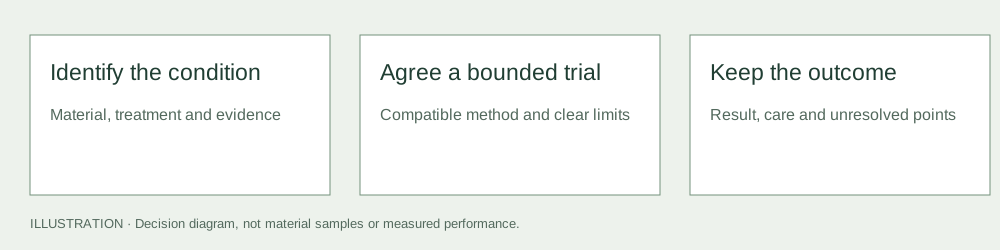
A broken granite corner needs an assessment of the stone and its support, not just a matching adhesive colour. Keep loose fragments and photographs, avoid loading the damaged area, and contact a competent stone fabricator or restoration specialist. Do not attempt to prove that the piece is secure by leaning on it or moving it repeatedly.
The useful decision is whether the actual assembly can be repaired acceptably, needs reinforcement or requires replacement. This guide provides the questions for that assessment. It does not prescribe a rod position, a groove dimension or a do-it-yourself structural repair.
Keep the evidence before a repair changes it
Photograph the whole countertop, the break, adjacent seams and the surrounding cabinets or supports without putting yourself beneath unstable stone. Keep any detached fragments safely aside and note when the damage was discovered. Record known impacts, recent appliance or cabinet changes and any earlier repair, but distinguish observations from assumptions about the cause.
If the top is newly supplied or recently installed, notify the responsible party before commissioning a repair that could obscure the evidence. The edge-damage decision file helps organise photographs and dispositions. A visible break does not by itself establish whether the original cause was material, fabrication, handling or support.
Ask what remains sound and supported
Have the specialist inspect the remaining stone, fracture path, fragment fit, edge profile and nearby cutouts or seams. Ask whether the support, movement or fixing conditions contributed and whether they need correction before the repair can be judged complete.
The Natural Stone Institute’s homeowner countertop reference treats support, reinforcement and repairs as parts of countertop planning. It is background for a professional assessment, not proof that the damage shown in a photograph can be repaired.
Rodding and related reinforcement are designed measures
Rodding places reinforcement in a prepared part of the stone assembly. Other arrangements may use appropriate support or reinforcement systems selected for the material and geometry. A professional must decide whether a proposed method is suitable and whether preparation itself could damage the remaining stone.
Tenax’s professional rodding product shows that this is a dedicated adhesive-and-reinforcement application. The manufacturer’s product page does not tell a homeowner where to cut an installed top or establish that a particular repaired corner will recover its original capacity. Do not substitute an arbitrary metal strip or household adhesive on that basis.
Ask the fabricator to describe the intended support and reinforcement, the products used and the limitations of the result. Keep those statements separate from any claim about how invisible the repair will look.
Compare repair and replacement on the same basis
| Assessment | Repair may remain worth investigating | Replacement deserves serious consideration |
|---|---|---|
| Remaining material | Specialist finds a coherent repairable area | Important material is missing or surrounding stone is compromised |
| Support | A clear, achievable correction is identified | The underlying support problem cannot be resolved acceptably |
| Appearance | A sample or agreed example establishes acceptable visibility | The required appearance cannot reasonably be matched |
| Scope and access | Work can be done with an appropriate safe method | Removal, access or repeated failures make repair unsuitable |
| Responsibility | Written scope, limits and acceptance can be agreed | No accountable proposal addresses the essential questions |
These are decision prompts, not a remote diagnosis. A repair that restores ordinary use may still leave a visible line. Ask what the specialist can actually warrant and which outcome would require a different remedy.
Find the right fabricator and approve the work
Look for relevant installed-stone repair experience, not only general building work. Send overall and detailed photos, the stone and finish information, measurements that can be taken safely, and the original installation records if available. Ask for an inspection where photographs cannot settle support or fracture questions.
Approve the repair scope, expected visibility, any finish restoration, curing and return-to-use instructions, and how the completed result will be inspected. Follow the actual product and specialist instructions rather than a generic internet curing time. Cutting or grinding stone can create hazardous dust; OSHA’s silica reference explains why uncontrolled dry work is not an acceptable shortcut.
Keep the completed repair record with the general repair guide and the original damage evidence. If the cause or a critical acceptance question remains unresolved, record that limit instead of treating a cosmetically improved corner as proof of a sound assembly.
Questions & discussion
Share a question or a useful experience about this guide. Comments appear immediately. Your name and comment are public. Email is optional and stays private; reply emails are not enabled yet. Comment privacy.