
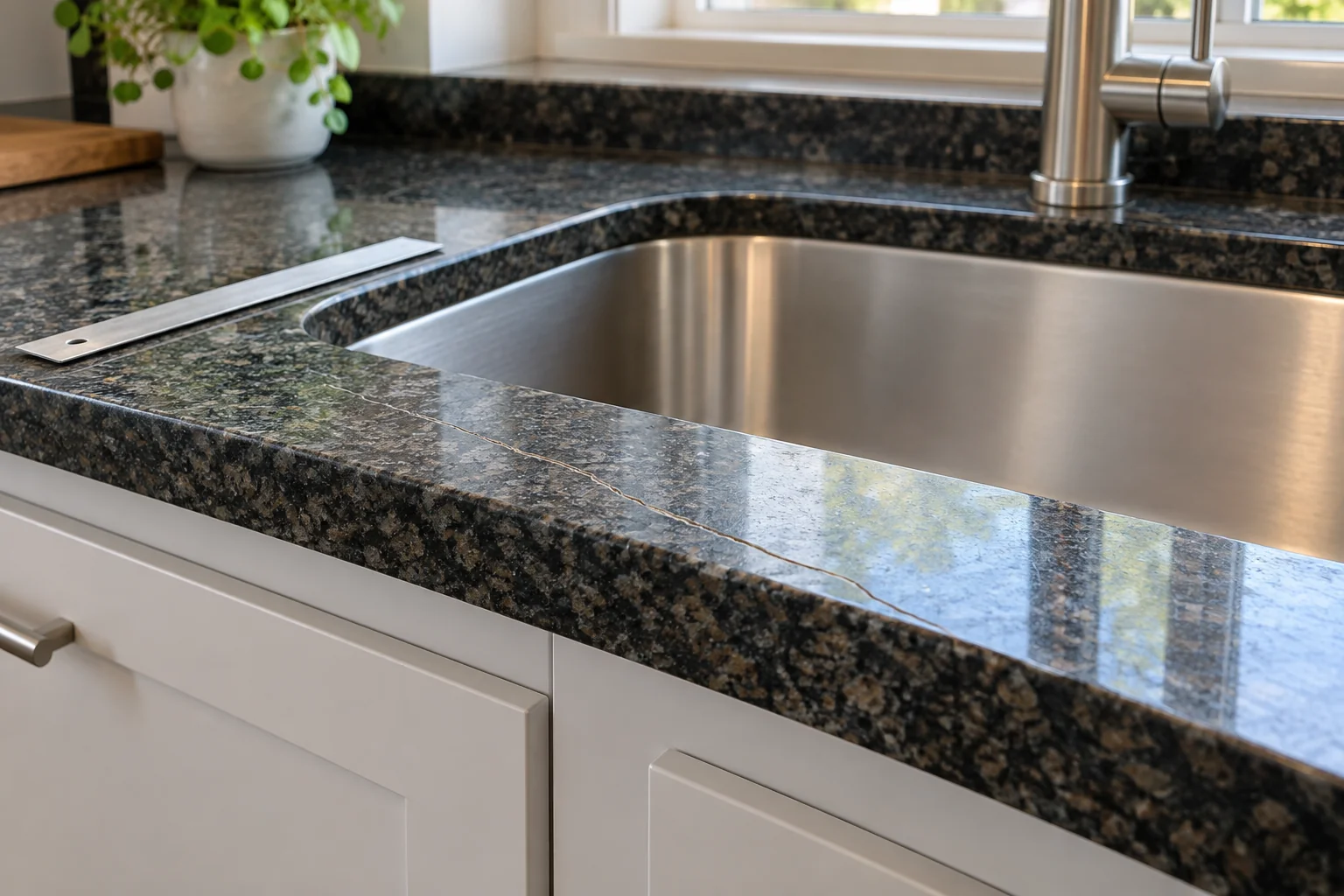
1. A crack by the sink: start with stability
A hairline along the narrow granite strip in front of a sink can remain visible long before a piece separates. If the line has grown, opened, changed level or begun to move, stop using that area and arrange an assessment by an experienced stone fabricator or restorer. A photograph cannot establish whether the strip will break or how much load it can carry.
One homeowner noticed a line that slowly grew over time. Appearance was tolerable; the concern was whether the front strip might eventually fall away. The choice was not simply which color of filler to buy. It was whether the strip and sink were adequately supported, what had caused the change, and whether a repair could address those conditions.
Keep heavy pots and pressure off the affected rail. If a piece is loose, detached or seems close to falling, keep people away from it and request prompt professional help. Do not push on it to test its strength or reach under an unstable piece.
2. Identify the part that is changing
The sink rail is the strip of countertop between the sink opening and the front edge. Its narrow shape leaves less material around the cutout than elsewhere on the slab. A line across that area deserves a different inspection from a small chip in an otherwise stable edge.
A natural fissure may be part of the stone’s appearance, while a crack may show a change, gap or displacement. These clues are not a reliable diagnosis on their own. Photograph the line straight on and from an angle, with a ruler beside it, and note where it begins and ends. Compare photographs taken from the same position under similar light; a change in angle or reflection can make a line appear longer.
If a corner has already separated, the corner-break guide addresses that different damage pattern. The general repair guide explains when ordinary chips and other damage need a professional. This guide focuses on the narrow area at the sink, including support and moisture questions.
3. Ask what lies beneath the rail
Some fabricators reinforce narrow areas with rods embedded in grooves on the underside. The LSI Stone’s stone terminology guide describes this practice, including metal and fiberglass rods. It does not establish that every countertop has a rod or identify one in a particular kitchen.
A stone repairer documented a crack behind a sink where a wet, rusted metal rod was found beneath the stone. That case illustrates a possible mechanism; it does not prove that rust caused your crack. Marble Restoration & Stone Care: Rusted Rod Crack Behind a Kitchen Sink.
Other conditions worth asking about include an unsupported area, movement at the cabinet or sink, and an existing weak area in the stone. A dark line by itself cannot identify any of them. Without disturbing the installation, note visible staining, moisture, failed sealant or gaps you can safely see. Do not remove cabinet parts, pull on the sink or assume the concealed support is sound because it is out of sight.
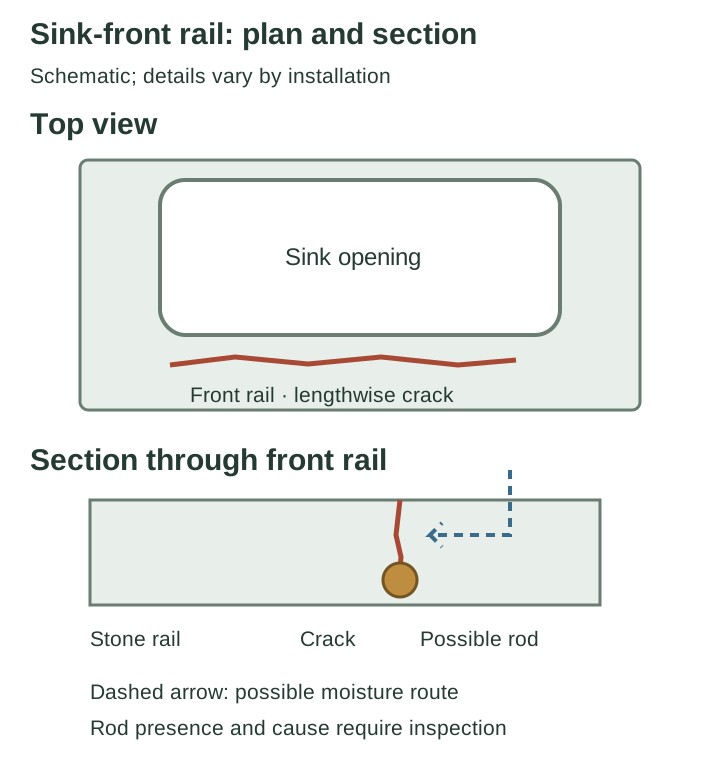
The cross-section shows one possible arrangement, not what is necessarily under your countertop. Have the repairer determine whether reinforcement exists, what it is made of, whether it has corroded, how the sink is supported and where moisture may be entering. The sealing guide covers stain protection; a surface sealer should not be treated as a repair for a loose sink or failed support.
4. Record changes without making them worse
Write down when you first noticed the line and whether it has lengthened, widened, become uneven or produced loose material. Take dated photos and note any leak or water accumulation. If you cannot tell whether it is moving, say so: an uncertainty is more useful to the repairer than a guessed diagnosis.
Arrange an assessment rather than a cosmetic fill if the crack is growing, the edges have shifted, the rail has a visible gap, a section is loose, or you suspect the sink or its support has moved. A repairer may need access beneath the sink to assess support and reinforcement. Ask what they will inspect and whether the sink or plumbing needs to be disconnected for access.
A line that looks unchanged is not a strength test. Avoid standing, leaning or placing heavy items on the strip while the condition is being assessed. If active leaking is involved, address the water source with the appropriate professional as well as asking the stone specialist to inspect the rail.
5. Separate appearance, stability and strength
A professional may use a compatible, color-matched stone adhesive to bond or fill a crack, then refine the finish where appropriate. The Natural Stone Institute’s restoration guidance discusses different adhesives and crack types; the procedure must match the condition and the product instructions.
Appearance: Matching dark, speckled stone can require more than one color. A fine repair may be unobtrusive, while a shifted or open crack can remain visible. Ask to see comparable completed work and agree what level of visibility is acceptable. No one can promise an invisible line from a photograph alone.
Stability: Filling the visible line is not the same as fixing inadequate support, movement or a corroding rod. A plan to stabilize the rail should explain the cause being addressed, how the sink and stone are supported, and what happens if hidden damage is discovered.
Strength: An adhesive can bond stone, but a surface fill does not establish that an installed rail has regained its original strength or that it cannot separate. The result depends on the crack, preparation, support and repair system. Ask the specialist what the proposed work is intended to achieve and what limits remain. Do not assume sealing after polishing restores structural strength.
There is no reliable service-life or yellowing interval for an unidentified adhesive in this setting. A repair that looks good on completion still needs a follow-up plan appropriate to the actual condition and use.
6. Choose a repairer and compare the scope
For a crack that may affect a thin, loaded or supported strip, look for a stone fabricator or restoration specialist who handles installed countertops. Ask the original installer if available; a local natural-stone fabricator may also be able to identify a repair specialist. Describe it as a longitudinal crack in the granite rail in front of the sink, mention any change over time, and provide the dated photos and dimensions. Ask whether they accept small in-place repair jobs.
Request a written scope that answers:
- Will the visit include an assessment of the rail, sink support, moisture and possible concealed reinforcement?
- Is the quoted work cosmetic filling only, or does it include a stabilization plan? What happens if corrosion or insufficient support is found?
- Who disconnects and reconnects the sink and plumbing if access is needed, and who repairs affected cabinet finishes?
- What finished appearance is realistic, what follow-up is included, and which conditions are excluded from the quote?
Compare the same scope rather than an isolated price. No reliable project-specific quote or duration was established for this example, and concealed work can change the proposal. Ask for a revised price before approving additional work.
Do not grind or polish the rail as a household experiment. Cutting, drilling and grinding stone can release respirable crystalline silica. Canadian Centre for Occupational Health and Safety guidance identifies these operations as exposure sources; the professional should plan appropriate exposure controls for the actual work and occupied home.
7. Compare repair, an apron-front sink and replacement
A color-matched repair can be sensible when the fabricator finds a workable way to stabilize the rail and address the underlying issue, and the owner accepts the likely appearance. That conclusion must follow an inspection of the actual installation. It is not a promise that every crack can be repaired in place.
An apron-front or farmhouse sink may eliminate the damaged front strip in some layouts, but it is a remodeling project, not a universal shortcut. A fabricator and cabinet installer need to check the new sink’s dimensions and support, the remaining stone, cabinet modifications, plumbing, access, dust controls and the risk of further breakage. Get a specific proposal before buying the sink or authorizing a cut. A homeowner’s difficulty finding someone willing to cut an installed counter is a useful question to ask prospective contractors, not a rule about the entire trade.
Replacing the affected slab or counter run may be appropriate when a safe, acceptable repair is not feasible or when remaining damage and movement make other options unattractive. Clarify whether the quote covers removal, matching or replacing adjacent pieces, sink support, plumbing reconnection and disturbed finishes. Matching natural stone can be difficult, and changing the whole kitchen is not necessarily the only replacement scope.
Additional support beneath the rail may form part of a professional plan. Its location, attachment and load path depend on the cabinet, sink and stone; a loose board, metal plate or newly installed rod is not a proven universal fix. If an existing rod is corroded, ask how the professional will deal with it and the moisture source. Do not assume covering the crack makes the concealed problem stop.
8. Before the visit, gather the details
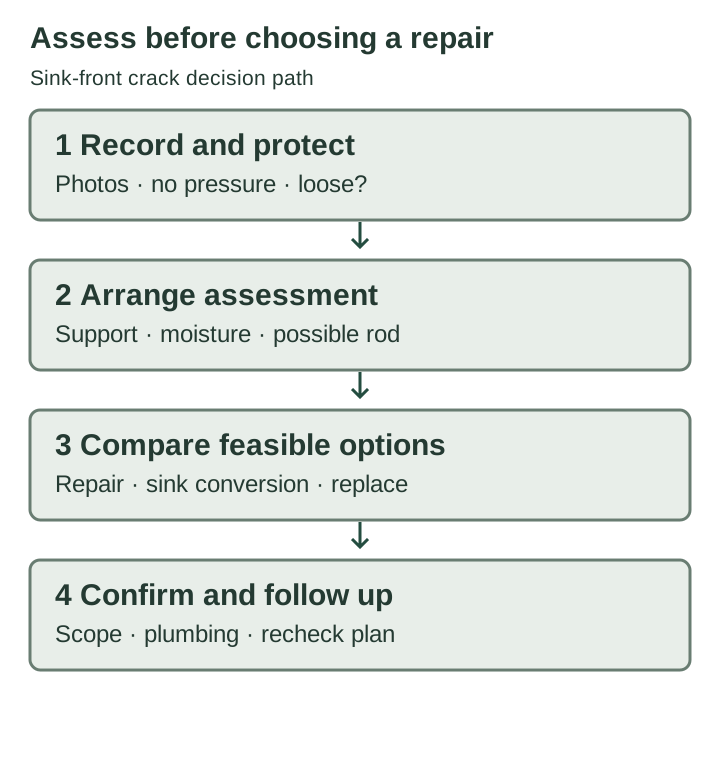
- Record the crack’s location and visible length with dated photographs; note any change rather than forcing the stone to see if it moves.
- Keep weight and pressure off the strip; request prompt help if a piece is loose, displaced or at risk of falling.
- Note moisture and visible gaps only where safe, and ask the specialist to assess concealed support and any rod.
- Agree whether the proposed work addresses appearance, stability or both, and what strength claims can actually be supported.
- Obtain comparable written scopes for repair, sink conversion or replacement where each is feasible.
- Agree who handles plumbing and cabinet work, what happens if hidden damage appears, and when to check the repair again.
The useful outcome is a documented assessment and a repair plan that addresses the condition beneath the visible line as well as the finish above it.
Sources
- Reddit discussion · r/DIY · 168 comments
- LSI Stone: Stone Terminology and Rodding
- Natural Stone Institute: Restoration and Maintenance
- Marble Restoration & Stone Care: Rusted Rod Crack Behind a Kitchen Sink
- Canadian Centre for Occupational Health and Safety: Engineered Stone Countertops
Questions & discussion
Share a question or a useful experience about this guide. Comments appear immediately. Your name and comment are public. Email is optional and stays private; reply emails are not enabled yet. Comment privacy.