
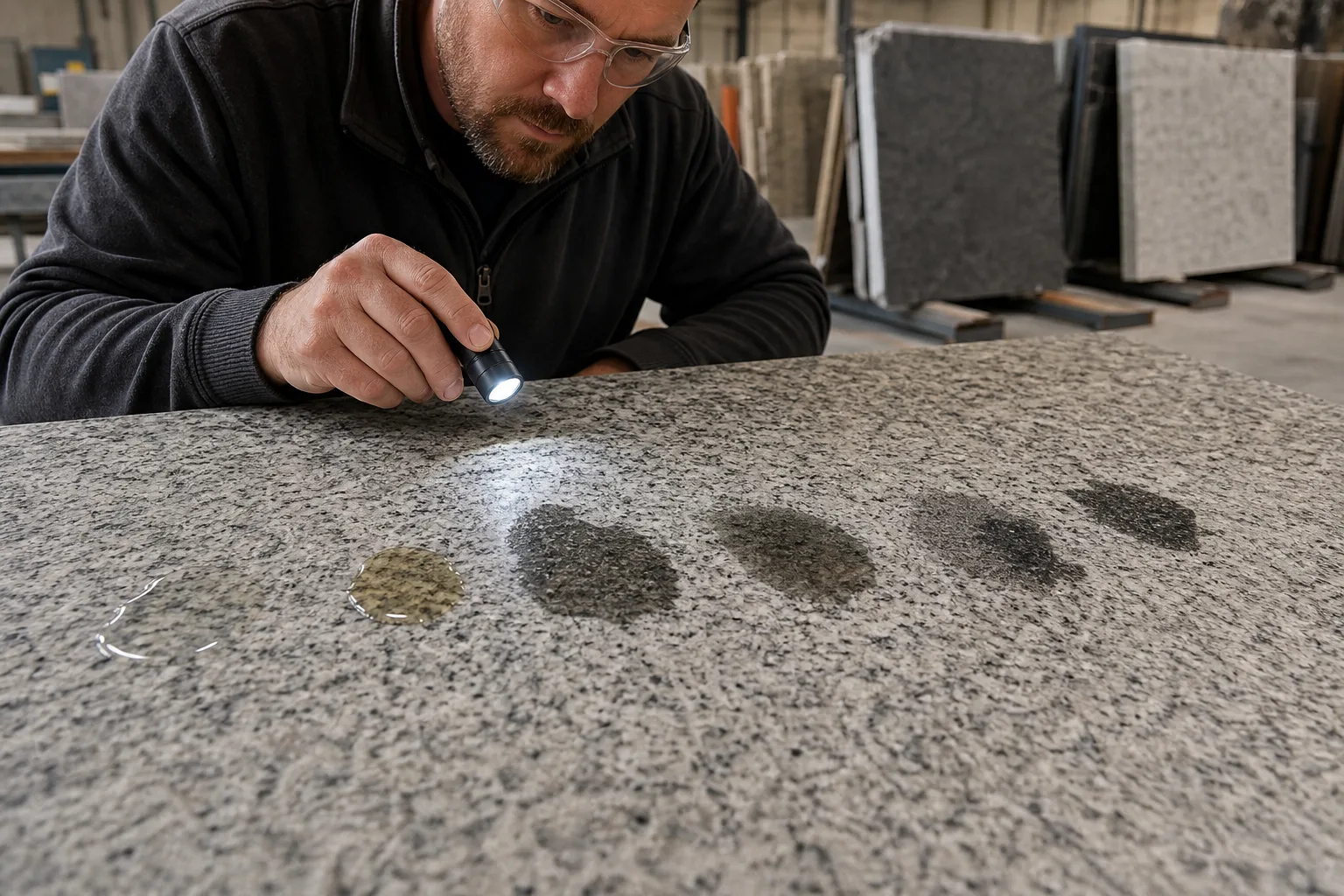
A dark spot in granite is most likely temporary moisture if it appeared after a spill or wet use and becomes lighter as the stone dries. Oil generally remains dark after surrounding moisture has evaporated and may develop a diffuse or translucent edge. A mark that never changes may be an older stain, adhesive or resin seen through the slab, a natural mineral feature, or a finish variation rather than absorbed water. Do not apply sealer, heat, bleach, acid or a random stain remover until the cause is narrowed down.
Start with location, timing and change
The appearance alone rarely proves what caused a dark area. Granite sold in the dimension-stone trade includes several crystalline rock types, not only geologically strict granite, so absorption and staining behavior cannot be predicted from the word granite or a trade name alone. The Natural Stone Institute explains that commercial stone groupings are broader than scientific rock classifications. Review the specific slab, finish, treatment history and installation conditions instead of assuming that all materials in the granite category behave identically.
Ask four questions before cleaning
- When did it appear? A mark noticed immediately after washing, a leaking appliance or a spill points first to moisture or contamination. A mark present since installation requires comparison with pre-installation photographs and samples.
- Where is it? Spots beside a sink, faucet, soap dispenser or countertop seam may have a recurring moisture source. Marks under cooking equipment, dispensers or food-preparation areas may be oil-based. Darkening along a floor joint or slab edge can indicate moisture entering from below or behind.
- Does it change? Photograph the area under the same lighting and check it over time. Temporary water darkening should generally reduce as the stone dries, although drying time varies with stone, thickness, finish, temperature and the moisture source.
- What shape does it follow? A ring may be a surface deposit from hard water rather than moisture inside the stone. A spot matching a container, fitting or spill supports an external cause. A mineral-shaped patch or band that follows the stone's grain may be natural variation.
Do not conduct a diagnosis by deliberately applying cooking oil, solvents or colored liquids. If sealing performance is the concern, use a controlled method described in the granite water-drop test guide, preferably first on an inconspicuous area or retained sample.
A non-destructive diagnosis sequence
The safest sequence is to remove surface residue, stop further exposure and observe the mark during drying. This protects evidence that may be useful to an installer, fabricator, restoration specialist or supplier.
| Step | Action | What to record | What not to do |
|---|---|---|---|
| 1 | Stop water, oil and cleaning-product exposure. Check nearby plumbing, dispensers, seams and wet equipment. | Date, likely source and whether the area is still being wetted. | Do not reseal the spot or cover it with an impermeable coating. |
| 2 | Blot any fresh liquid. Wash gently with a neutral stone cleaner or a small amount of mild dishwashing detergent and clean water. | Whether residue transfers to a white cloth. | Do not scrub with abrasive powder, aggressive pads or wire brushes. |
| 3 | Rinse away cleaner and dry the surface with a clean, colorfast cloth. | A straight-on photograph and an oblique-light photograph. | Do not use a heat gun, torch or concentrated hair-dryer heat. |
| 4 | Keep the area dry and ventilated. Compare it after 24, 48 and 72 hours. | Changes in area, edge, color and intensity. | Do not treat 72 hours as a universal drying limit; concealed moisture can take longer. |
| 5 | If unchanged, review the original contaminant, installation records, sample and slab photographs. | Sealer, resin, adhesive, backing, grout and cleaning products used. | Do not combine chemicals or experiment on the visible area. |
The Natural Stone Institute recommends blotting spills, cleaning with a neutral cleaner or mild detergent, rinsing and drying with a soft cloth. It also warns that acidic and abrasive products can damage some stone finishes and that hydrofluoric-acid-containing rust removers attack silicate stones, including granite. See its natural stone care guidance.
How water, oil and other marks usually differ
Temporary absorbed moisture
Water commonly makes an absorbent or insufficiently protected area look darker because the wet stone interacts with light differently from the dry surface. The patch may be strongest at an edge, joint, cutout or repeatedly wet work area. If it steadily fades after the source is stopped, moisture is the leading explanation. If it returns after sink or floor use, investigate the recurring source rather than repeatedly cleaning the face.
Water absorption is a measurable material property, but a home water-drop check is not equivalent to laboratory testing. ASTM C97/C97M covers laboratory determination of absorption and bulk specific gravity for dimension stone and states that absorption testing helps indicate differences among stones and compare stones of the same type. A test report does not by itself identify the cause of one installed dark spot.
Hard-water deposits
A hard-water mark is often lighter, cloudy, crusted or ring-shaped because minerals remain on the surface after water evaporates. On dark polished stone it can look gray or white rather than dark. A wet deposit may temporarily become less visible, which is the opposite of absorbed moisture becoming darker. Removal methods depend on the deposit and the stone; avoid defaulting to vinegar or acidic scale remover.
Oil-based stains
Cooking oil, grease, cosmetics, plumber's putty, oily sealants and some adhesives can darken stone. According to the Natural Stone Institute, an oil-based stain normally must be dissolved so the source can be flushed or rinsed away. Because solvents introduce fire, ventilation, exposure and finish risks, identify the likely substance and follow a stone-care product manufacturer's instructions or use a qualified restoration professional.
Natural features, resin and installation shadows
Not every dark area is a stain. Crystals, mineral concentrations, veins and structural features may form darker patches within the stone. Some slabs are resin-treated during processing, and localized resin concentration or filled features can respond differently to light. Adhesive, setting material, reinforcement or contamination behind thin or translucent areas can also create a visible shadow. A retained sample, approved mockup and pre-fabrication slab photograph are valuable references; see the guidance on samples and mockups and granite color variation.
Treatment should follow the cause
When the mark is moisture
Stop the source and allow natural drying. Repair leaks and failed wet-area joints where applicable. Do not seal while the stone is visibly dark from moisture: a sealer is not a leak repair, and premature application may interfere with later diagnosis or treatment. If moisture appears to enter from below a floor, behind cladding or around a countertop cutout, the assembly should be investigated rather than treating only the exposed face.
When the mark is a surface deposit
Begin with neutral cleaning and a soft cloth. A deposit may require a product specifically labeled for natural stone and suitable for the confirmed stone and finish. Test it in an inconspicuous place and follow the manufacturer's dwell time, dilution, rinsing and safety instructions. A highly polished surface can reveal fine scratches or localized dulling more readily; review the characteristics of a polished granite finish before using any mechanical method.
When the mark is an absorbed stain
A poultice combines an appropriate cleaning agent with a white absorbent material to draw contamination from the stone. The Natural Stone Institute describes applying a prepared poultice approximately 1/4 to 1/2 inch thick, covering it and allowing 24 to 48 hours of working time. It also notes that multiple applications may be necessary and that some stains cannot be completely removed. The chemistry must match the identified stain; a universal homemade paste is not suitable for every contaminant or stone.
Use a commercial stone poultice according to its label or obtain professional advice where the contaminant is uncertain. Protect adjacent materials, provide ventilation and use specified personal protective equipment. Never mix bleach and ammonia. Do not use flame, concentrated heat or an unidentified rust remover.
When the mark may be permanent
Stop treatment if the area does not respond as expected, the finish begins to change, or the cause remains unclear. Deep oil, metal contamination and installation-related discoloration can be difficult to remove. A natural inclusion, resin-filled feature or adhesive shadow may not be removable at all. Refinishing can sometimes make a visual difference, but it changes the surface and should be evaluated against the surrounding finish before work begins.
Sealing reduces risk but does not make granite stain-proof
Penetrating products commonly called sealers function as repellents. The Natural Stone Institute states that sealing can make stone more stain resistant but not stain-proof, and that some granite does not require sealing. Product selection and reapplication should therefore be based on the actual stone, finish, exposure and sealer manufacturer's instructions—not on a fixed annual schedule.
- Resolve active moisture and remove stains before considering sealer.
- Confirm whether the existing product is water-repellent only or also oil-repellent.
- Test for appearance change on a sample or inconspicuous area.
- Use only products identified as suitable for the application, including food-contact surfaces where relevant.
- Remove excess product as directed; residue on a dense polished surface can produce haze, streaks or uneven sheen.
For kitchen countertop applications, routine spill control, coasters, dry sink edges and neutral cleaning remain important even when the stone has been treated.
Specification, inspection and China sourcing context
A stain complaint cannot be resolved reliably from a trade name alone. During China sourcing, define the approved stone, slab range, finish, surface treatment and acceptance method in the purchase documents. Do not infer quarry origin, petrographic identity, absorption or sealer performance from a catalog label without supporting records.
Before production
- Approve current slab photographs or physical samples under agreed lighting.
- Record acceptable natural variation, resin-filled features and repair limits.
- Specify whether the finish and sealer are factory-applied or completed after installation.
- Where performance data are required, identify the test method, edition, sampling basis and material represented. ASTM C97/C97M is a laboratory absorption method; it is not a substitute for visual slab approval.
During and after production
- Inspect stone when dry and clean, using consistent lighting and viewing distance.
- Check edges, cutouts, seams and backs for contamination, adhesive transfer, reinforcement and uneven treatment.
- Separate suspected moisture darkening from natural color range before classifying a piece as defective.
- Photograph each disputed area with a scale, piece number, crate number and overall view.
- Use retained samples or approved references when applying the project's granite quality-control plan.
If dark patches are discovered in packed or recently unloaded material, document the packaging condition and allow representative pieces to reach a stable dry condition before making a final color judgment. Do not assume that every mark is transit moisture, however. Persistent localized discoloration may require review under the agreed defect criteria or a defined third-party inspection. The appropriate remedy depends on evidence: drying, cleaning, poulticing, refinishing, replacement or acceptance as natural variation are not interchangeable outcomes.
When to stop and call a specialist
Obtain professional assessment when a spot continues to expand, returns without an obvious surface spill, occurs near plumbing or electrical equipment, crosses multiple installed pieces, or appears to come from behind the stone. Professional help is also appropriate for unidentified chemicals, deep oil or metal stains, widespread floor discoloration and any treatment that may require solvents or refinishing.
Provide the assessor with dated photographs, the likely exposure, installation date, stone and finish description, cleaning products, sealer records, fabrication drawings and retained samples. A restrained diagnosis starts with change over time: fading supports moisture, persistence after thorough drying supports an absorbed substance or fixed feature, and a raised or cloudy residue supports a surface deposit. When the evidence is mixed, preserve the surface and investigate rather than escalating the chemistry.
Frequently asked questions
How can I tell if a dark spot in granite is only water?
Stop wetting the area, clean it gently, dry the surface and photograph it under consistent lighting. A spot that steadily becomes lighter is probably moisture. A mark that remains after the area has thoroughly dried may be oil, another absorbed contaminant or a fixed material feature.
Will a water stain in granite disappear by itself?
Temporary darkening often fades after the moisture source is removed, but drying time varies. A hard-water deposit will not necessarily disappear because minerals remain on the surface, and recurring darkening can indicate continued moisture entry.
Should I seal granite while a dark spot is still visible?
No. First identify and stop the moisture or contaminant, then allow the stone to dry and complete any stain treatment. Sealer improves resistance but does not repair leaks, remove stains or make granite stain-proof.
Can oil be removed from granite?
Some oil stains can be reduced with correctly selected cleaning chemistry and a poultice, but repeated treatment may be necessary and complete removal is not guaranteed. Unknown contaminants, large stains and solvent-based work are best assessed by a stone restoration professional.
Can a natural dark patch be mistaken for a granite stain?
Yes. Mineral concentrations, veins, resin-filled features, finish variation and material visible from behind the slab can resemble stains. Compare the area with approved slab photographs, retained samples and records from before installation.
Questions & discussion
Share a question or a useful experience about this guide. Comments appear immediately. Your name and comment are public. Email is optional and stays private; reply emails are not enabled yet. Comment privacy.