
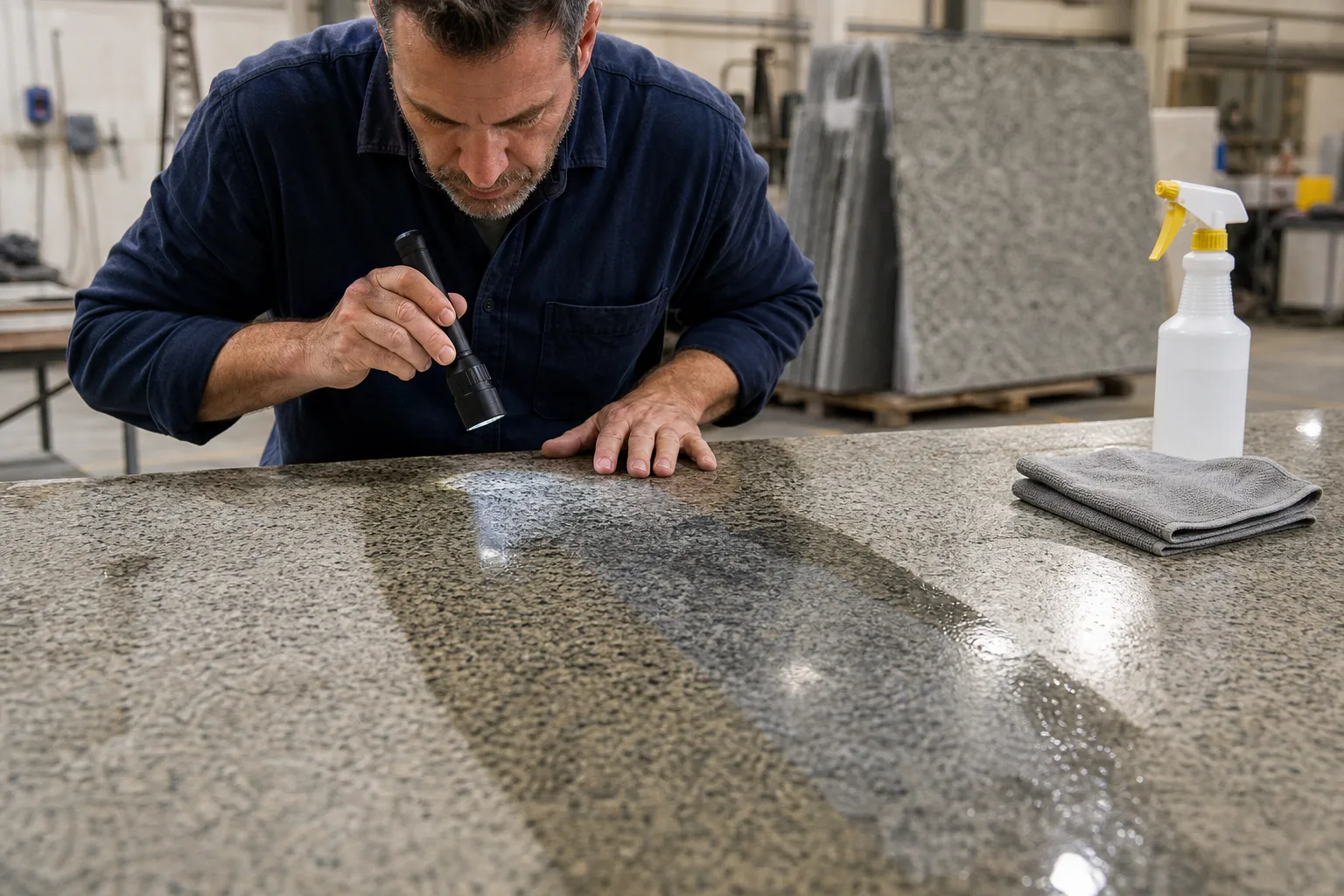
When granite develops haze, streaks or dark patches after sealing, do not add another coat until the cause is identified. A cloudy film commonly points to material left on the surface, while darkening may come from retained moisture or solvent, an intentional color enhancer, uneven absorption, contamination or a previous treatment. Record the product, application time and symptoms; follow its stated cure period; and test any corrective method in a small, inconspicuous area. If the product cannot be identified, or the surface is tacky, coated or physically dull, pause the work and consult the sealer manufacturer or a qualified stone restoration contractor.
First determine what is on the granite
Identify the product category
The word “sealer” is used for products with different behavior. An impregnating or penetrating product is intended to enter accessible pores and act as a repellent rather than form a continuous surface film. A topical coating remains at the surface. A color-enhancing impregnator is formulated to deepen color and may make the stone look persistently wet. These categories are not interchangeable, and the appropriate residue-removal method depends on the actual formulation.
The Natural Stone Institute explains that common stone-industry impregnators make stone more stain resistant rather than stain proof. It also advises following the supplier or sealer manufacturer's recommendations for the stone and application. ([naturalstoneinstitute.org](https://www.naturalstoneinstitute.org/consumers/care/))
- Find the container, invoice, technical data sheet and safety data sheet.
- Confirm whether the product is penetrating, topical or color enhancing.
- Record whether it is water based or solvent based without assuming that one can remove the other.
- Check the stated dwell time, excess-removal procedure, number of coats, cure period and approved remover.
- Determine whether another cleaner, wax, polish, enhancer or sealer was already present.
Do not judge the surface before the stated cure period
Evaporating carrier and moisture can temporarily deepen granite or produce uneven-looking areas. Cure times vary by formulation, coating thickness, temperature, ventilation and substrate condition, so a universal waiting period is unreliable. Keep the area dry and out of service for the period stated by the product manufacturer. Do not perform a water-drop test while the stone or treatment is still curing.
Match the symptom to the likely cause
Use appearance as a diagnostic clue, not as proof. Examine the stone in diffuse daylight and under low-angle or raking light. Photograph the full surface and close details before attempting removal.
| Observed symptom | Likely possibilities | Next check |
|---|---|---|
| Cloudy or milky film visible in raking light | Excess impregnator not buffed away, cleaner film, or a topical coating that cured unevenly | Wipe a test area with a clean white cloth; consult the product's approved residue-removal instructions |
| Greasy smears or fingerprints | Unremoved product, incomplete cure, or oily contamination | Check whether the marks move or transfer and whether the surface remains tacky |
| Uniform, permanent-looking darkening | Color enhancer, intentional topical finish, or broad absorption of a penetrating product | Verify the product category and compare with an untreated sample or concealed area |
| Irregular dark islands or edges | Uneven absorption, retained moisture, filled fissures, resin-treated areas, repairs or contamination | Map the pattern against veins, fissures, edges, seams, sink areas and previous wetting |
| Dull patches without transferable residue | Abrasion, chemical damage, coating disturbance or pre-existing finish variation | Stop chemical experimentation; determine whether professional refinishing is required |
| Dark area that gradually fades | Water or carrier temporarily held in the stone | Allow controlled drying and compare photographs over time |
| Tacky, soft or easily marked surface | Excess material, an uncured topical product, incompatible layers or unsuitable curing conditions | Restrict use and obtain formulation-specific removal guidance |
Soap or cleaner residue can also produce streaking. The Natural Stone Institute notes that excessive cleaner concentration may leave a film and recommends thorough rinsing and drying with a soft cloth. It warns that hydrofluoric-acid-containing products attack silicate stones, including granite and quartzite. ([naturalstoneinstitute.org](https://www.naturalstoneinstitute.org/consumers/care/))
Use a controlled recovery sequence
Start with the least aggressive step
- Stop recoating. Additional product can increase surface residue and make incompatible layers harder to separate.
- Document the condition. Record application date, product name, lot if available, number of coats, dwell time, removal method, finish and previous treatments.
- Allow the specified cure period. Provide the ventilation and service restrictions required by the product instructions.
- Remove ordinary soil or cleaner film. If the sealer instructions permit cleaning, use a neutral cleaner approved for natural stone, rinse thoroughly and dry with a soft, lint-free cloth.
- Test the manufacturer-approved correction. Some fresh residues can be reworked or removed with a specified product, while cured films may require a dedicated stripper. Do not substitute an unlisted solvent or mix chemicals.
- Inspect the test after complete drying. Check color, gloss and residue from several viewing angles before expanding the work.
- Escalate when necessary. Large coated areas, damaged polish, unidentified products and repeated failed treatments are restoration issues rather than routine cleaning.
Avoid improvised stripping
Vinegar, acidic bathroom cleaners, abrasive powders, aggressive pads and random solvent combinations can change gloss, damage accessory minerals, spread contamination or create a second defect. Never mix bleach and ammonia. On food-preparation surfaces, confirm that any applied treatment is suitable for that use; the Natural Stone Institute specifically advises checking that a sealer used in a food-preparation area is non-toxic and safe for the application. ([naturalstoneinstitute.org](https://www.naturalstoneinstitute.org/consumers/care/))
After the stone is dry and the treatment has cured or been removed, a controlled granite water-drop test may help compare absorption between areas. It cannot identify a coating, prove compatibility or distinguish water from an oil stain. Persistent isolated marks should instead be assessed using the dark spots: water or stain guide.
Account for stone identity, finish and prior treatment
Geological identity and trade name are not the same
Commercial “granite” is a broad dimension-stone category and can include several igneous and metamorphic rock types that are not granite in the strict geological sense. The Natural Stone Institute distinguishes scientific classification, which emphasizes mineralogy and formation, from commercial grouping based on appearance, locality and similar performance. ([naturalstoneinstitute.org](https://www.naturalstoneinstitute.org/consumers/varieties/definition/?utm_source=openai)) A trade name therefore does not establish porosity, sealer demand or treatment response.
Ask for the declared stone identity, but inspect and test the supplied material rather than predicting behavior from a name alone. Different batches, slabs and mineral zones can respond differently. Do not infer quarry origin or geological identity solely from a color name, code or supplier listing.
Finish changes surface behavior
A polished finish may expose less readily accessible pore space than a honed or textured face, but mineral structure, microfissures, resin filling and fabrication also matter. Residue is often conspicuous on polished black or dark stone because low-angle light reveals smears and gloss differences. On honed material, an enhancer may produce stronger or less uniform color change. A procedure approved for one finish should not automatically be transferred to another.
Factory resin treatment may affect the diagnosis
Some granite slabs receive resin treatment during processing to fill fissures or surface depressions before polishing. The Natural Stone Institute notes that polishing removes most surface resin while material may remain in depressions and intercrystalline areas; it also states that sealing resin-treated countertops may add resistance to an already resistant surface. ([naturalstoneinstitute.org](https://www.naturalstoneinstitute.org/consumers/sealing-stone/)) Uneven darkening can therefore follow the distribution of natural pores, resin, repairs and open fissures rather than indicate a simple lack of sealer.
Specifications and inspection records matter
Do not replace project-specific testing with a household test
ASTM C97/C97M is a laboratory method for determining absorption and bulk specific gravity of dimension stone and is useful for comparing absorption among stones or stones of the same type. ([store.astm.org](https://store.astm.org/c0097_c0097m-25.html)) It does not diagnose sealer haze on an installed countertop, and a supplier's laboratory absorption result does not determine how much of a proprietary treatment should be left on a finished face.
For slabs, tiles or finished work, the treatment specification should identify the stone, finish, intended application, product system and acceptance criteria. Useful documentation includes:
- exact product and manufacturer rather than “stone sealer”;
- factory resin, mesh, repair, wax or protector disclosure;
- approved substrate and finish;
- surface preparation and moisture restrictions;
- application rate, dwell time and excess-removal method;
- recoat window and full cure conditions;
- approved cleaner, remover or stripper;
- food-contact suitability where relevant;
- an agreed sample or mockup viewed under controlled lighting.
Use an inspection hold point
Inspect a small treated sample before full production or installation. Compare it with the approved untreated reference under frontal, diffuse and raking light. Record color shift, gloss, streaks, tackiness and water behavior only after the specified cure. Guidance on samples and mockups, color approval under controlled lighting and sample-to-slab variation can help establish a repeatable review process.
Price factors and China sourcing controls
Remediation cost depends on the failure mode
No reliable repair price can be assigned from photographs or the symptom name alone. Cost factors include surface area, vertical or horizontal access, product identity, cure state, number of layers, finish, edge details, nearby materials, test work, waste handling and whether mechanical refinishing is necessary. Removing fresh excess from a small polished surface is a different scope from stripping a cured topical film or restoring a damaged finish.
Specify treatment history when sourcing from China
For granite slabs or finished products sourced in China, the purchase specification should separate the stone trade name from its finish and surface-treatment schedule. Do not assume that a named stone, including a standardized-looking code, is untreated. Request written disclosure of resin filling, color enhancement, wax, factory-applied protector and local repairs for the actual order.
Before authorizing full production, require a representative finished sample or mockup using the proposed treatment process. Record the product name, application date, cure conditions and inspection lighting. For quality control, include haze, streaking, tackiness and unacceptable color change in the approved visual criteria rather than relying only on the word “sealed.” Useful related references include granite quality control, color variation and stone defect assessment.
When discoloration is discovered after delivery, preserve an untreated offcut, treated sample, packaging labels and production records. These materials can help distinguish stone variation from application residue or product incompatibility. A new sealer coat should be considered only after the existing condition is understood, the surface is clean and dry, and a cured test area meets the agreed appearance.
Frequently asked questions
Will another coat remove granite sealer haze?
Not reliably. Another coat can add residue or compound an incompatible treatment. Identify the product, observe its cure requirements and test the manufacturer's approved residue-removal method before considering any additional sealer.
Why did granite become darker after sealing?
Possible causes include temporary moisture or carrier retention, an intentional color enhancer, uneven absorption, contamination, excess product, factory resin or previous treatments. The pattern, product category and change after complete drying are needed for diagnosis.
Can vinegar remove cloudy sealer from granite?
Vinegar is not a general sealer remover and should not be used as an improvised treatment. It may affect acid-sensitive minerals or nearby materials without dissolving the sealer. Use only a cleaner or remover approved for the identified product and test it first.
Does a failed water-drop test mean granite needs more sealer?
No. A water-drop test is a limited comparison of surface absorption after the stone is clean, dry and fully cured. It does not identify residue, verify product compatibility or prove that another coat is appropriate.
Questions & discussion
Share a question or a useful experience about this guide. Comments appear immediately. Your name and comment are public. Email is optional and stays private; reply emails are not enabled yet. Comment privacy.