
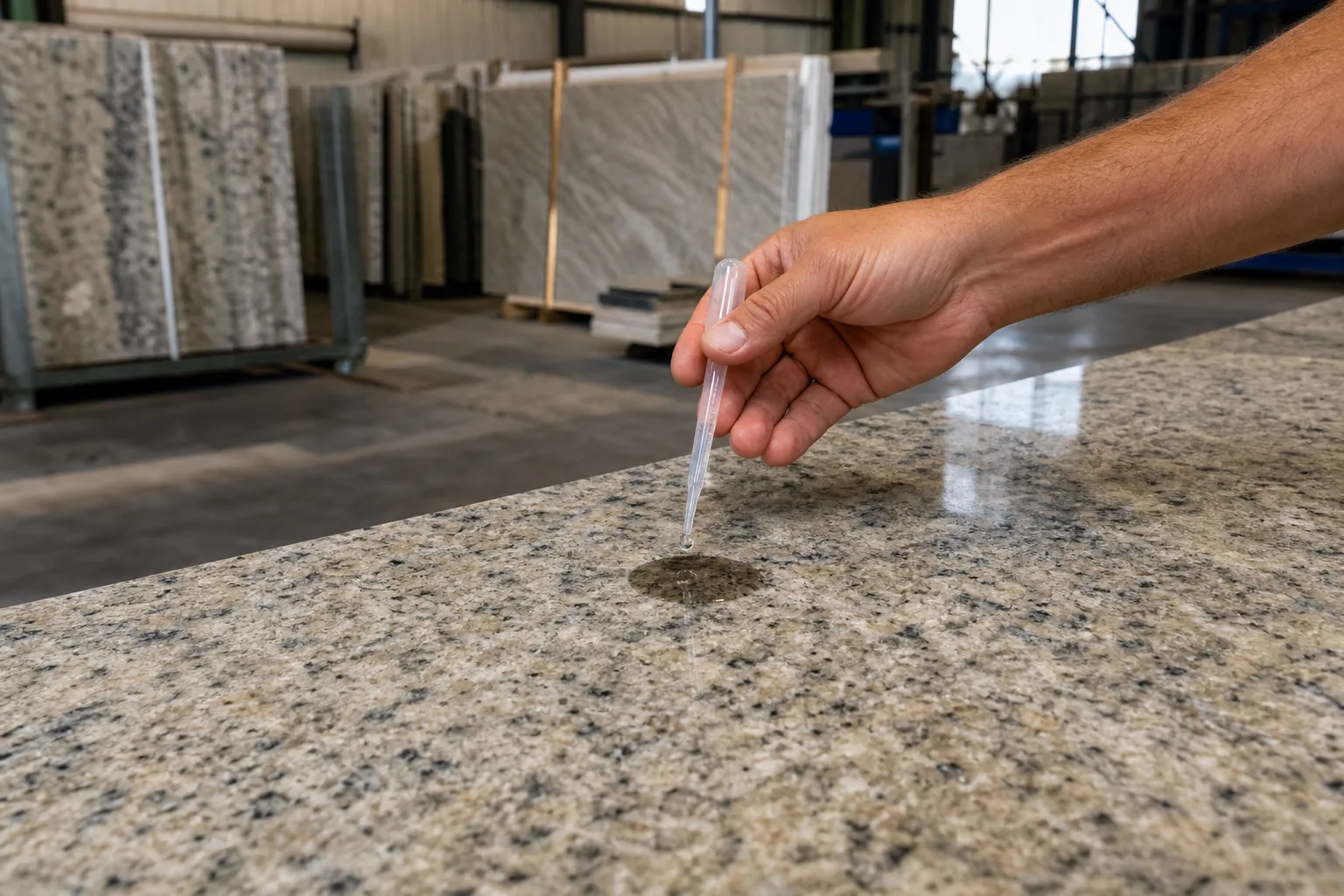
A granite water drop test is a practical screening method: place water on a clean, dry area and watch for spreading, loss of beading or temporary darkening. Rapid darkening suggests that water is entering the tested surface. Water remaining on top suggests lower uptake under those conditions. The result can help determine whether further inspection or sealing is worth considering, but it does not measure standardized absorption, identify the stone, predict oil staining or prove that a countertop needs immediate resealing.
Key numbers
| Indicator | Reference value or method | Standard and limit |
|---|---|---|
| Household observations | Approximately 5, 10 and 15 minutes | Screening convention, not an ASTM pass/fail test |
| Laboratory absorption | ASTM C97/C97M | Conditioned specimens and mass measurements; no numerical drop-test equivalent |
What the water-drop test actually checks
Natural stone contains pores, grain boundaries and, in some materials, microfissures through which liquids may move. An impregnating treatment can reduce this movement without creating a completely impermeable surface. The Natural Stone Institute describes commonly used impregnators as repellents rather than absolute seals and emphasizes that treatment makes stone more stain resistant, not stain proof. It also notes that some stones do not require sealing. See its guidance on care and cleaning of natural stone.
The household water test observes the interaction among the stone, its finish, any factory resin or field-applied treatment, and the condition of the surface at that moment. Its most useful output is comparative: one area can be checked against another, or a documented result can be compared with a later test performed under similar conditions.
Temporary darkening is the main observation
If the area beneath a drop becomes darker, water has probably entered near-surface pores or discontinuities. The mark should become lighter as the moisture evaporates. Faster or broader darkening generally indicates greater surface uptake, but a domestic test does not quantify how much water was absorbed.
A bead alone is not conclusive. Surface tension, polish, cleaning residue, grease, wax and recently applied products can all affect bead shape. Look for a change in the stone beneath and around the water, not merely whether the drop appears rounded.
It is not the same as an absorption test
ASTM C97/C97M-25 is the active ASTM method for determining absorption and bulk specific gravity of dimension stone. It uses prepared specimens, controlled conditioning, immersion and mass measurements. ASTM states that the method is useful for indicating absorption differences among dimension stones and for comparing stones of the same type. A few drops on an installed counter do not reproduce that procedure and should not be reported as an ASTM result.
How to perform a useful household test
Use the following method as a repeatable field check rather than a pass-or-fail standard. Test only where water can be left undisturbed and where temporary darkening will not cause concern.
- Confirm the surface is natural stone. Engineered quartz, porcelain, sintered materials and coated products require different interpretation.
- Select an inconspicuous location. Keep the first test away from edges, seams, sink cutouts, filled fissures and areas with existing discoloration.
- Clean gently. Remove dust, grease and cleaner residue with a product suitable for natural stone. Rinse if required and wipe dry.
- Allow the area to dry fully. A damp surface cannot provide a reliable baseline. Areas beside sinks may require longer drying than open countertop areas.
- Place several drops together. Use enough clean water to form a visible spot without allowing it to run across the surface.
- Start a timer and observe. Check for edge spreading, loss of water volume and darkening at approximately 5, 10 and 15 minutes. Photographing the same area under fixed lighting can improve later comparison.
- Blot rather than wipe. After the observation period, lift the water with a clean white absorbent cloth. Inspect the stone immediately and again after it dries.
- Repeat selectively. If the first area darkens, compare it with another representative area. Do not repeatedly soak the same location.
Record the test conditions
For a meaningful comparison, note the date, location, finish, observation time and approximate drying time. Also record recent cleaning or sealing. A test performed immediately after treatment is not an adequate assessment of cured performance; follow the treatment manufacturer's written curing and evaluation instructions.
How to interpret the result
| Observation | Likely interpretation | Reasonable next step |
|---|---|---|
| Water remains with no visible darkening after 15 minutes | Low water uptake was observed at this location under the test conditions. | Do not seal solely because a calendar interval has elapsed. Continue routine care and monitor spill behavior. |
| A faint dark area develops slowly | Some near-surface water uptake may be occurring. | Repeat on another representative area and review the stone and treatment documentation before deciding on treatment. |
| Darkening appears within a few minutes | The tested area is readily taking up water, or a local feature is providing an entry path. | Compare multiple areas. If stain exposure is significant, consult the fabricator or treatment manufacturer about compatibility and preparation. |
| Only the seam, edge or fissure darkens | The result may concern joint material, an exposed edge, a repair or a local discontinuity rather than the whole slab. | Inspect the localized detail. Applying sealer to the entire surface may not correct a seam or installation problem. |
| The mark remains after surrounding moisture has dried | The condition may be contamination, an existing stain, trapped moisture or another surface alteration. | Stop testing and investigate the discoloration before applying any treatment. |
| Water spreads into a flat sheet without darkening | Cleaner residue or altered surface tension may be influencing the test. | Clean and rinse appropriately, allow complete drying and retest once. |
The Natural Stone Institute's position on sealing natural stone countertops states that many granite countertops gain additional moisture resistance from treatment, while many do not inherently need it. This supports condition-based evaluation rather than a universal annual or semiannual resealing rule.
What the test cannot tell you
It cannot confirm geological identity or a trade name
In geology, granite has a specific mineralogical meaning. In the dimension-stone trade, “granite” may be used more broadly for several hard crystalline stones sold for similar applications. USGS documentation distinguishes geological granite from broader commercial granite terminology. Appearance and a water drop cannot establish petrographic classification, quarry origin or the validity of a trade name. Buyers should treat the test as a surface observation, not a material identification method.
It cannot predict every stain
Water uptake and stain susceptibility are related but not identical. Cooking oil, cosmetics, dyes and acidic liquids behave differently from clean water. A hydrophobic treatment may repel water-based liquids, while an oleophobic product is intended to resist both oil- and water-based substances. Even a treated surface can stain if a spill is sufficiently persistent or if treatment coverage is incomplete.
It cannot diagnose etching, residue or damage
A dull patch is not necessarily absorption. It may be cleaner residue, abrasion, an altered coating or chemical attack on an acid-sensitive mineral. A dark area may also reflect oil, moisture entering from a sink opening or water trapped below the surface. Sealer should not be used as a general repair product for every visible defect.
It cannot provide a service-life guarantee
The test records conditions at one place and time. Wear, cleaning chemistry, exposure, finish, fabrication and local stone variation can produce different results elsewhere on the same installation. It cannot establish how many months or years a treatment will remain effective. Product-specific instructions and observed performance are more useful than a fixed industry-wide interval.
Finishes, applications and local variation
A polished finish may show water behavior differently from a honed, textured or weathered surface. Polishing can reduce accessible surface pathways in some stones, while rougher finishes expose more surface area. Factory resin, color enhancers, waxes and topical coatings can further change the result. Therefore, compare like with like: the same stone, finish and treatment condition.
Application also matters. On kitchen countertops, water testing is mainly a maintenance and stain-risk screen. On flooring, patios or facades, performance decisions may also involve slip resistance, drainage, freeze-thaw exposure, salts, substrate moisture and structural specifications. A countertop drop test is not a substitute for project-specific testing in those applications.
The Natural Stone Institute reports low absorption ranges for stones in its granite grouping, but this should not be assigned automatically to an unidentified slab or commercial variety. Published category ranges are background information, not batch-specific test data. See its granite technical overview.
Using the test in specification and China sourcing
For imported slabs or fabricated work, the water-drop test is most useful as a documented visual inspection point—not as a certificate. A result on one showroom sample cannot prove the performance of an entire shipment, particularly if the sample and production material differ in finish, resin treatment, sealer, thickness or lot.
Sample and inspection checklist
- Request a representative finished sample, not only an unfinished quarry chip.
- Record the commercial name, declared geological description and slab or production-lot reference separately.
- State the finish and whether resin, color enhancer, impregnator or topical treatment has been applied.
- Agree whether samples are supplied untreated, factory treated or both.
- Photograph the dry baseline and timed water observations under consistent lighting.
- Inspect more than one location where variation or filled features are present.
- Do not label a household drop test as ASTM C97/C97M compliance.
- For contractual absorption requirements, request results from the specified laboratory method and verify that the tested specimens represent the supplied material.
These records can form part of broader granite quality control, sample and mockup review, and third-party inspection. They should be assessed alongside color range, repairs, dimensions, finish consistency and other specified defect criteria. Neither a Chinese trade name nor an exporter's statement alone establishes quarry origin, treatment history or tested absorption.
When sealing or further investigation is justified
Consider further action when representative areas repeatedly darken, the surface is exposed to staining liquids, and the stone or existing treatment is compatible with an appropriate impregnator. Before application, identify previous treatments as far as practical, follow the product manufacturer's preparation and curing instructions, and test an inconspicuous area for appearance changes. Food-preparation surfaces require products identified by their manufacturer as suitable for that use.
Do not add treatment merely because water fails to form a perfect bead. Over-application or failure to remove excess product can leave haze, streaks or residue. Likewise, sealing will not correct standing water, failed joints, moisture entering through an unprotected edge, an oil stain or a defect below the surface.
Escalate the issue when discoloration does not dry, appears around a sink or seam, follows a crack, or differs markedly between adjacent pieces. In such cases, the next step may be moisture investigation, stain identification, repair assessment or laboratory testing—not routine resealing. The granite water drop test is most reliable when used narrowly: observe, document, compare and then choose the least invasive response supported by the evidence.
Stone properties
density and weight · compressive strength · water absorption · slip resistance · freeze thaw · sizes and tolerances
Use this field screen alongside the sealing decision. A temporary moisture mark is not a laboratory absorption result, and the choice of a treatment still requires identification of the stone, existing products and a compatible trial.
Frequently asked questions
How long should water remain on granite during a water-drop test?
Observe the spot at consistent intervals up to about 15 minutes, checking for darkening as well as changes in the water. The timing is a household screening convention, not an ASTM test or a universal pass-fail limit.
Does darkening mean the granite must be resealed immediately?
Not necessarily. Darkening indicates water uptake at the tested location, but the cause may be untreated stone, worn treatment, an exposed edge, a seam or a local fissure. Repeat the test on representative areas and investigate persistent or localized moisture before selecting a treatment.
If water beads on granite, is it protected from oil stains?
No. Beading only describes water behavior under the test conditions. Oil can behave differently, and some products repel water without providing equivalent oil resistance. No impregnating treatment makes granite completely stain proof.
Is the granite water-drop test equivalent to ASTM C97?
No. ASTM C97/C97M uses conditioned specimens, controlled immersion and mass measurements to determine absorption and bulk specific gravity. A surface drop test is qualitative and cannot be reported as standardized absorption data.
Questions & discussion
Share a question or a useful experience about this guide. Comments appear immediately. Your name and comment are public. Email is optional and stays private; reply emails are not enabled yet. Comment privacy.