
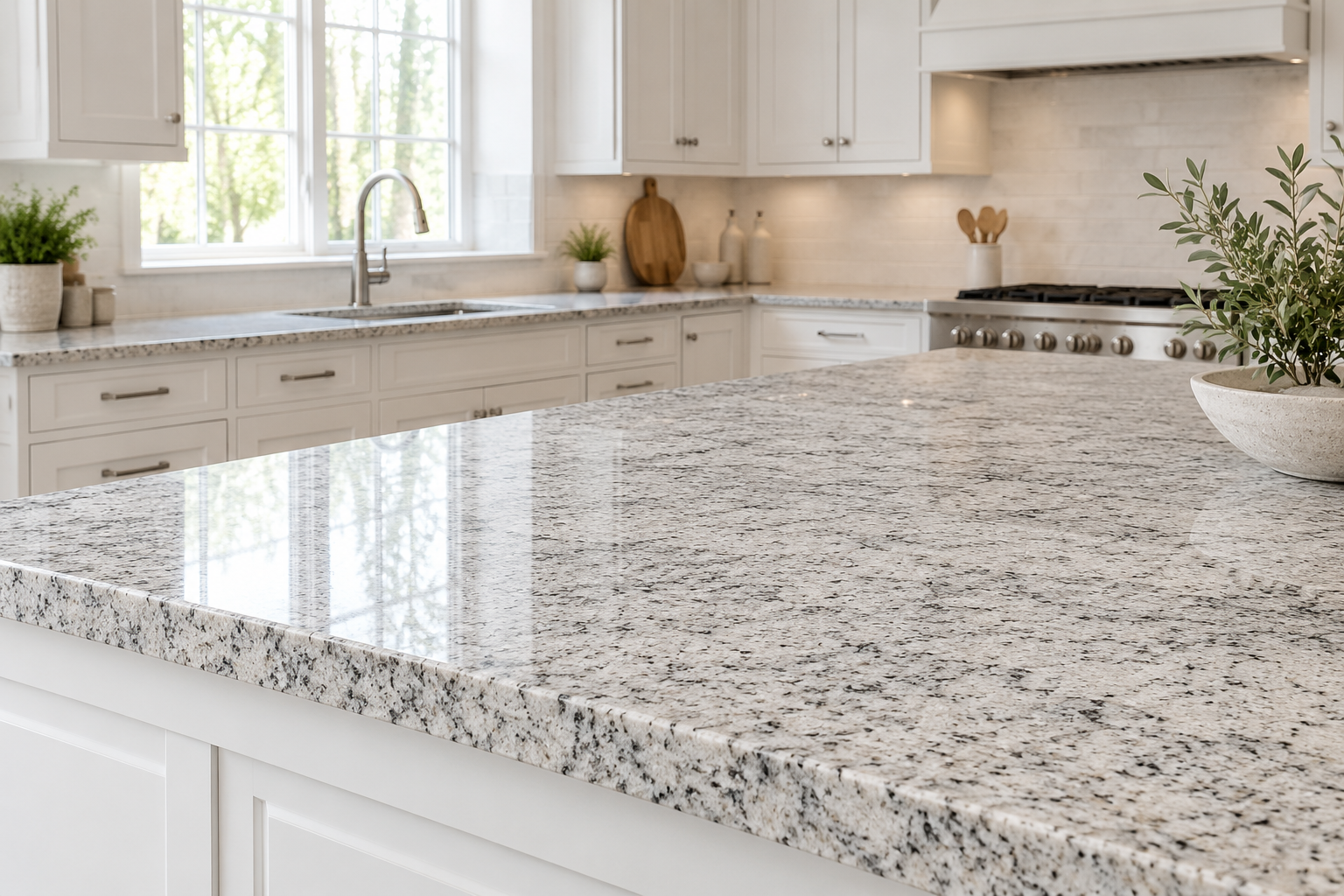
If you want the clean white-grey appearance of a plain quartz countertop, natural granite requires a compromise: expect natural variation rather than a completely pattern-free light grey surface. Some slabs look quieter than others, but a trade name cannot guarantee a particular pattern. Decide how much variation you can accept, then inspect the actual slab alongside your cabinets and lighting.
The goal is not to find an objectively least-patterned granite. It is to choose a slab whose flecks, background colour and larger markings feel right in your kitchen, and whose treatment and care requirements you understand. If even subtle variation is unacceptable, compare manufactured surfaces as separate options instead of ordering a natural stone while hoping its pattern disappears after installation.

Define what “quiet” means to you
A light slab may have a fairly even background with small dark flecks, a broader movement of grey and white, or occasional larger patches. Decide which type of variation bothers you. A sample can look calm when viewed from a distance but busy close up; a large slab can reveal a feature that was absent from a small showroom chip.
Bring a cabinet door or a reliable finish sample to the stone yard. A grey that looked neutral online may look blue, warm or cream next to a white cabinet. Compare the surface under daylight and the artificial light planned for the kitchen. Stainless steel, flooring and wall colour also affect the overall impression. Take photographs to remember options, but do not let automatic phone colour correction make the final decision for you.
For a small kitchen, identify the most visible run and the places where a seam or sink cutout will fall. A prominent patch might be acceptable behind a sink but distracting at the front of an island, or the reverse. Ask the fabricator to explain the proposed layout on the full slab. Reserve the slab you approve and record its identifying details in the order. The sample-versus-slab guide explains why a small sample is only the starting point.
Use names to find slabs, not to rank them
Ask suppliers to show available light granite slabs and compare the actual background, flecks and larger markings. Appearance can vary between lots and suppliers, and a trade name alone does not guarantee a quiet pattern. View the full slabs currently available and decide from the actual material.
Pitaya is offered as a light granite trade name. Its colour and markings can make it relevant to a buyer looking for a lighter natural surface, but its name does not establish how much liquid a particular slab will absorb or whether it has received resin treatment. Ask the supplier to identify the slab, explain existing treatment and show a representative sample. For the related decision between a light granite and a white manufactured surface, see white granite versus quartz.
Light granite slabs may show more or less movement than you expect. Do not choose solely from a catalogue image or assume that the sample used in a review matches the stone in your order. Ask for a full slab photograph, dimensions, finish and lot reference, and preferably see the slab in person. If the supplier uses an alternative trade name, ask for written identification rather than assuming two names always describe identical material.
A darker grey option may appear quieter in some lighting, but it changes the visual goal of a light kitchen. Compare a dark sample with the same white cabinet before ruling it in or out. Dark surfaces can also show dust, water marks or fingerprints differently from a patterned light surface. How a surface looks during normal use is part of the purchase decision.
Ask what resin treatment and sealing actually mean
Some stone slabs receive resin or other treatment during processing. Ask who applied it, what was applied, where it was used and whether the fabricator proposes additional treatment. Do not assume every slab with a particular name needs the same process or that resin and sealer are interchangeable. Obtain the supplier’s documentation and care instructions for the exact slab.
A compatible impregnating sealer may improve resistance to some liquid penetration, but it does not make a countertop stain-proof. Not every stone needs another application. Existing resin, finish, absorption and intended use all affect the decision. A controlled water-drop screen on clean, dry representative stone can indicate visible darkening; it is not a laboratory absorption percentage and does not predict every oil stain. Ask a qualified stone professional to interpret the result for the chosen slab.
Review any proposed sealer on a representative piece first, following the manufacturer’s instructions. Check for a change in colour, gloss or residue once the product has cured. The sealing guide explains why an automatic annual schedule is not appropriate for every stone. Ask what to do if water darkens the surface temporarily and what cleaning products the supplier recommends.
Consider porcelain and other options honestly
If a very uniform light grey is the priority, a manufactured quartz surface may offer designs with less natural variation. Read the exact manufacturer’s guidance on heat, sunlight and cleaning. The granite-versus-quartz guide covers the wider material trade-offs. A manufactured pattern can still vary between batches, so view an appropriate full-size sample before ordering.
Porcelain surfaces are another option, with their own range of finishes and printed designs. Ask about the edge, sink opening, support, seams and care for the exact product. Edges and cutouts need careful fabrication and can be vulnerable to impact in use. Find a fabricator with porcelain slab experience who can show comparable completed work, and check the manufacturer’s installation requirements. See granite versus porcelain for a broader comparison.
Natural quartzite and other stone products can have an attractive light appearance, but a trade name alone does not establish their geological identity or performance. Ask the supplier to identify the actual material and provide its treatment and care information. Super White is classified as dolomitic marble, not quartzite; its care needs differ from those of true quartzite, including sensitivity to acidic substances. Ask the supplier to identify the actual stone and provide its care instructions.
Other surfaces, including solid surface or metal, may also be worth considering if the visual requirement is very strict. Each has different seams, heat precautions and maintenance. Obtain a sample and compare the complete installed proposal. No countertop is entirely free of care, and choosing by appearance alone can leave an important practical question unanswered.
Plan the order around the actual kitchen
When you have shortlisted slabs, ask the fabricator to mark the proposed sink opening, edge and seams. Confirm whether the price includes measurement, delivery, fabrication, installation and any agreed treatment. If the layout needs more than one slab, compare both under the same light and decide whether their backgrounds and markings work together. Keep the approved slab identifiers and layout with the written order.
Ask how overhangs will be supported and how an unexpected fissure, repair or change in available material will be handled. Agree whether a substitute requires your approval. Make sure the surface and treatment are appropriate for the intended location, including any unusual sun or outdoor exposure. The supplier’s location alone does not establish where a slab was quarried.
For daily use, request a written care guide and ask about spills, hot cookware and suitable cleaners. Use a trivet for hot pans and clean spills promptly. A countertop can look calm and uniform in a showroom but still require a care routine that you dislike. Check both appearance and practical use before committing.
Keep a record of the choice
Photograph the selected slabs under consistent light and keep their identifying numbers with the order. Note the areas you want visible and the positions reserved for cutouts. Ask whether a substitute requires fresh approval if the selected lot is no longer available. A written record helps the fabricator reproduce the choice you made in the yard and gives you a practical reference when comparing the finished installation.
Take these five things to the slab yard
- A cabinet door or accurate finish sample.
- A way to view the stone under light similar to the planned kitchen lighting.
- Your preferred limit for flecks, veins and larger colour patches.
- A drawing of the counter, sink and most visible areas.
- Questions about slab identity, existing resin, sealing, seams and aftercare.
Choose the specific slab whose natural variation you like, not a name that promises a perfectly uniform result.
Sources
Reddit discussion · r/CounterTops · 24 comments
Questions & discussion
Share a question or a useful experience about this guide. Comments appear immediately. Your name and comment are public. Email is optional and stays private; reply emails are not enabled yet. Comment privacy.