
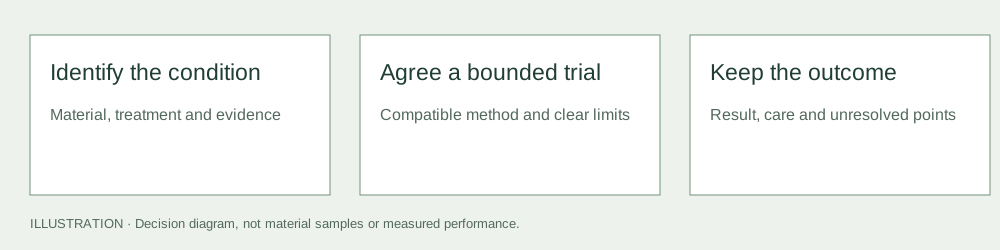
Identify the surface before selecting a stain remover. A worktop sold as granite may need a more precise material description, and a natural stone face may also carry resin, repairs, sealer or a topical coating. The visible colour or trade name does not settle which cleaner will be compatible.
Start with records and non-destructive observation. Do not use an acid spot test, scratching or an aggressive cleaning trial to identify an installed stone. If the material or treatment remains uncertain, ask a competent stone professional before escalating the intervention.
Collect the purchase and treatment records
Find the supplier’s material name, slab or piece references, installation invoice and care instructions. Ask whether the stone was filled, resin-treated, enhanced, coated or sealed, and what products were used. Keep a seller-declared identity separate from any independent identification evidence.
The Natural Stone Institute’s scientific-versus-commercial explanation shows why a commercial category is not always a precise geological identification. This distinction matters for treatment compatibility; it does not require the owner to become a petrographer before routine mild cleaning.
The stone library gives examples of trade labels and evidence gaps. A page describing a stone family does not certify the identity of the countertop in front of you.
Record the mark under repeatable conditions
Photograph the full area and an identifiable close-up after ordinary compatible cleaning and drying, where that can be done without worsening the condition. Note when the mark appeared and any known exposure. Compare normal and side lighting; reflections can help show a changed finish but do not identify its chemical cause.
Record whether the mark is raised, wet-looking, coloured, dull or associated with a joint, repair or fitting. Do not assume that a white mark is water scale or that a dark area is permanent oil staining. The dark-spot guide explains why temporary moisture darkening needs to be distinguished from other changes.
Classify the problem before choosing a remedy
| What may be happening | Evidence to collect | Why it changes the next step |
|---|---|---|
| Surface deposit | Raised or removable residue and exposure history | Cleaning may address material on the surface |
| Absorbed staining | A coloured change and plausible exposure | A material-compatible stain treatment may be needed |
| Etching or abrasion | Persistent loss of sheen or surface change | Removing a deposit alone will not restore the finish |
| Treatment residue or coating damage | Product and application history | The treatment system, not only the stone, needs assessment |
| Ongoing moisture or joint problem | Location, recurrence and related installation details | The source may need correction before cosmetic work |
These categories organise an investigation; they are not a diagnosis from appearance alone. If more than one seems plausible, keep that uncertainty in the record rather than applying several unrelated products in succession.
Select a compatible method and a limited trial
The Natural Stone Institute’s care reference is a starting point for identifying compatible cleaning and distinguishing staining from surface damage. Obtain instructions for the actual stone and treatment, then use a limited inconspicuous trial where the product and responsible professional allow it.
Protect adjacent fittings and surfaces, follow the label and do not mix products. A product marketed for a broad stone category does not override its own limitations or establish compatibility with an unknown coating. Stop if the trial changes the finish, colour or joint condition unexpectedly.
Use the stain-removal guide once the task is identified. For pale deposits around fittings, consult its white-scale section. If the mark followed sealing, read sealer haze before adding another treatment.
Know when observation is not enough
Seek a qualified restorer’s assessment where the surface identity is unresolved, a coating or repair is involved, finish restoration may be necessary, or the mark recurs despite compatible routine cleaning. Provide the records and clear photographs rather than only a close-up stripped of context.
Ask the specialist to state what is known, what remains uncertain and what a proposed trial can establish. No chemical should be used merely to force an answer from an unidentified surface.
Keep the outcome with the care record
Record the identified material and treatments, the product used, instructions followed, trial location, result and any remaining limits. Keep before-and-after photographs under similar lighting. A successful local clean does not prove that the same method suits every stone or finish in the property.
This page has not examined the surface or identified a stain. It provides the order of questions that reduces the chance of treating the wrong material or mistaking finish damage for removable dirt.
Questions & discussion
Share a question or a useful experience about this guide. Comments appear immediately. Your name and comment are public. Email is optional and stays private; reply emails are not enabled yet. Comment privacy.