
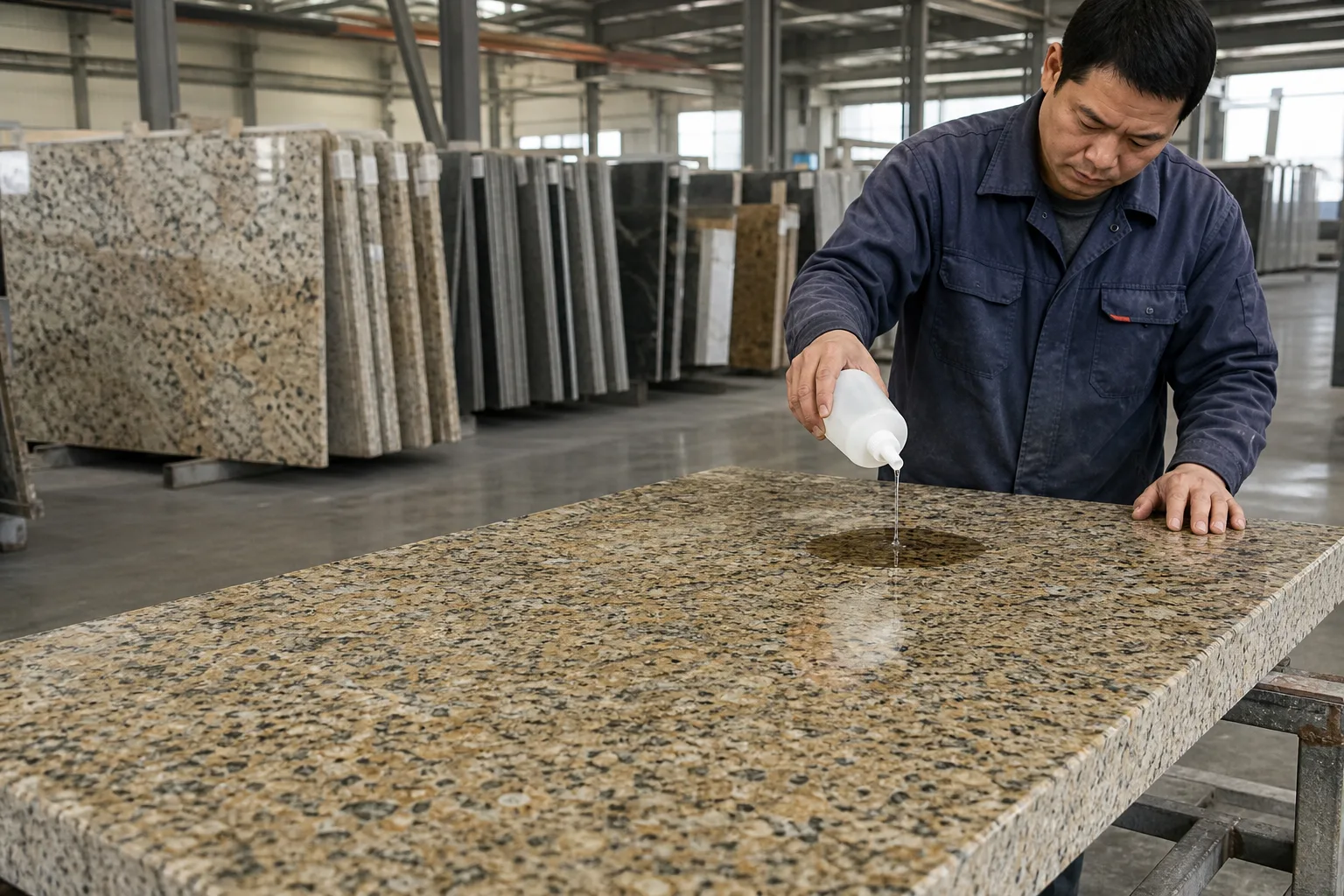
Does granite need sealing? Not always. Some granite surfaces benefit from an impregnating sealer because it slows the entry of water- and oil-based liquids. Other dense or previously treated granites absorb so little that an additional application may provide limited benefit or leave residue on the surface. The correct decision should be based on the actual stone, finish, application, treatment history and absorption behavior—not on color, trade name or a universal annual schedule.
When granite should—and should not—be sealed
The Natural Stone Institute states that many granite countertops do not require sealing, although many receive additional protection from a suitable sealer. It also emphasizes that sealing improves stain resistance rather than making stone stain-proof. In stone-industry terminology, the commonly used product is usually an impregnator: it penetrates near-surface pores and acts as a liquid repellent instead of forming an impermeable shell. See the Institute's position on sealing natural stone countertops and its care guidance.
Sealing is more likely to be useful when
- A clean, dry test area darkens readily after controlled contact with water.
- The surface will regularly encounter cooking oil, cosmetics, drinks or other potential staining agents.
- The finish exposes a more absorbent surface than the approved polished reference sample.
- The stone producer, sealer manufacturer or qualified stone professional recommends treatment for the specific material and use.
- A project specification requires an approved impregnator and defines the acceptance criteria.
Do not apply sealer automatically when
- Liquids remain on the surface without visible absorption during an appropriate screening test.
- The slabs have already received resin, impregnator or another factory treatment that has not been identified.
- A trial application causes haze, uneven gloss, darkening, tackiness or patchy color.
- The proposed product is not approved for the intended environment, including food-preparation areas where relevant.
- The stone is wet, dirty or otherwise outside the sealer manufacturer's application conditions.
Sealer cannot compensate for cracks, open joints, poor drainage, unsuitable substrates, incorrect installation or persistent moisture entering from another part of the assembly. It also does not make a surface scratch-proof, acid-proof or maintenance-free.
Geological granite, commercial granite and trade names
Geological identity
In geology, granite is a coarse-grained intrusive igneous rock associated principally with quartz and feldspar. The U.S. Geological Survey notes that the word is also used relatively broadly and that some rocks commonly called granite are technically other granitoid rock types. This distinction matters because products sold within the commercial granite category do not necessarily have identical mineral composition or pore structure. See the USGS overview of intrusive igneous rocks and granite.
Trade names are not performance specifications
A commercial name, color code or catalogue label helps identify a product in a transaction, but it does not establish absorption, quarry source, resin treatment, mineralogy or sealing need. Similar-looking material may be sold under different names, while one trade name may cover production with visible variation. A China-based processor may also fabricate imported blocks or slabs; the supplier's location does not by itself prove Chinese quarry origin.
For procurement, tie the name to physical evidence: approved samples, slab photographs, bundle or lot references, finish, dimensions and declared origin where origin is contractually important. Do not infer that all material carrying the same short code will respond identically to a sealer.
How finish and application affect the decision
Surface finish
Finish changes texture, reflectivity, cleanability and the area exposed at the surface. Polished granite is smooth and reflective; honed granite has a matte appearance; leathered, flamed, bush-hammered and split finishes introduce varying degrees of texture. An overview of common polished, honed and textured options is available in Marble.com's granite finish reference.
Do not assume that one sealing rule applies to every finish. Test the production finish rather than a polished sample if the order calls for honed, brushed, flamed or bush-hammered granite. A treatment that appears clear on a polished face may change the apparent color or sheen of a textured face.
Application exposure
| Application | Main sealing question | Practical review |
|---|---|---|
| Kitchen countertops | Will the surface encounter oils, colored liquids and frequent wiping? | Evaluate water and oil repellency, food-area suitability, appearance and cleaning instructions. |
| Interior flooring | Will treatment affect appearance, maintenance or slip-related requirements? | Approve the complete finish-and-treatment system on a representative sample. |
| Patios and exterior paving | Is moisture entering through the face or from the installation below? | Review drainage, substrate and vapor movement; sealer is not a remedy for trapped moisture. |
| Facades | Is a surface treatment compatible with the specified cladding system? | Follow the project designer's specification and assess appearance on a mockup. |
| Vanities and wet areas | Will cosmetics, soaps or standing water contact the stone? | Test the actual stone and confirm compatibility with cleaners and joint materials. |
Exterior exposure introduces concerns beyond face staining, including drainage, joints, anchorage, weather and freeze-thaw conditions. These must be assessed separately; sealing is only one possible component of the system.
Specifications and tests for a defensible decision
Laboratory absorption data
ASTM C97/C97M-26 provides methods for determining absorption and bulk specific gravity of dimension stone. ASTM describes absorption testing as useful for indicating differences among stones and as one element in comparing stones of the same type. The method does not, by itself, prescribe a maintenance interval or prove that a particular sealer is compatible. Refer to the current ASTM C97/C97M-26 scope.
ASTM C615/C615M-23 is the active material specification for granite dimension stone used for general building and structural purposes. It addresses physical-property categories including absorption, density and strength. These standards should be cited by exact designation and edition in project documents where required. A supplier statement that material is simply “ASTM quality” is insufficient without relevant test reports, specimen identification, test dates and a defined acceptance basis.
Water-drop screening
A granite water-drop test can be a useful field screening method. Place water on a clean, dry and inconspicuous area, observe whether the stone darkens, then wipe and allow it to dry. Repeat under consistent conditions on untreated and proposed-treated samples when possible.
This screening cannot replace standardized absorption testing. Results can be affected by surface moisture, existing resin or sealer, finish, contamination, droplet size and observation time. A temporary dark area may indicate absorbed moisture rather than a permanent stain; consult the guide to distinguishing water darkening from staining.
Minimum information to specify
- Commercial stone name and approved sample or slab reference.
- Product form, dimensions, tolerance and exact surface finish.
- Whether the stone is untreated, resin-treated, pre-sealed or otherwise coated.
- Sealer manufacturer, product name and current technical instructions if treatment is required.
- Required test area or mockup and acceptable limits for color or gloss change.
- Who applies the product, at what production stage and under what curing conditions.
- Removal procedure for excess material and acceptance criteria for haze or streaks.
- Required records, including batch identity, application date and inspection photographs.
Practical sealing and maintenance procedure
Always follow the written instructions and safety information for the selected product. Different formulations have different preparation, ventilation, application, dwell-time, excess-removal and curing requirements. Avoid substituting one product for another without repeating the compatibility trial.
- Identify the surface. Confirm the stone, finish and any resin, enhancer, wax or previous impregnator.
- Inspect before treatment. Record cracks, repairs, moisture marks, edge residue, gloss variation and contamination so they are not later attributed to sealing.
- Clean and dry. Use a stone-compatible method and allow the surface to reach the manufacturer's required condition.
- Test a representative area. Review the sample after it has fully cured, under the lighting used for approval.
- Apply uniformly. Maintain controlled coverage and prevent untreated overlaps, runs and pooling.
- Remove excess promptly. Material left on a dense surface can dry as haze or streaking rather than entering the stone.
- Protect during curing. Keep the surface away from water, contaminants and packaging contact for the stated period.
- Reinspect. Check color, sheen, residue and repellency against the approved control.
Do not adopt an automatic six-month or annual resealing rule without evidence. Reapply according to observed performance and the product manufacturer's instructions. Routine care should use a neutral cleaner, stone soap or mild liquid detergent as appropriate. Hydrofluoric-acid-containing products must not contact granite; the Natural Stone Institute warns that hydrofluoric acid attacks silicate minerals.
China sourcing, quality control and price factors
Questions for the supplier
When importing granite from China, request answers against the specific lot rather than accepting a general catalogue statement. Ask whether the slabs are resin-treated, whether a sealer is included in the quotation, and whether treatment occurs before or after cutting and finishing. Obtain the proposed product data and instructions before approving factory application.
Approval should cover both appearance and performance. A small sample may not reproduce the absorption behavior, repairs or finish consistency of full slabs, so use samples and mockups together with lot-specific photographs or slab selection where the project warrants it.
Pre-shipment inspection checklist
- Verify stone name, approved reference, finish and lot identification.
- Confirm whether inspection surfaces are clean and dry.
- Check for unexplained darkening, edge marks, residue, haze or uneven gloss.
- Compare treated pieces with the signed control sample under consistent lighting.
- Review repairs, fissures and resin separately from the sealer assessment.
- Confirm labeling and records for the applied product when sealing is specified.
- Check packing only after the required cure period stated by the manufacturer.
- Document findings through the agreed granite quality-control process or third-party inspection.
Price factors
Sealing cost depends on the product, coverage, number of applications, surface texture, drying and curing time, labor, testing, rehandling and the level of documentation. Textured or highly absorbent stone may require a different process from dense polished slabs. Correcting sealer haze or uneven enhancement can add rework and delay. Because these variables are order-specific, buyers should request a separate line item rather than assume sealing is included in the stone price.
The purchasing decision is therefore not simply “sealed versus unsealed.” Specify the stone, finish, exposure, treatment and acceptance method as one coordinated system. If the untreated granite already meets the project's stain-resistance and maintenance expectations, additional sealer may be unnecessary. If testing shows useful improvement without unacceptable appearance change, a compatible impregnator can provide an extra margin of protection.
Make the water-drop screen part of the sealing decision
Use the same distinction as the water-drop test guide: visible darkening on clean, dry stone is a field observation, not a standardized absorption percentage or a guaranteed answer about sealing. Note the finish, existing treatment, observation conditions and what happens after the water is wiped away and the area dries. There is no universal observation time in this guide that proves every granite needs a sealer.
If temporary darkening is observed, identify the actual stone and existing treatments, then ask whether a compatible impregnator would provide a useful improvement for the intended use. Trial the selected product on representative material, follow its instructions and review the cured appearance. If the surface does not visibly darken in a screen, do not turn that observation into proof against oil staining or every other exposure.
Laboratory absorption testing is a different task. ASTM's public absorption-method scope describes a test used to compare dimension stones; it does not provide a resealing schedule for the countertop being viewed. Keep lab reports, field observations and product compatibility decisions separate.
Resolve deposits, suspected etching or treatment haze before adding another coating. The white-scale decision near taps explains why a pale patch is not by itself evidence that the stone needs sealing. Follow the specific manufacturer's cleaning and reapplication instructions rather than an automatic calendar rule.
Frequently asked questions
Does every granite countertop need to be sealed?
No. Some dense or previously treated granite surfaces may gain little from another application. Test the exact stone and finish, identify existing treatments and follow the stone or sealer manufacturer's guidance.
How can I tell whether granite needs sealing?
Use a controlled water-drop screening test on clean, dry stone and watch for darkening that indicates moisture entry. Treat this as a field screen rather than a substitute for laboratory absorption data or a compatibility trial.
How often should granite be resealed?
There is no reliable universal interval. Reapply only when performance indicates a need and in accordance with the selected product's instructions. Finish, exposure, cleaning practices and previous treatments can all affect service life.
Can granite sealer prevent all stains and damage?
No. A compatible impregnator can improve resistance to liquid penetration, but it does not make granite stain-proof, scratch-proof or acid-proof. It also cannot correct drainage, installation, joint or persistent-moisture problems.
Should imported granite be sealed before shipping from China?
Only if factory treatment is specified and approved through a representative trial. Confirm the stone lot, finish, existing resin treatment, sealer identity, application procedure, curing time and inspection criteria before production.
Questions & discussion
Share a question or a useful experience about this guide. Comments appear immediately. Your name and comment are public. Email is optional and stays private; reply emails are not enabled yet. Comment privacy.