
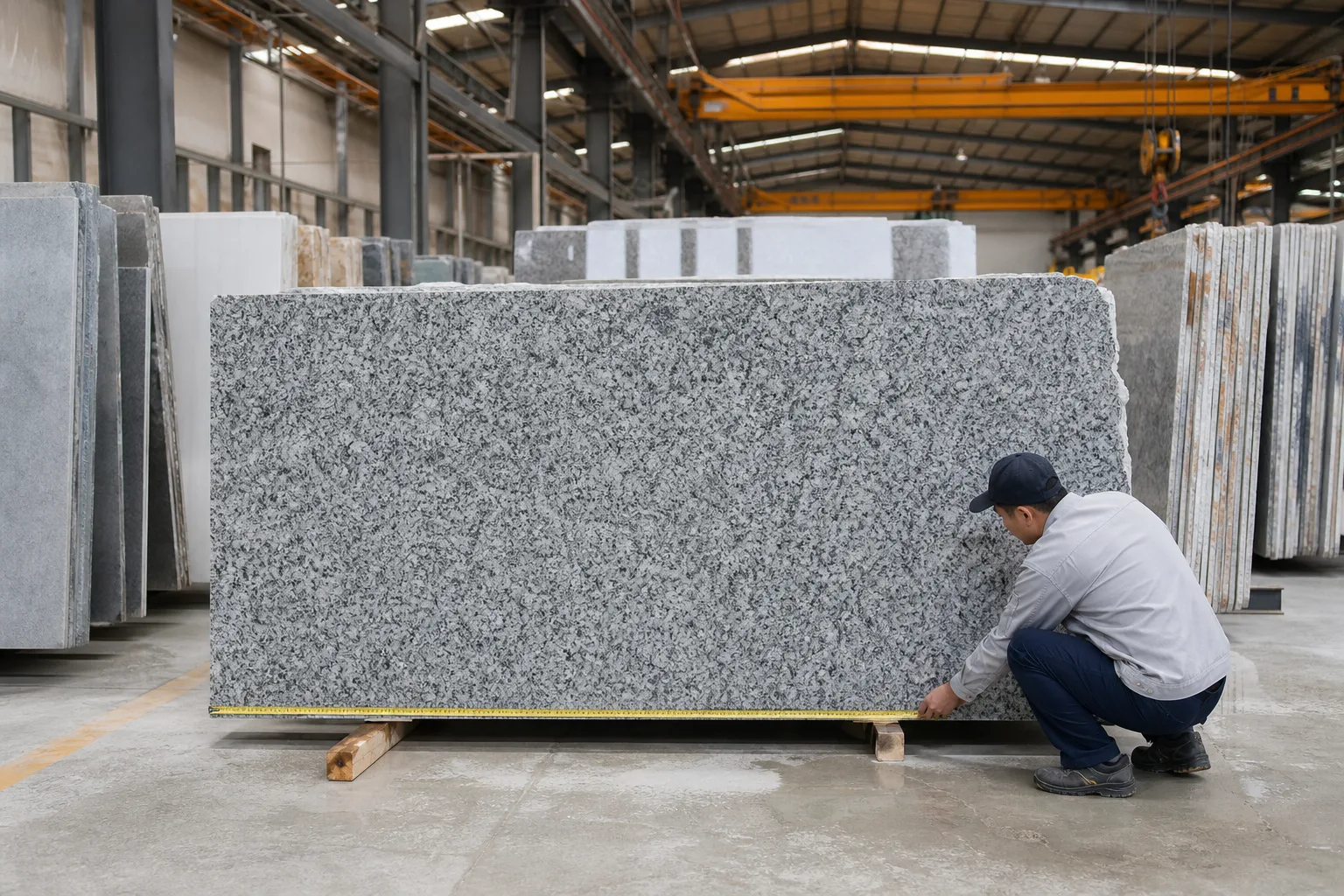
Granite slab sizes and tolerances are not controlled by one universal size chart. Slabs are cut from natural blocks, so their dimensions depend on block geometry, sawing equipment, trimming, defects and the selected finish. Chinese supplier listings commonly quote nominal formats such as 2400 × 1200 mm, 2700 × 1500 mm and 3000 × 1600 mm, with 18, 20 and 30 mm among the listed thicknesses. These are market examples rather than guaranteed standards. A purchase specification should state the required usable dimensions, finished thickness, permitted deviation, finish, edge condition and inspection method.
Key numbers
| Indicator | Reference value or method | Standard and limit |
|---|---|---|
| Listed slab examples | 2400 × 1200; 2700 × 1500; 3000 × 1600 mm | Seller examples already described below; not guaranteed standard sizes |
| Listed nominal thicknesses | 18, 20 and 30 mm | Agree finished tolerances and usable size; ASTM C615 does not replace drawings |
Common Granite Slab Sizes
A slab should be described by length, width and thickness in one measurement system. Avoid combining rounded inch dimensions with exact metric requirements. ASTM C615/C615M treats SI and inch-pound values as separate systems and warns that combining them may cause non-conformance. For international sourcing, a fully metric specification is usually the clearest approach.
| Commercial description | Indicative dimensions encountered in listings | Typical sourcing purpose | Points to confirm |
|---|---|---|---|
| Small or strip slab | Approximately 1800–2400 mm long and 600–900 mm wide | Stairs, sills, narrow tops and cut-to-size production | Usable width, end cracks, thickness and quantity per bundle |
| Standard slab | Examples include 2400 × 1200 mm and 2700 × 1500 mm | Countertops, wall panels, flooring and general fabrication | Whether dimensions are minimums, averages or individual measurements |
| Large slab | Examples include 3000 × 1600 mm and larger seller-specific formats | Large islands, long countertops and reduced-seam layouts | Handling limits, soundness, usable area and shipping-frame capacity |
| Nominal thickness | 18, 20 and 30 mm are frequently listed; other thicknesses are available by project | Selected according to fabrication and engineering requirements | Finished versus sawn thickness, calibration, local variation and edge build-up |
The examples above summarize formats visible in Chinese marketplace listings, including a StoneContact listing that identifies 2400 × 1200 mm, 2700 × 1500 mm and 3000 × 1600 mm slabs. They do not establish industry-wide availability. Ask for an inventory list or slab photographs with measured dimensions before planning a cutting layout.
Nominal size versus usable size
Nominal size is the commercial description. Usable size is the sound rectangular area available after excluding rough ends, broken corners, fissures requiring removal, resin-heavy margins and other agreed defects. A slab described as 3000 × 1600 mm may provide less usable area if its edges are irregular. State whether the order requires a minimum full rectangle or permits irregular perimeter areas.
Geological Identity and Trade Names
Dimension stone is natural rock quarried as blocks or slabs to meet requirements for size, shape and architectural or engineering use, according to the U.S. Geological Survey. Dimensions are therefore only one part of selection; pattern, grain, finish, strength and durability also matter.
Scientific granite is an intrusive igneous rock, but the commercial granite category is broader. The Natural Stone Institute explains that gabbro, diabase, anorthosite, gneiss, basalt and some other rocks may be sold in the granite group because of their general working and performance behavior. Consequently, a trade name alone does not prove petrographic identity, quarry location or technical performance.
- Record the commercial name and any known alternative names.
- Request the declared country and quarry region separately from the trade name.
- Do not assume that two suppliers using the same name are offering the same quarry, color range or geological material.
- For performance-critical work, request current test reports tied to the offered stone and required test method.
- Approve representative slabs or a defined range rather than relying only on a small sample.
See the main granite reference and the separate sample-versus-slab guide for these distinctions.
How to Specify Dimensional Tolerances
A tolerance is the permitted deviation from a stated value. It is not the same as the nominal dimension. For example, “20 mm granite” states a target thickness but does not explain how much variation is acceptable, where measurements will be taken or whether the value applies before or after finishing.
ASTM C615/C615M covers material characteristics, physical requirements and sampling for granite dimension stone used in building and structural applications. It should not be treated as a substitute for project drawings, fabrication dimensions or an agreed inspection plan. The Natural Stone Institute’s Dimension Stone Design Manual separately addresses fabrication and installation tolerances, emphasizing that critical dimensions affect appearance and structural integrity.
Dimensions to define in the purchase specification
| Control item | Specification question | Suggested verification method |
|---|---|---|
| Length and width | Is the value nominal, minimum or target with plus/minus tolerance? | Steel tape at agreed edge locations |
| Thickness | Does the limit apply to each reading, the slab average or variation within one slab? | Calibrated thickness gauge at a defined grid of points |
| Flatness or bow | What maximum gap is permitted over what reference length? | Straightedge and feeler gauges on a supported slab |
| Squareness | Is the requirement based on diagonal difference or corner measurement? | Compare diagonals on trimmed rectangular pieces |
| Edge straightness | Are rough slab edges acceptable, or must a minimum rectangle be obtainable? | String line or straightedge along the reference edge |
| Fabricated size | Are cut-to-size dimensions measured before or after edge finishing? | Measure finished pieces against approved drawings |
| Finish consistency | What visual range, gloss level or texture reference applies? | Approved control sample under specified lighting |
Do not copy a tolerance from an unrelated countertop, paving or cladding specification. Required accuracy depends on application, piece size, joint design, support conditions, edge treatment and installation method. Where a published tolerance conflicts with the contract documents, the parties should resolve the hierarchy before production.
A clear thickness clause
A workable clause identifies the nominal finished thickness, permitted individual readings, maximum variation within one piece, gauge type, measurement locations and treatment of textured surfaces. For flamed or bush-hammered granite, clarify whether thickness is measured to the highest texture points, an average plane or the sawn back. This prevents a rough finish from being judged as though it were a calibrated polished surface.
Finish, Application and Size Selection
Finish changes appearance and may also alter measured thickness, edge definition and inspection conditions. Marble.com distinguishes polished granite by its reflective surface, honed granite by its matte appearance and leathered granite by its textured surface. Flamed, sandblasted, sawn and bush-hammered finishes are also used, particularly outside countertop work.
- Polished slabs: Surface reflection makes waviness, scratches and inconsistent polishing easier to see. Review under controlled lighting.
- Honed slabs: Specify the approved color and sheen because honing may make some materials appear lighter or less saturated than polished stone.
- Leathered or brushed slabs: Texture can complicate thickness readings and cleaning. Approve the texture range.
- Flamed or bush-hammered slabs: Surface relief must be considered when setting finished thickness and joint expectations.
- Split-face pieces: Natural relief makes overall thickness different from the backing or bedding thickness. Define both if installation depends on them.
Review granite finishes, including polished, bush-hammered and split-face stone, before fixing the measurement method.
Application affects the required format
Kitchen countertops may prioritize slab length, cutout positioning and seam planning. Flooring requires attention to calibrated thickness, squareness, joint width and lippage after installation. Facade panels require engineering, anchorage design and material test data rather than selection by slab thickness alone. Stairs, patios, driveways and landscape units have different load, support and exposure conditions. Thickness for these applications should be determined from the complete assembly and project design.
Inspection Checklist for Slabs and Cut-to-Size Work
Inspection should compare production with approved documents, not with an unwritten expectation. The purchase order, drawings, approved sample, slab layout, defect standard and inspection plan should use consistent terminology.
Before production
- Confirm the material name, finish, nominal thickness and required usable slab size.
- Approve the acceptable color, grain, movement and natural-feature range under defined lighting.
- Issue cutting drawings with dimensions, edge details, cutouts, joint locations and piece numbers.
- Define the sampling level and whether dimensions are checked on every piece or an agreed sample.
- Identify measuring tools, measurement points and rounding rules.
- State how repairs, resin, mesh backing, fissures, chips and broken corners will be classified.
During or after production
- Verify labels and piece numbers against the packing list.
- Measure length, width and thickness using calibrated tools.
- Check diagonals where squareness is required.
- Inspect flatness on appropriate supports rather than against an uneven floor or frame.
- View finish and color in consistent light after cleaning and drying the surface.
- Check polished faces for scratches, dull bands and edge-to-center differences.
- Confirm that finished edges, holes, slots and cutouts match the approved drawings.
- Photograph non-conformities with a scale or gauge visible.
- Separate accepted, repairable and rejected pieces before packing.
For a broader framework, use the granite quality-control guide, defect reference and third-party inspection guide.
Price and Yield Factors
Slab dimensions influence cost through yield rather than area alone. An oversized slab may reduce seams on one project but create more offcut on another. Small defects near a cutting line can also reduce the number of usable pieces even when the invoiced slab area is unchanged.
Relevant price factors include raw block size and grade, finished thickness, calibration, finish, reinforcement, repair requirements, cut-to-size complexity, edge processing, inspection, packing and shipment configuration. Tight project-specific tolerances may require extra sorting or processing. Large formats can increase handling and breakage exposure. None of these factors supports a universal price premium; request a quotation tied to drawings, quantities and acceptance criteria.
Compare the quoted basis carefully: gross slab area, net usable area, finished-piece area and container quantity are different measures. The China granite price guide explains the main quotation variables without treating marketplace prices as fixed benchmarks.
China Sourcing Context
China-based listings show a broad range of nominal slab and cut-to-size formats, but a listing is evidence of an offer, not proof of current stock, quarry continuity, production capability or compliance. Confirm the actual material, slab dimensions, lot quantity and processing route for each order.
A practical inquiry should include a dimension schedule, finish reference, quantity by size, tolerance table, inspection method, packing requirement and required documents. Request dated slab photographs or video with visible measurements when layout depends on individual dimensions. For patterned stone, approve the slab layout and seam plan before cutting.
Supplier type does not by itself establish quality. Determine which party controls material selection, processing, inspection and corrective action. Useful background references include importing granite from China, evaluating Chinese granite suppliers, factory versus trading company and container loading.
The central rule is simple: buy to a written, measurable specification. Nominal slab sizes help with early planning, but approved usable dimensions, project-specific tolerances and documented inspection determine whether the stone will fit its intended application.
Stone properties
density and weight · compressive strength · water absorption · slip resistance · water-drop screening · freeze thaw
Printable working records
Use these blank records to document your own order and observations: Granite Specification Enquiry Record. They can be filled in the browser or printed for handwritten notes.
Build your specification text
Use the specification builder to combine your entered requirements with the existing tolerance and sample approval wording from these guides. It provides copyable text and has no submission function.
Frequently asked questions
What is the standard size of a granite slab?
There is no single universal standard size. Chinese marketplace listings commonly show nominal formats around 2400 × 1200 mm, 2700 × 1500 mm and 3000 × 1600 mm, but dimensions vary by block, material and supplier. Confirm the minimum usable rectangle for the actual slabs.
Are 20 mm and 30 mm granite slabs exactly that thick?
Not necessarily. These are normally nominal thicknesses. The order should state the permitted individual readings, variation within each slab, measurement locations and whether the thickness applies before or after finishing.
Does ASTM C615 define every granite slab tolerance?
No. ASTM C615/C615M addresses material characteristics, physical requirements and sampling for granite dimension stone. Project drawings and specifications must still define slab dimensions, fabrication tolerances, finish, edge conditions and inspection procedures.
How should granite slab dimensions be checked before shipment?
Use calibrated tapes, thickness gauges, straightedges and feeler gauges according to a written inspection plan. Check usable length and width, thickness at defined points, flatness, edge condition, finish, repairs and correspondence with approved cutting drawings.
Questions & discussion
Share a question or a useful experience about this guide. Comments appear immediately. Your name and comment are public. Email is optional and stays private; reply emails are not enabled yet. Comment privacy.