
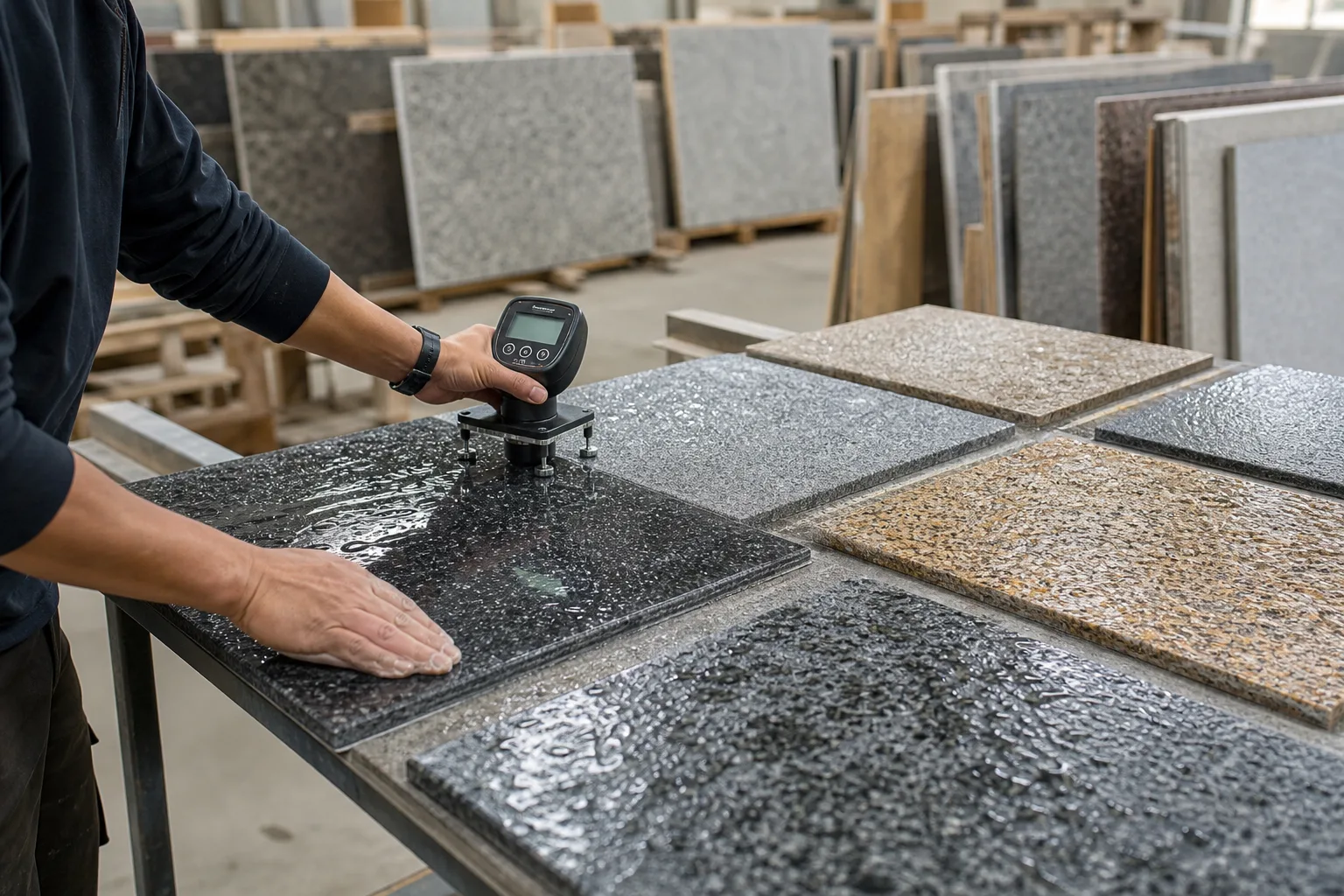
Granite slip resistance is primarily a property of the finished walking surface under defined conditions, not a guaranteed characteristic of granite as a geological category. A polished tile, a honed tile and a flamed paver cut from the same stone can perform differently when dry, wet or contaminated. For practical specification, identify the application and expected exposure, select a finish, state an applicable test method and acceptance requirement, and test representative production samples. Do not approve flooring from a trade name, photograph or untested hand sample alone.
Key numbers
| Indicator | Reference value or method | Standard and limit |
|---|---|---|
| British Pendulum | ASTM E303-22 | No universal pass value specified here |
| Dynamic coefficient of friction | ANSI A326.3 | Select project-specific use, condition and criterion; do not convert between methods |
What determines granite slip resistance?
Slip resistance describes the interaction among the floor surface, footwear or bare feet, contaminants and movement. Granite composition can influence how a finish develops, but the final texture and service conditions are usually more relevant to pedestrian safety than the commercial stone name.
Surface texture and finish
A highly polished surface has limited surface relief and may become more difficult to walk on when water, oil, dust or cleaning residue separates footwear from the stone. Textured finishes create different degrees of microtexture and macrotexture, but a rough appearance is not a substitute for measured performance. Texture depth, uniformity and exposed mineral grains can vary between stones and between production runs.
Water, contaminants and maintenance
Test reports should state whether the specimen was evaluated dry, wet or under another defined condition. Entrances, commercial kitchens, pool surrounds and exterior paving have different contamination risks. Drainage, slope, grout joints, footwear, cleaning products and maintenance frequency also affect the completed installation. A finish that performs adequately when clean may not remain adequate if grease, algae, sealer residue or compacted dirt accumulates.
Wear and installation
Traffic can alter the exposed texture over time. Installation details can also create local hazards even when the stone itself meets a specified result. Examples include lippage, ponding water, uneven joints, loose units and abrupt transitions. Slip-resistance review should therefore cover the whole walking surface rather than only the laboratory specimen.
Geological identity and commercial granite names
Geologically, granite is a coarse-grained intrusive igneous rock. The U.S. Geological Survey identifies granite as a common intrusive rock formed when magma cools slowly below the surface. It also notes that the term is used relatively broadly and that some rocks sold or described as granite may technically belong to related rock types. [1] [2]
In the dimension-stone trade, a name may identify a visual selection, quarry product or established commercial category rather than a strict petrographic classification. Similar-looking names do not prove identical mineralogy, quarry origin or performance. Conversely, one quarry material may be sold under several translated or distributor-assigned names.
What to record in a specification
- Commercial name and any local or supplier reference code.
- Declared quarry location or country of origin, when traceability is required.
- Petrographic description if geological identity affects the project decision.
- Approved range sample showing acceptable color, grain and natural variation.
- Exact finish name plus a physical finish-control sample.
- Product format, thickness, edge treatment and intended application.
None of these identifiers establishes slip resistance by itself. The tested specimen must correspond to the stone, finish and production condition being supplied.
How common granite finishes compare
Granite can be processed into polished, honed, leathered, sawn, sandblasted, flamed, bush-hammered and other finishes. Published finish descriptions confirm that polished granite is reflective, honed granite is matte, and flamed or bush-hammered treatments are among the textured finishes used beyond conventional countertop work. [3] Finish terminology is not fully self-defining: two factories can produce noticeably different textures under the same label.
| Finish | Typical surface character | Potential applications | Specification caution |
|---|---|---|---|
| Polished | Smooth, reflective and low-relief | Countertops, walls and selected dry interior areas | Do not assume suitability for wet or contaminated walking areas; require project-specific review and testing. |
| Honed | Smooth matte or satin surface | Interior floors, walls and countertops | Hone level can vary. Approve a control sample and test the intended surface condition. |
| Leathered or brushed | Textured surface following mineral structure | Countertops and some low-traffic design applications | Texture may be irregular and harder to clean; it is not automatically a tested flooring finish. |
| Flamed | Thermally textured, visibly granular surface | Exterior paving, patios and steps | Appearance and relief depend on mineral response and processing. Confirm uniformity, cleanability and tested performance. |
| Bush-hammered | Regularly pitted mechanical texture | Exterior paving, stairs and landscaping | Specify texture grade or an approved sample. Deep texture may affect cleaning and barefoot comfort. |
| Sawn or sandblasted | Tool-marked or fine abrasive texture | Paving, cladding and selected floors | Fine textures can differ substantially between machines and production lots. |
| Split face | Irregular natural-looking relief | Walls, landscape units and limited paving formats | Check dimensional regularity, trip risk and accessibility before considering pedestrian surfaces. |
For stairs, ramps, pool decks and exposed exterior paving, finish selection should be coordinated with drainage, nosings, joints and applicable building requirements. No finish should be described as “non-slip,” because no pedestrian surface eliminates slipping in every condition.
Test methods and specification limits
A useful test requirement names the method, specimen condition, surface finish, contaminant or wetting procedure, reporting unit and acceptance criterion. A coefficient or pendulum value without this context is incomplete because results from different instruments and protocols are not necessarily interchangeable.
British Pendulum testing
ASTM E303-22 covers measurement of surface frictional properties with the British Pendulum Tester. ASTM states that the instrument can be used on flat surfaces in the laboratory or field and warns that its results do not necessarily agree or correlate with results from other friction or skid-resistance equipment. [4] A result reported under ASTM E303 should therefore not be converted casually into a value from another method.
Dynamic coefficient of friction
The Natural Stone Institute lists dynamic coefficient of friction testing among its laboratory services for natural stone surfaces, including testing referenced to ANSI A326.3. It also lists physical tests for absorption, strength and abrasion, which may be separately relevant to a flooring specification. [5] The project professional should select the method and criterion appropriate to the jurisdiction and use rather than applying an isolated threshold from another product category.
Outdated or mismatched references
ASTM C1028, a static coefficient of friction method historically applied to ceramic tile and similar surfaces, was withdrawn in 2014. [6] If an existing drawing or purchase specification cites that method, obtain clarification rather than silently replacing it, testing under an unrelated procedure or presenting an old result as evidence of current compliance.
Requirements differ by country, authority, project type and date. Confirm the current governing code, standard edition and contractual threshold with the architect, safety consultant or other qualified specifier.
Production approval and quality-control checklist
Slip-resistance control should begin before mass production. A small color sample may not reproduce the texture made on full-size equipment, while a laboratory specimen prepared separately from the order may not represent shipped goods.
Before ordering
- Define the use area, including interior or exterior exposure, expected water, contaminants, footwear and barefoot use.
- Confirm the commercial stone name and requested finish without treating either as proof of performance.
- Obtain finish samples large enough to assess texture, appearance and cleaning behavior.
- State the test method, test condition, sampling plan and acceptance requirement in the purchase specification.
- Identify who selects specimens, who pays for retesting and what happens if results fail.
- Approve color and finish separately where one sample cannot represent both adequately.
During production and inspection
- Compare production with the signed or sealed control sample under consistent lighting.
- Check texture across the face and from piece to piece, not only on one convenient unit.
- Inspect for polished bands, untreated edges, tool transitions and local smooth spots.
- Verify dimensions, thickness, squareness, warpage, edge condition and visible defects.
- Record the production lot and the location from which test specimens were selected.
- Keep retains from the approved lot when later verification may be necessary.
- Review packaging methods so textured faces are not abraded, contaminated or pressed against staining materials.
Field testing may be useful after installation, but it should not be used to excuse an undefined material specification. Completed-floor results can be influenced by installation, cleaning, weather and site contamination as well as factory finishing.
Applications, price factors and China sourcing
Matching the finish to the use
Polished granite is commonly associated with countertops and decorative surfaces, while textured finishes are frequently considered for exterior paving, patios, driveways, landscaping and stair treads. Interior flooring requires a balance among measured slip resistance, cleaning, appearance and traffic. Facades do not normally require pedestrian slip testing, although their finish may still be controlled for appearance and weathering.
The Natural Stone Institute notes that slip-resistance testing is relevant to walking applications but would not normally be necessary for a vertical stone application with no foot traffic. It also emphasizes selecting tests according to the intended use. [7]
Price factors
A slip-resistant granite finish can affect cost through processing speed, tooling, additional handling, sample development, testing and rejection risk. Other price variables include stone availability, block yield, dimensions, thickness, edge work, quantity, packing, inland transport and commercial terms. Deep or tightly controlled textures may require more processing than a supplier's standard finish. No general price premium should be assumed without a written quotation based on the same material, dimensions, finish sample and inspection scope.
Sourcing from China
China-based stone listings show a broad commercial market for granite slabs, tiles and cut-to-size products, including polished, flamed and bush-hammered offerings. Such marketplace listings establish availability claims only; they do not independently verify quarry origin, factory ownership, testing competence or production consistency. [8]
For a China order, issue a bilingual or visually unambiguous finish specification where practical. Ask whether the contracting company performs the finishing itself or subcontracts it, but verify the answer through documentation, samples or an audit rather than assumption. Testing should use specimens traceable to the proposed material and production finish. For large or safety-sensitive orders, consider pre-production samples, an initial production review and random lot selection by an independent inspection or laboratory party.
The central procurement rule is simple: purchase the tested stone-and-finish combination, not a generic promise that granite is slip resistant. Clear test conditions, representative sampling and production controls provide stronger evidence than stone names, finish labels or supplier descriptions alone.
Stone properties
density and weight · compressive strength · water absorption · water-drop screening · freeze thaw · sizes and tolerances
Frequently asked questions
Is granite naturally slip resistant?
Not as a universal material property. Slip resistance depends on the surface finish, moisture, contaminants, footwear, wear and test method. The same granite can produce different results when polished, honed, flamed or bush-hammered.
Which granite finish is best for wet outdoor paving?
Textured finishes such as flamed or bush-hammered granite are often considered for wet exterior paving, but a finish name alone is insufficient. Specify drainage and installation details, approve a physical texture sample, and require testing under conditions relevant to the project.
Can slip-resistance results from different test methods be compared?
Not directly unless the applicable standards provide a validated relationship. Instruments, sliders, preparation procedures and reporting units differ. ASTM E303 specifically cautions that its results do not necessarily correlate with those from other methods.
What should buyers request from a Chinese granite supplier?
Request traceable stone identification, a signed finish-control sample, dimensions and tolerances, the required test method and condition, representative production testing, lot records and agreed inspection criteria. Supplier statements should not replace test evidence or production verification.
Questions & discussion
Share a question or a useful experience about this guide. Comments appear immediately. Your name and comment are public. Email is optional and stays private; reply emails are not enabled yet. Comment privacy.