
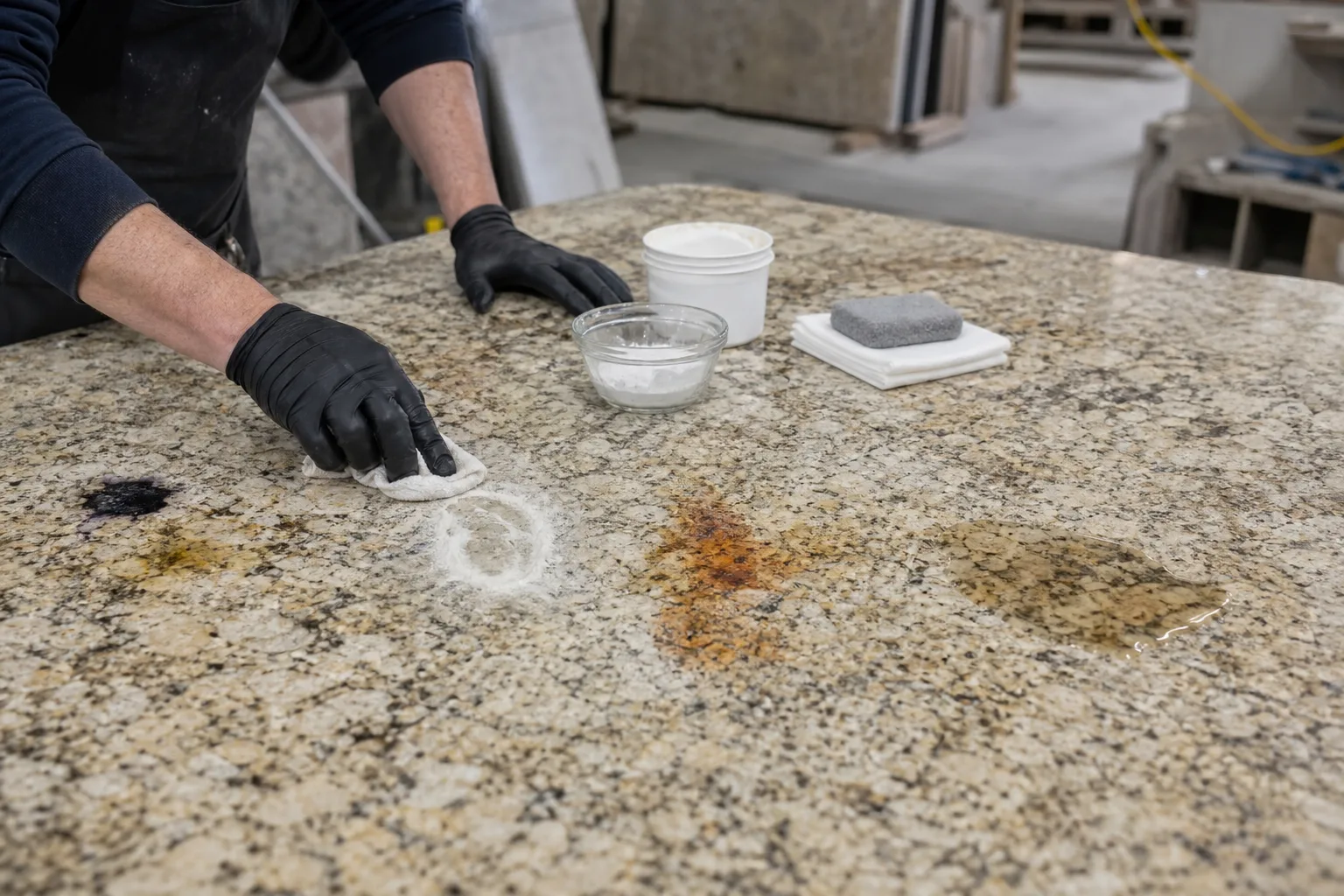
To remove stains from granite, first blot and clean the area with plain water and a small amount of mild soap. If a dark or colored mark remains after the stone has dried, identify the likely contaminant before selecting a treatment. Absorbed oil, food, ink and metal stains require different cleaning agents. A poultice—an absorbent powder mixed with a compatible cleaner—is the usual method for drawing a deeper stain from natural stone. Test every treatment in an inconspicuous area, follow the chemical manufacturer's instructions and stop if the color or finish changes.
Start by identifying the mark
Do not assume that every dark patch is a stain. Granite may show temporary moisture, mineral deposits, sealer residue, resin discoloration, surface contamination or physical finish damage. Applying a strong cleaner before establishing the cause can make diagnosis more difficult.
Immediate response to a spill
- Blot the liquid with a white paper towel or absorbent cloth. Do not wipe it across a larger area.
- Rinse with clean water and a small quantity of mild, neutral cleaner.
- Rinse again so that no soap film remains.
- Dry the surface with a soft white cloth.
- Allow the granite to dry fully before judging the remaining mark.
The Natural Stone Institute advises blotting rather than wiping and states that identifying the type of stain is central to selecting a treatment. It distinguishes surface stains, which may respond to cleaning, from deep contamination that may require a poultice or professional attention. Natural Stone Institute stain-removal guidance.
Stain, moisture or surface damage?
- Absorbed stain: remains after drying and often follows the outline of a spill or object.
- Temporary moisture: usually appears darker and gradually fades as the stone dries. Check the moisture source before applying chemicals.
- Hard-water deposit: feels rough, chalky or crusted and sits on the surface rather than within the stone.
- Etch or finish damage: appears duller under angled light. Cleaning cannot restore material that has been physically or chemically altered.
- Sealer haze: may look streaky, cloudy or uneven rather than following the shape of a spill.
For uncertain dark patches, compare the behavior with the diagnostic steps in the water-or-stain guide before beginning a poultice.
Confirm the material and trade name
Geological identity
Scientific granite is a visibly crystalline igneous rock associated with quartz and feldspar. In the dimension-stone market, however, “granite” is also used as a broader commercial category that can include several hard crystalline igneous and metamorphic stones. The U.S. Geological Survey defines dimension stone as natural rock quarried into blocks or slabs that meet requirements for size, shape, color, pattern and finish. USGS dimension-stone overview.
This distinction matters because stones sold within the commercial granite group do not all have identical absorption, mineral composition, resin treatment or chemical response. A stain-removal method that is acceptable for one material may alter another.
Trade names are not technical specifications
A trade name may describe color, locality, pattern or market convention, but it does not by itself establish geological identity or maintenance performance. Similar-looking materials may be sold under different names, while one name may be applied to material from more than one production lot. Confirm the approved sample, slab photograph, finish and treatment history. For Chinese procurement, an alphanumeric name such as G603 should still be tied to a defined reference sample rather than accepted as complete proof of source or performance.
Choose a treatment by stain type
The following table is a practical decision aid, not a universal chemical prescription. Begin with the least aggressive option and use a stone-specific commercial product when its label clearly covers the material and contaminant.
| Observed mark | Likely source | First controlled action | When to escalate |
|---|---|---|---|
| Brown, yellow or pink discoloration | Coffee, tea, wine, fruit, leaves or other organic matter | Clean with neutral cleaner; if absorbed, use a manufacturer-approved peroxide-based stone poultice after a patch test | If the stone lightens, the finish changes or several applications produce no improvement |
| Dark translucent patch | Cooking oil, grease, cosmetics, sealant or putty | Remove surface residue, then use an absorbent poultice formulated for oil | If the source is construction sealant, adhesive or contamination from below |
| Orange or brown mark shaped like metal | Iron or rust | Remove the metal source and use only a stone-compatible rust treatment | Deep rust can be permanent; avoid improvised acidic rust removers |
| Green or muddy-brown mark near metal | Copper, bronze or brass corrosion | Correct the moisture and metal contact before treating the stone | Use a stone conservator or restoration contractor for persistent marks |
| Pen or marker line | Ink or dye | Blot fresh ink; select a stone-specific ink remover suitable for the granite color and existing treatment | If the slab contains resin, surface coating or unknown enhancement |
| White crust or ring | Hard-water minerals or surface residue | Soften with neutral cleaner and remove carefully with a plastic scraper or non-scratch pad | If deposits are extensive or an acidic descaler would be required |
| Green, black or biological growth | Algae, mildew, lichen or fungi | Address drainage and use a labeled stone-compatible biological cleaner | For recurring exterior growth, failed joints or moisture entering the assembly |
| Cloudy or streaked appearance | Sealer haze, cleaner film or finish variation | Review the product used and test the manufacturer's recommended residue-removal method | If mechanical refinishing may be necessary |
Never mix bleach with ammonia or combine cleaning products unless the manufacturer expressly permits it. Use gloves, eye protection and ventilation appropriate to the product label. Keep solvents and oxidizing cleaners away from flames, food and incompatible materials.
How to apply a granite poultice
A poultice combines an absorbent white material with a cleaning liquid selected for the stain. As the mixture dries, it can draw dissolved contamination toward the surface. The Natural Stone Institute describes an application approximately 1/4 to 1/2 inch thick, extending beyond the visible stain, with a typical working and drying period of 24 to 48 hours. It also notes that repeated applications may be necessary and that some stains cannot be completely removed.
Practical procedure
- Record the condition. Photograph the stain under consistent lighting and note its dimensions, color and suspected source.
- Check the surface. Determine whether the granite is polished, honed, textured, sealed, resin-treated or coated.
- Patch test. Test the complete mixture on spare material or an inconspicuous location. Allow it to dry before evaluating color and gloss.
- Prepare the area. Remove loose contamination and dampen the stained area with distilled water if required by the selected system.
- Mix the poultice. Follow a stone-care product label or established professional procedure. The mixture should be a stable paste rather than a runny liquid.
- Apply evenly. Spread it with a wood or plastic tool, covering the stain and a margin around it.
- Cover and dry. Cover as directed, then permit the poultice to dry fully. Drying is part of the extraction process.
- Remove without scratching. Lift the dried material with a plastic or wooden scraper. Rinse according to the product instructions and dry with a white cloth.
- Reassess after drying. Do not judge the result while the granite is wet. Repeat only if the previous application improved the mark without damaging the surface.
Do not seal over an active stain or damp stone. A sealer may slow future absorption, but it does not make granite stain-proof. See the granite sealing guide and water-drop test guide for separate evaluation procedures.
Account for finish and application
Finish affects cleaning access and appearance
A polished finish is reflective and generally easier to wipe clean, but residue, haze and gloss changes can be conspicuous. Honed surfaces are matte and may show absorbed oils more readily. Leathered and other textured finishes can retain contamination in low areas and may require a soft brush that reaches the texture without abrading it. Bush-hammered, flamed and split surfaces require inspection from multiple angles because the apparent stain boundary can be difficult to distinguish from normal shadow and texture. Marble.com similarly notes that textured granite can trap dust and be more difficult to clean than polished material. Marble.com granite finishes overview.
Application changes the diagnosis
- Kitchen countertops: investigate oils, food colors, soap film, sealant and water around sinks and appliances.
- Flooring: check tracked oils, maintenance coatings, grout residue and moisture migration.
- Facades: consider metal runoff, failed joints, biological growth and water entering from behind the stone.
- Exterior paving and landscaping: examine drainage, leaves, fertilizer, irrigation water and contact with corroding metal.
Recurring stains often indicate an unresolved source rather than an ineffective cleaner. Moisture entering from a substrate, joint or fixing must be corrected before cosmetic treatment can remain successful.
Specifications, inspection and China sourcing
Specify stain-related requirements before ordering
ASTM C1528/C1528M-26 states that dimension-stone selection should consider the complete assembly and applicable building codes, not the stone in isolation. ASTM C615/C615M-23 covers material characteristics, physical requirements and sampling for granite dimension stone used in building and structural applications. A project specification should identify the required standard and test edition instead of accepting a generic statement that material is “ASTM quality.” ASTM C1528/C1528M-26 and ASTM C615/C615M-23.
For stain appearance and maintenance, the purchase specification should separately state the commercial name, approved reference sample, geological or petrographic information when required, finish, dimensions, edge treatment, resin or mesh backing, color enhancer, sealer and intended application. Test reports must identify the tested material and should not be assumed to represent every quarry face or production lot.
Inspection checklist
- Compare production with the approved sample under agreed lighting.
- Check for oil, rust, adhesive, marker and packing-transfer marks before loading.
- Inspect dry stone; wet surfaces can conceal or create apparent color differences.
- Verify finish consistency across pieces and between replacement lots.
- Record resin, sealer or enhancer use rather than treating these as undisclosed corrections.
- Confirm that packaging materials, metal straps and timber do not transfer contamination.
- Document nonconforming pieces with lot references and scaled photographs.
Use the granite quality-control guide and color-variation guide to establish acceptance rules before shipment.
China sourcing context and price factors
China-based listings may cover domestically quarried granite, imported stone processed in China, and products marketed with granite-like appearances. A marketplace listing is therefore a lead, not proof of quarry origin, geological identity, factory ownership or current capacity. StoneContact's China listings show multiple product forms, finishes and material descriptions, reinforcing the need to verify each offer against the purchase specification. StoneContact China granite supplier listings.
Stain-removal expectations and price should not be assessed independently. Relevant price factors include material selection, finish, thickness, cut-to-size complexity, resin or sealing treatment, dry-lay requirements, inspection scope, packing and replacement allowance. A lower quotation may exclude surface treatment, mockups, documented inspection or stain-related rejection criteria. Consult the China import guide, supplier guide and granite price guide when preparing procurement documents.
Prevent recurrence and know when to stop
- Blot spills promptly and keep routine cleaning neutral and low-residue.
- Use trays beneath oils, cosmetics, plants and corrodible metal objects.
- Keep joints, sink cutouts and exterior drainage details functional.
- Do not use vinegar, lemon juice or an unverified acidic descaler.
- Do not scrub polished granite with abrasive powders or aggressive pads.
- Do not assume that frequent sealing will correct moisture entering from below.
Stop do-it-yourself treatment if the granite changes color, loses gloss, develops a wider halo or contains unknown resin, dye or coating. Professional assessment is also appropriate for deep rust, extensive paint, recurring facade stains, valuable installations and contamination associated with structural moisture. Complete removal cannot be guaranteed: the result depends on the contaminant, depth, stone fabric, finish and previous treatments.
White water-scale near taps: identify the change first
A white patch around a tap can be a deposit sitting on the surface, a change in the surface itself, or residue from a treatment. The location suggests repeated water exposure but does not prove the cause. Photograph the clean, dry area in direct and side light, note whether the patch feels raised or looks dull, and record what products have already been used. Avoid scraping or adding a sealer simply to see whether the mark disappears.
| Observation | Possibility to investigate | First response |
|---|---|---|
| Pale raised or crusty residue where splashes dry | Mineral scale or a mixed deposit | Use a stone-compatible cleaning trial on an inconspicuous area; identify the stone and any treatment before choosing a remover. |
| A dull area that remains after compatible cleaning | Etching, abrasion or other surface change | Ask a stone restoration specialist to assess the finish rather than escalating cleaners. |
| Smears, streaks or haze after sealing | Excess treatment or other residue | Identify the applied product and consult its instructions and the sealer-haze guide. |
The Natural Stone Institute's care guidance distinguishes deposits and stains from damage to the surface and cautions against inappropriate cleaners. Start with a compatible mild cleaning method, rinse as instructed and dry the area. If residue persists, obtain a stone- and treatment-compatible product recommendation and follow its label. A remover suitable for one surface can damage a differently classified stone, a repair, the sealer or nearby fittings.
Do not assume that vinegar, toilet cleaner or an acidic descaler is safe because the worktop was sold as granite. Do not mix cleaning products or improvise stronger concentrations. Hydrofluoric-acid products must not contact natural stone. Repeated abrasive scrubbing can also change the finish. If identification or treatment compatibility remains uncertain, stop the trial and ask a qualified restorer to inspect a sample area.
Clean-up does not resolve the reason water repeatedly collects there. Check splash habits and ask an appropriate professional about persistent leakage or joint problems. Once the surface is clean and dry, consult the sealing decision; a new sealer is not a scale remover, an etch repair or a fix for persistent moisture.
Frequently asked questions
Can baking soda remove a stain from granite?
Baking soda can serve as an absorbent component in some poultices, particularly for oil-related marks, but it should not be scrubbed dry across a finished surface. Patch test the complete mixture and use a stone-specific product when the material or treatment history is uncertain.
How long should a poultice remain on granite?
A typical poultice procedure allows approximately 24 to 48 hours for working and drying, although the product instructions take priority. Judge the result only after the granite has dried completely.
Why is the granite still dark after cleaning?
The area may still contain absorbed contamination, or it may simply be wet. Moisture from the substrate, a leaking joint, sealer discoloration or natural mineral variation can also create a dark patch. Allow drying time and investigate the source before repeating treatment.
Can rust be completely removed from granite?
Shallow rust may respond to a stone-compatible rust poultice, but deep metal staining is difficult and can be permanent. Avoid generic acidic rust removers unless their manufacturer expressly approves them for the specific stone and finish.
Should granite be resealed after stain removal?
Resealing may be appropriate after the surface is clean and fully dry, but not every granite needs the same sealer or schedule. Confirm absorption, existing treatment and sealer compatibility first. Sealing improves resistance; it does not make stone stain-proof.
Questions & discussion
Share a question or a useful experience about this guide. Comments appear immediately. Your name and comment are public. Email is optional and stays private; reply emails are not enabled yet. Comment privacy.