
Yes: stone sold in the Chinese-granite category can have flowing bands that resemble marble. But that appearance is not a geological identity. A trade name identifies a commercial offering; “granite” may be a broader trade category, and batches can differ visibly. Your first step is to request the seller’s material description, supporting identification and representative samples from the proposed supply. Approve by physical sample range before placing the order. This file explains how to screen an offer, not how to identify a stone remotely.
Trade name vs what it is
A supplier’s White Wave listing illustrates that wave-patterned material is marketed in a Chinese-granite category (accessed October 8, 2026). That is evidence of a commercial description, not independent geological identification or verified provenance.
Keep separate fields for trade name, geological identity and batch reference. The Natural Stone Institute’s commercial-granite explanation notes that the trade grouping includes rocks beyond geological granite, including gneiss (accessed October 8, 2026).
A pale background with dark movement is an appearance description. It cannot establish mineral composition, durability or equivalence between suppliers. If geological identity matters to the specification, request a relevant petrographic report tied to the offered material. We have not authenticated a named stone or production batch here.
Three visual tells
Texture direction: follow the movement
Inspect a full slab, then its close-up. Trace whether dark features form continuous bands, isolated veins or scattered clusters. Mark the intended cutting direction on the layout; a cropped photograph can hide a dramatic turn in the pattern.
Gneiss can show aligned or folded mineral bands, as explained in the Institute’s gneiss guide (accessed October 8, 2026). Banding is a clue to investigate, not permission to label every flowing stone gneiss.
Crystal grains: examine the background
Look between the bands for visible grains and their relationships. Ask for focused close-ups alongside a scale, with the face dry and the lighting recorded. Sparkle alone is weak evidence: surface polish and reflections can obscure what you are seeing.
A crystalline appearance does not separate all commercial granite from marble; both can show crystals. We cannot name minerals reliably from a sales photograph.
Background uniformity: compare the range
Compare quiet areas, darker concentrations and transitions across the proposed slabs. Use the same finish, dry condition and lighting for comparisons. Record the extremes you accept instead of selecting only the most attractive corner.
Cutting direction and natural variation can change the pattern even under the same trade name. A small sample cannot establish the appearance of an entire delivery.
Visual screening record
| Feature | What it can indicate | Limit |
|---|---|---|
| Aligned or folded bands | Directional movement relevant to cutting and seams | Not a geological identification |
| Visible grain boundaries | Texture worth examining more closely | Not proof of specific minerals or performance |
| Background changes across slabs | A range that needs approval | Photographs depend on lighting and processing |
| Sharp reflected shapes | A clue about surface reflectivity | Not proof of stone type, treatment or slip performance |
This is an original inspection framework, not a completed test report. Confirm its observations against the offered physical range.
Where buyers go wrong
The common mistake is making a catalogue photograph the acceptance standard. It records a selected view, lighting and finish; it may not represent the stock proposed for your order.
Another mistake is assuming the sample and shipment share a batch because their trade names match. Link sample IDs to proposed slab or block references, retain approval records and check production against them. Request disclosure of repairs, fillers and surface treatments before approval.
Matching appearance does not verify geological identity, and matching identity does not guarantee matching appearance. We have no evidence that a particular seller’s sample represents its current inventory.
What to put in your PO
Use a material description that separates identity from appearance, then attach the approval record:
Trade name: [seller’s exact name]. Geological identity: [supported description, or pending verification]. Batch/slab references: [IDs]. Finish: [agreed finish and reference]. Acceptable appearance: [background range, band intensity, direction and mineral clusters]. Approve by physical sample range: [signed sample IDs and approval date]. No substitution without written approval.
Add dimensions, thickness, agreed tolerances, edge details and inspection conditions. Retain matching signed samples with buyer and supplier; use a layout approval where seam continuity matters. Numerical acceptance limits must come from your project specification, not this example. This wording does not establish suitability for an application.
Limits
No specimen was handled or tested for this file. No quarry, origin, price or batch performance is verified. A qualified assessment may be needed to establish geological identity; visual screening cannot replace it. Always approve by physical sample range.
Over to you
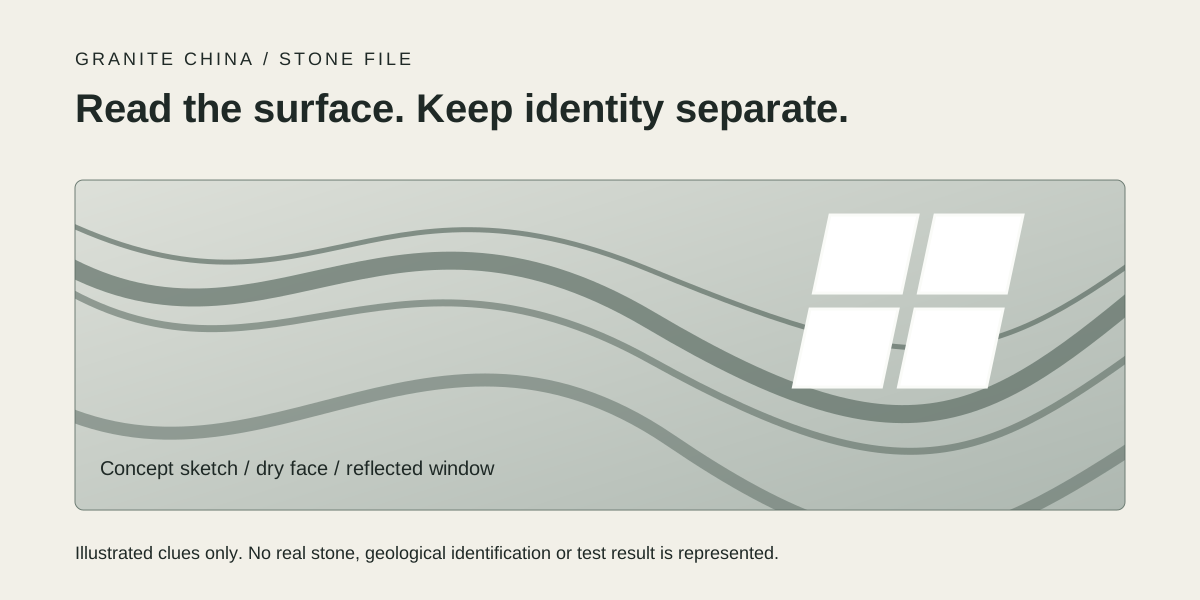
Guess the finish — polished, honed or flamed? Answer at the end.
Reveal the answer
Polished is the intended answer: the drawing shows a sharp reflection. Honed surfaces have a subdued sheen; flamed surfaces are textured. These finish distinctions are described in Selecting the Ideal Stone Finish (accessed October 8, 2026). The illustration cannot authenticate a real finish; inspect the physical reference.
Next steps
Read next:
Download the Stone Inquiry Template.
Printable working records
Use these blank records to document your own order and observations: Granite Sample Approval Record · Granite Specification Enquiry Record · Granite Receiving Inspection Record. They can be filled in the browser or printed for handwritten notes.
Questions & discussion
Share a question or a useful experience about this guide. Comments appear immediately. Your name and comment are public. Email is optional and stays private; reply emails are not enabled yet. Comment privacy.