
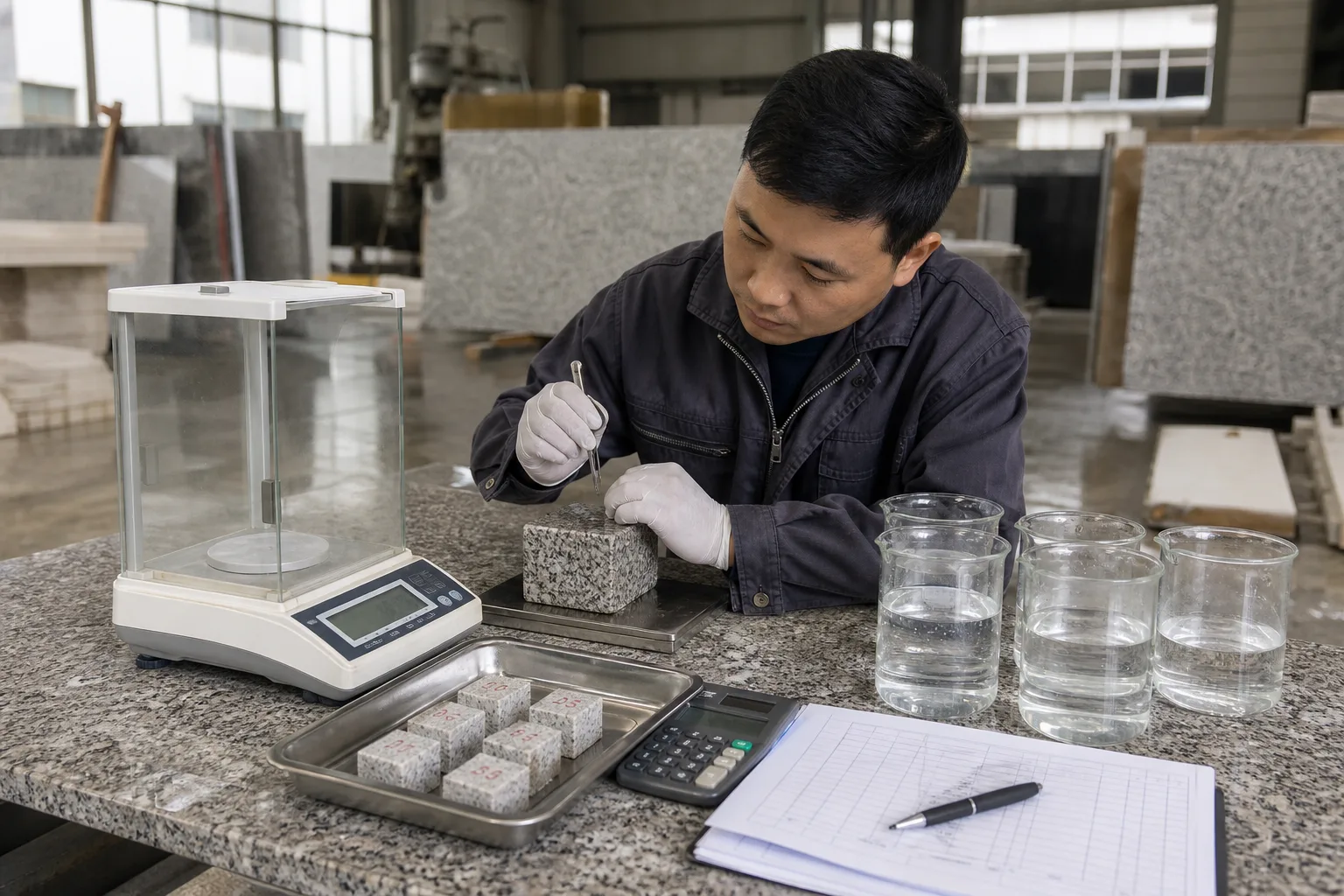
Granite water absorption is the amount of water a dry stone specimen takes up under defined laboratory conditions, normally reported as a percentage of its dry mass. It is useful for comparing materials and assessing moisture-related risk, but it does not by itself prove that a stone is stain-proof, frost-resistant or suitable for every application. The Natural Stone Institute reports absorption rates of approximately 0.05% to 0.40% by weight for stones in the commercial granite group. A buyer should still obtain test data for the specific material and production source rather than relying on this general range. ([naturalstoneinstitute.org](https://www.naturalstoneinstitute.org/stoneprofessionals/varieties/granite/))
Key numbers
| Indicator | Reference value or method | Standard and limit |
|---|---|---|
| Commercial granite absorption | About 0.05–0.40% by dry mass | Natural Stone Institute general range |
| Referenced C615-based maximum | 0.40% by mass | Confirm project edition and sampling; test under ASTM C97/C97M |
What granite water absorption measures
Laboratory meaning
Water absorption by mass is generally calculated from the increase between a specimen's dry mass and saturated mass:
Absorption (%) = (saturated mass − dry mass) ÷ dry mass × 100
A result of 0.20%, for example, means that the specimen gained water equal to 0.20% of its dry mass during the specified test. It does not mean that 0.20% of the slab surface is open or that water penetrated to a particular depth.
Absorption, porosity and permeability are different
- Absorption records how much water enters accessible voids under the test conditions.
- Porosity describes void space within the stone, including pores that may not readily connect to the surface.
- Permeability concerns how easily fluid can move through connected pores and fractures.
- Stain resistance also depends on the liquid, contact time, finish, mineral composition, treatment and cleaning response.
A dense granite can temporarily darken where water contacts the face, especially on honed or textured finishes, without necessarily having an unacceptable laboratory absorption result. Conversely, a stone that does not darken quickly in a casual test has not automatically passed a project specification.
Geological identity and trade names
Commercial granite is a broad group
Scientific granite is an igneous rock with a defined mineral composition. In the dimension-stone trade, the granite group is broader and can include gabbro, diabase, anorthosite, gneiss and other hard crystalline stones with broadly similar working or performance characteristics. ([naturalstoneinstitute.org](https://www.naturalstoneinstitute.org/consumers/varieties/definition/))
This distinction matters because two products sold as “black granite,” “white granite” or under similar catalogue names may not be the same geological material. Their absorption, mineral stability and response to finishing can differ.
Do not transfer results by name alone
A report for one quarry, block or shipment should not automatically be assigned to another product merely because the trade name and appearance are similar. For traceability, the material submission should identify:
- the declared trade name and any supplier or factory code;
- the quarry or extraction region, when the seller can substantiate it;
- the tested lot, block, bundle or sample reference;
- the specimen dimensions and surface condition;
- the laboratory, test method, report date and report number;
- any resin, sealer, wax or other treatment applied before testing.
If geological identity is important to the specification, request a petrographic description rather than attempting to infer the rock type from a sales name.
Standards and specifications
ASTM C97/C97M
ASTM C97/C97M is the principal ASTM method for determining absorption and bulk specific gravity of dimension stone other than slate. As of September 26, 2026, ASTM lists C97/C97M-26 as the active edition. The standard controls specimen preparation, drying, immersion, weighing and reporting; an informal soak test is not equivalent. ([store.astm.org](https://store.astm.org/c0097_c0097m-26.html))
ASTM C615/C615M
ASTM C615/C615M covers granite dimension stone for general building and structural purposes and includes physical-property requirements for absorption, density, compressive strength, modulus of rupture, abrasion resistance and flexural strength. ASTM lists C615/C615M-23 as the active edition on the access date. ([store.astm.org](https://store.astm.org/c0615_c0615m-23.html))
A maximum absorption of 0.40% by weight has long been referenced for granite under ASTM C615-based specifications. However, the purchaser should verify the exact threshold, edition and sampling rules written into the current project documents rather than copying a value from an old data sheet.
| Document or check | What it addresses | Practical purchasing action |
|---|---|---|
| ASTM C97/C97M | Absorption and bulk specific gravity | Name the required edition and reporting units in the purchase specification. |
| ASTM C615/C615M | Granite dimension-stone material requirements | Confirm whether the project adopts the full specification or selected properties only. |
| Project specification | Application-specific acceptance criteria | Treat it as controlling where it is more restrictive than a general material standard. |
| Laboratory report | Results for submitted specimens | Check sample identity, dates, individual results, average result and test method. |
| Production-lot verification | Relationship between test sample and goods | Require traceability or arrange fresh testing when the source or lot changes. |
Absorption should be reviewed with other relevant properties. Exterior paving may require abrasion, slip and freeze-thaw assessment; cladding may require flexural and anchorage data; structural or heavily loaded units may require strength testing. A low absorption figure cannot replace these checks.
How finish and application affect moisture behavior
Finishing changes the exposed surface, appearance and cleaning behavior, although it does not change the fundamental identity of the rock. Polished, honed and leathered finishes are common for counters, while flamed, bush-hammered, sandblasted and sawn finishes are often considered for other applications. ([marble.com](https://marble.com/articles/granite-finishes))
| Finish or use | Moisture-related consideration | Recommended evidence |
|---|---|---|
| Polished finish | The smooth face is usually easier to wipe clean, but joints, edges, cutouts and the underside remain possible moisture paths. | Laboratory result, slab sample and treatment disclosure. |
| Honed or leathered counter | Temporary darkening and residue may be more visible; textured surfaces can require more deliberate cleaning. | Finished sample tested with representative liquids and cleaning methods. |
| Bush-hammered or split-face | The larger exposed surface and recesses can hold water and dirt even when bulk absorption is low. | Production-finish mock-up plus drainage and maintenance review. |
| Kitchen countertop | Oil, food colorants, seams and sink cutouts may be more relevant than water alone. | Absorption report, stain trial and approved sealer procedure if treatment is specified. |
| Flooring and stairs | Wet appearance, slip resistance, abrasion and installation moisture must be considered together. | Finish sample, relevant slip assessment and installation specification. |
| Patios, driveways and landscaping | Standing water, deicing salts, drainage and freeze-thaw exposure may control performance. | Project-specific exterior performance data and construction details. |
| Facade panels | Water management depends on joints, cavities, anchors, edges and panel design as well as the stone. | Stone test data reviewed with the complete cladding design. |
Where a finish removes or disrupts the original slab face, do not assume that a report for polished material fully represents the finished product. For high-risk work, test specimens prepared from the intended stone with the intended finish.
Interpreting reports, sealers and water-drop tests
Read beyond the headline number
A useful report should state more than an average percentage. Review the number of specimens, spread of individual results, specimen size, drying and saturation procedure, test date and material identification. Large variation between specimens can be as important as the average because it may indicate natural variability, fissures, inconsistent treatment or mixed material.
Test reports also have a shelf life in practical sourcing. Older data may remain technically informative, but it may not represent a newly opened quarry bench, a changed commercial source or a shipment assembled from several blocks.
Sealers do not make granite waterproof
An impregnating sealer is intended to reduce the entry of liquids and provide more time for cleaning. It does not correct unsuitable stone selection, open cracks, failed joints, poor drainage or saturated installation beds. Film-forming treatments can also alter color, gloss, slip behavior and vapor movement.
Clarify whether acceptance testing applies to untreated stone or to the supplied treated product. Comparing a sealed specimen with an untreated specification can produce a misleading conclusion unless the project expressly permits that treatment.
Use the water-drop test only as a screening check
A controlled granite water-drop test can help compare surface wetting or indicate whether an installed counter may need maintenance review. It is not an ASTM absorption test. Drop size, contact time, finish, cleaning residue, temperature and previous sealing all influence the observation.
If a wet area remains dark after the surface appears dry, distinguish temporary retained moisture from a stain before applying chemicals or another sealer. The troubleshooting guide on granite dark spots explains this distinction.
Quality control when sourcing granite from China
China sourcing does not change the technical meaning of absorption, but distance, multiple commercial names and long production chains increase the need for written traceability. A marketplace listing, catalogue value or supplier screenshot should be treated as preliminary information rather than project evidence.
Before placing the order
- Define the material by approved sample, trade name, factory code, source declaration and finish.
- State the test method, edition, acceptance limit and whether individual values or only the average must comply.
- Request complete reports, not cropped result tables. Confirm the report's material description matches the offered stone.
- Ask whether slabs or cut-to-size units receive resin, mesh, wax, color enhancer or sealer.
- Approve a representative finished sample or mock-up under the intended lighting and wet conditions.
During production and inspection
- Keep block, slab, bundle and crate references where practical.
- Check for mixed shades, open fissures, repairs, resin concentrations and edge defects.
- Compare production with the approved control sample, while allowing documented natural variation.
- Verify finish consistency and inspect representative pieces when dry and after controlled wetting.
- Arrange independent sampling or third-party inspection when project risk justifies it.
- Repeat laboratory testing if the quarry source, material identity or production lot materially changes.
These controls should form part of the broader granite quality-control plan. Samples are valuable, but a small sample may not display the range present in full slabs; see sample versus slab approval for related limitations.
Price factors and a practical acceptance checklist
Low water absorption is not, by itself, a reliable indicator of price. Cost is also affected by block recovery, availability, color consistency, slab size, thickness, finish, cutting complexity, reinforcement, treatment, testing, inspection, packing and logistics. Additional testing can raise procurement cost while reducing the risk of supplying unsuitable material.
Before approving granite for production, confirm the following:
- The geological or commercial classification is understood and does not rely only on a color name.
- The report is for the same material source and is traceable to a relevant sample or lot.
- The specified ASTM or other test edition is stated.
- The absorption result complies with the project's actual limit.
- Other properties required by the application have also been reviewed.
- The specified finish and any factory treatment are disclosed.
- Finished samples show acceptable wet and dry appearance.
- Exterior details provide drainage and avoid persistent standing water.
- Sealer requirements identify the approved product, application method and appearance criteria.
- The purchase order defines retesting, rejection and source-change procedures.
For a general introduction to the material category, see the granite reference. For dimensional requirements that should be coordinated with testing and inspection, consult the sizes and tolerances guide. The practical rule is simple: use published ranges for initial screening, but base final acceptance on traceable tests, representative finished samples and the demands of the intended installation.
Stone properties
density and weight · compressive strength · slip resistance · water-drop screening · freeze thaw · sizes and tolerances
Frequently asked questions
What is a good water absorption rate for granite?
Commercial granite commonly has low absorption, and the Natural Stone Institute gives a general range of about 0.05% to 0.40% by weight. Acceptance should nevertheless follow the project specification and a test report for the specific material source.
Does low water absorption mean granite never needs sealing?
No. Sealing depends on the stone, finish, treatment history, expected contaminants and maintenance requirements. A low laboratory result does not guarantee resistance to oils, dyes or staining at joints and cut edges.
Can a water-drop test replace ASTM C97 testing?
No. A water-drop test is a surface screening or maintenance check. ASTM C97/C97M uses controlled specimen preparation, drying, immersion and weighing to determine absorption by mass.
Should polished and flamed granite use the same test report?
A bulk absorption report may provide useful material data, but finish preparation can change surface wetting and near-surface behavior. For demanding work, test representative specimens with the specified production finish.
How should buyers verify absorption data from a Chinese supplier?
Request the complete laboratory report and match its trade name, sample code, source, finish, treatment and date to the offered goods. Add independent sampling or retesting if traceability is weak or the production source changes.
Questions & discussion
Share a question or a useful experience about this guide. Comments appear immediately. Your name and comment are public. Email is optional and stays private; reply emails are not enabled yet. Comment privacy.