
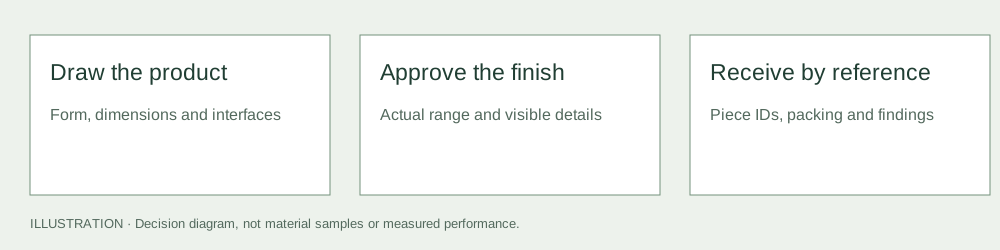
Order granite kerbs against a profile and setting-out schedule. The top, exposed face, back, transitions and special units need to match the designed application. A stone code and a running length do not fully describe the product, and a supplier’s standard shape may not fit the project’s interfaces.
Start with the driveway or landscaping requirements and have the responsible designer settle the assembly. This page gives purchasing checks, not road or drainage design dimensions.
Formats and the complete piece schedule
Draw straight units, curved units, corners, transitions and other special forms separately. Identify exposed surfaces and the direction each special piece faces. Record dimensions, profile references and quantities so the supplier can reconcile the drawings with a cutting and packing list.
Distinguish face dimensions from measurement points on an irregular or split surface. Note holes, recesses or other fabrication details if required. Do not leave curved or transition pieces as a verbal instruction to be resolved after the regular units have been made.
Thickness, tolerances and the specification basis
Put actual dimensional requirements and the agreed checking method into the order. The project’s loads, support and installation details must be settled by the responsible professionals; this guide does not supply a universal kerb thickness or an allowable deviation.
DIN Media’s natural-stone kerb catalogue entry identifies a product-specific requirements and test-method framework. Refer to the contract’s chosen standards and editions where applicable. The public catalogue description is not evidence that a shipment complies, and no paid dimensional clauses are reproduced here.
Use sizes and tolerances to define what the inspector will measure. Request material and test evidence relevant to the order instead of applying a strength number from another stone with a similar trade name.
Specify finish by face and edge
Identify the finish of the top and every visible face. A rough exposed face with a sawn top is a different order from a uniformly finished unit. Approve the arris, junctions and changes in processing on a full-profile sample where appearance matters.
Use the Finishes group and sample approval references. Record the acceptable visual range and any permitted repairs. Do not treat natural variation as permission to omit the agreed shape or finish.
Pack for the form being supplied
Identify special units clearly and keep their orientation traceable to the drawings. Specify protection of exposed corners and profile details, separation where surfaces could rub, crate counts and marks. Confirm that the planned handling method suits the actual packing and receiving arrangements.
StoneV’s packing examples illustrate product-dependent crate and pallet arrangements. They are examples, not a load plan for the order. Work through container loading with the supplier and logistics team.
Inspection points that prevent the wrong pieces reaching site
| Check | Evidence to keep |
|---|---|
| Profile and handedness | Drawing revision, piece ID and an end/profile view |
| Dimensions and checking points | Measurements against the contract’s method and tolerance |
| Curves, corners and transitions | Quantity and orientation against the setting-out schedule |
| Visible finish and repairs | Retained sample comparison and identified photographs |
| Edge damage | Overall piece view plus a scaled close-up |
| Packing and counts | Crate marks, packing list and receiving notes |
Inspect against the current drawing revision. A correctly made obsolete profile is still a contract problem if production proceeded after an agreed revision. Keep that distinction separate from damage discovered during handling.
Use Inspection & receiving and the receiving claim guide to connect crate and piece records. Decide how nonconforming or damaged units will be held, assessed and replaced before installation makes them difficult to examine.
Compare complete offers
Ask each bidder to confirm the same stone, source declaration, profile, finish, quantities, special units, packing and inspection requirements. Clarify what changes if the source or finish is substituted. No current price or guaranteed service performance is established here.
Retain the approved profile sample, drawings and receiving records together. They make the purchase inspectable; the short product name alone does not.
Questions & discussion
Share a question or a useful experience about this guide. Comments appear immediately. Your name and comment are public. Email is optional and stays private; reply emails are not enabled yet. Comment privacy.