
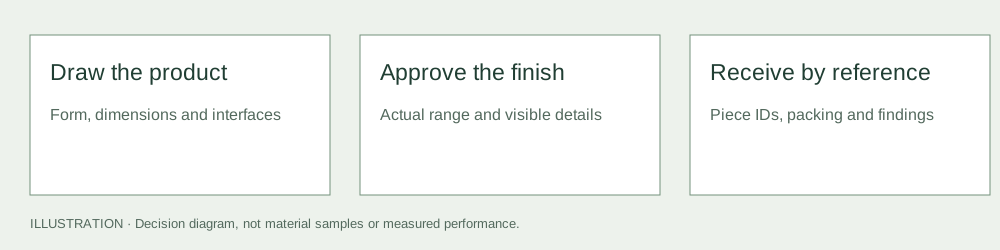
Buy a granite monument as a coordinated set of components, drawings and responsibilities. The stone name and overall outline do not describe the inscription, visible finishes, mating surfaces, foundations or fixing arrangement. Have the intended site or burial authority’s requirements available before fabrication starts.
This is a product-procurement reference, not a memorial stability assessment or an installation method. A competent memorial contractor and the relevant authority must settle the design, installation and site permissions.
Describe the form and every component
Provide drawings for the upright, base, plinth, covers, plaques or other pieces being supplied. Identify visible and mating surfaces, orientation, dimensions and the piece schedule. Separate the stone supplier’s scope from transport, foundation, installation and any future reinstatement work.
Obtain the site’s applicable restrictions and approval process first. A product can match the buyer’s drawing yet still be unacceptable at its intended location. Keep the approved drawing revision and the authority’s correspondence with the purchase file.
Thickness, tolerances and fixing responsibilities
Specify dimensions and checking methods on the coordinated drawings. Have the responsible professional or competent memorial installer settle the foundations, support and fixing details. Do not use a supplier’s standard thickness or an online photo as a stability design.
The National Association of Memorial Masons’ guidance for burial authorities places emphasis on competent fixing and memorial safety. Its UK context is not automatically the rule in every location; use the requirements applying to the actual site and contract. No design or compliance certificate is issued by this article.
For material evidence, the ASTM granite specification scope identifies categories relevant to dimension-stone selection. Agree which reports and evidence the project requires and ensure that they identify the offered stone. A trade name cannot supply missing test results.
Approve finish and inscription separately
Approve the face, edges and any textured or contrasting areas using representative samples. Record the acceptable colour range and permitted repairs. A carved or sandblasted detail may read differently from a polished field; review the actual combination proposed for the order.
Approve the spelling, dates, layout, typeface, symbols, orientation and any applied colours in a separate inscription proof. Compare the finished work with the signed proof, not an earlier email draft. Resolve who bears responsibility for each stage of checking before a permanent inscription is made.
Use the Finishes group and Samples & approval for the stone and surface references. The landscaping application guide provides broader context for associated stonework; it does not replace memorial-specific requirements.
Pack to protect the finished work
Identify every component and its orientation, and protect inscriptions, polished faces, corners and mating surfaces. Confirm the crate plan, counts and handling arrangements with the supplier and the receiving contractor. Keep the piece schedule consistent across drawings, packing lists and labels.
StoneV’s packing examples include monument-related packing. Those examples do not certify a crate or lifting method for this order. Follow the competent contractor’s handling plan and the shipping and loading references.
Receiving inspection before installation
| Check | Approval reference | Evidence to retain |
|---|---|---|
| Components and quantities | Piece schedule and packing list | Crate marks and component IDs |
| Form and dimensions | Current approved drawings | Profile views and agreed measurements |
| Appearance and finish | Retained range and finish samples | Overall and detailed images |
| Inscription | Signed final inscription proof | Clear, readable images and any discrepancy |
| Interfaces and damage | Approved fixing details and contract criteria | Identified findings for the competent installer to assess |
Record damaged or nonconforming components before installation. Do not assume that a repair acceptable on a hidden surface is acceptable on a visible inscription or a fixing interface. Use Inspection & receiving and the edge-damage decision file to retain the evidence and the disposition.
Handover and later care
Retain the material declaration, approved drawings, inscription proof, installation documentation and care instructions. Have a competent person assess any later movement, instability or damage; do not treat a general cleaning or buying guide as a method for making a monument safe.
The Natural Stone Institute’s care reference can help frame compatible routine cleaning once the actual stone and treatments are identified. Site and heritage requirements may impose additional restrictions. This guide has not inspected a monument, tested a component or approved a foundation.
Questions & discussion
Share a question or a useful experience about this guide. Comments appear immediately. Your name and comment are public. Email is optional and stays private; reply emails are not enabled yet. Comment privacy.