
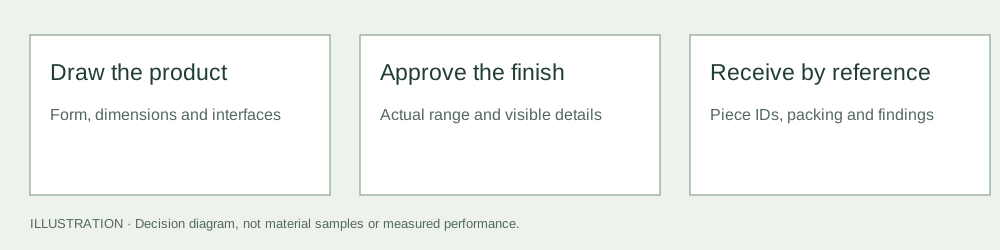
Specify a granite paver as part of the designed paving assembly, not as a stone name and an area quantity. The unit shape, thickness, support, joint layout, finish and expected use need to be compatible. A catalogue picture cannot establish that the proposed pieces will suit pedestrian traffic, vehicles or a wet exterior location.
Start with the intended application: patios and driveways raise different questions. Ask the responsible designer or installer to settle loading, support and drainage before the supplier prices a final unit schedule.
Formats, sizes and the layout schedule
Identify whether the order uses regular sawn units, split setts, special borders or other cut-to-size pieces. Put each form on a drawing with its dimensions and visible faces. Define which measurements are nominal and how production will be measured; do not assume a rough face has the same measurement convention as a sawn face.
Record the laying pattern, edge pieces, corners, different colours or finishes and any numbering needed to distribute the approved visual range. A total area alone may conceal missing special pieces or a cutting allowance that was excluded from the quotation.
Use sizes and tolerances to assemble the enquiry. Actual dimensions, thickness and tolerances are purchase requirements for this order, not fixed properties of a G-number.
Thickness and performance evidence
Have the responsible professional determine thickness and assembly details for the intended use. Traffic, piece geometry, support and installation interact; a heavier-looking unit does not by itself establish a suitable pavement.
The ASTM granite specification scope identifies categories of physical evidence relevant to dimension-stone selection. Obtain reports that identify the offered material, test method and date where the project requires them. No measured strength, absorption or exposure result for your lot is established by this product guide.
Finishes: approve the face that will be walked on
Specify the actual finish reference and any treatment. Review the production finish on the offered stone, including the top arrises and visible sides. A finish name or dry sample does not settle wet-slip suitability.
Use slip-resistance guidance and the Finishes group to prepare the approval. Discuss expected contamination and cleaning with the operator or owner. Changing the finish after price approval may also change appearance, edge condition and the processing scope.
Packing and identification
Agree crate or pallet design, separation, protection of finished edges, piece counts, marks and the intended unloading method. Identify mixed formats and special pieces in the packing list. StoneV’s packing examples show why different product forms use different arrangements; they do not certify the packing proposed for this shipment.
Keep pieces connected to their application or layout zone. The container-loading guide explains the wider shipping questions. Ask the supplier and logistics team to confirm handling arrangements instead of improvising how a heavy crate will be opened or moved.
Receiving and inspection points
| Check | Compare with | Record |
|---|---|---|
| Identity and quantity | Order, crate list and piece marks | Counts, missing formats and reference photos |
| Geometry | Approved drawing and measurement method | Dimensions and deviations in the agreed sample |
| Finish and range | Retained samples under agreed conditions | Overall layouts and identified exceptions |
| Edges and damage | Contract criteria and visible-face requirements | Piece ID, scale and location of each finding |
| Special pieces | Border and corner schedule | Correct form, sequence and completeness |
Photograph crate exteriors and labels before unpacking, then photograph overall groups and identifiable detail views. Keep doubtful pieces separate and consult Inspection & receiving and the edge-chip acceptance guide.
Close the enquiry before comparing price
Have each bidder price the same stone range, forms, finish, drawings, quantities, selection, packing and inspection scope. Include any spare or replacement arrangement the project needs without inventing a universal percentage.
Connect the order to Samples & approval and the receiving claim guide. This page is a product-procurement reference; it is not a pavement design, a supplier audit or a completed test of the proposed pavers.
Questions & discussion
Share a question or a useful experience about this guide. Comments appear immediately. Your name and comment are public. Email is optional and stays private; reply emails are not enabled yet. Comment privacy.