
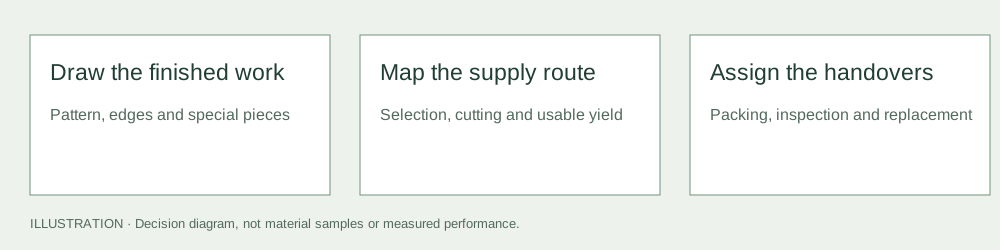
Choose slabs when the project benefits from selecting and cutting larger pieces under a coordinated fabrication plan. Choose tiles when repeatable units suit the layout and the supplier can deliver their dimensions, finish and visual range as agreed. The form changes where cutting, selection and breakage risk are managed; it does not decide the quality of the stone by itself.
Compare both routes against the same finished drawing. A low area price is not comparable if one offer includes finished pieces, edges and selection while the other stops at uncut slabs. This page gives no current price, guaranteed lead time or universal waste percentage.
Define what each supplier will deliver
A slab offer should identify the actual slabs, dimensions, thickness, finish, visible repairs and usable areas. A tile offer should identify the unit sizes, thickness, finish, tolerances, quantity and any special pieces. The Natural Stone Institute’s stone terminology reference helps keep product descriptions consistent, but it does not define the supply scope of a particular quote.
Use the slab guide for the first route and sizes and tolerances for both. Ask which cutting, calibration, edge work, sorting and packing operations are included and who performs them.
Yield and waste come from the layout
For slabs, map the finished pieces onto the actual usable slab areas. Include the cutting process, rejected features, pattern orientation, visible edges and any limits on joins. A theoretical slab area cannot establish the achievable yield of a particular countertop or floor schedule.
For tiles, reconcile the ordered units with the installed pattern, perimeter cuts, openings and special pieces. Repeating a unit can simplify some parts of the schedule, but it does not eliminate cutting, selection or the need for replacements. Differences in available colour range can also affect how the pieces are distributed.
Ask the supplier or fabricator to show its allowance rather than copying an online waste percentage. Record the assumptions and who bears the consequence if the usable yield differs. Distinguish material bought from finished area delivered so that quotations do not hide the same allowance in different places.
Compare the routes at the handover points
| Task | Slabs | Tiles | Question to resolve |
|---|---|---|---|
| Selection | Review the actual slabs and planned cuts | Review a representative range across repeated units | Who rejects pieces outside the approved range? |
| Fabrication | More of the final geometry may remain to be made | Many repeated dimensions may be finished before delivery | Who provides drawings, tolerances and edge work? |
| Lead time | Depends on material selection and fabrication sequence | Depends on quantity, calibration and special-piece production | What is included in the confirmed production programme? |
| Transport | Large pieces need suitable support and handling | Crates or pallets need counts, separation and edge protection | Can the receiving site handle the proposed packing? |
| Damage and replacement | A damaged slab may affect several planned pieces | Replacement units may be easier to describe but harder to match later | Which references and spare material will be retained? |
| Installation | Requires the agreed fabrication and support plan | Requires the agreed setting-out and installation system | Who coordinates interfaces and accepts deviations? |
Lead time: separate material, fabrication and logistics
Ask for milestones tied to the actual order: material allocation, sample approval, drawings, first-piece review, production, inspection, packing and dispatch. Slab availability is not the same as availability of finished pieces. A tile quotation that excludes unusual borders or transitions may also conceal additional work.
Record when changes become a new approval or quotation. A change in finish, thickness, source or visual selection after production starts may affect either route. Do not treat a generic website delivery statement as a confirmed programme for the project.
Transport and breakage risk need different controls
Slabs and tiles need packing and handling suited to their form, dimensions and finish. StoneV’s packing examples illustrate different product arrangements. They do not establish that any particular crate, rack or pallet is adequate for your order.
Confirm the packing list, piece or slab IDs, surface separation, edge protection, unloading method and destination equipment. Use the container-loading guide to keep logistics in the specification. Do not use this comparison as a slab-lifting method or assume that smaller pieces make all manual handling safe.
At delivery, photograph the unopened packing and identifying marks, then inspect counts, condition and critical edges. The receiving inspection guide explains how to retain evidence before installation or disposal of the packing makes a claim harder to assess.
Where each form may fit the project
Slab supply may suit a coordinated countertop project where the fabricator selects the cuts and controls visible seams. Tiles may suit a repeated flooring layout where modular units and installation interfaces are defined. Neither statement rules out other arrangements; the drawing and responsible contractor must settle the form for the actual work.
Compare the complete supply routes, not only stone area prices. Close the decision with the approved range, finish, finished-piece schedule, drawings, fabrication scope, inspection, packing and replacement responsibilities. Use Samples & approval and Terms & shipping to make those decisions traceable.
Questions & discussion
Share a question or a useful experience about this guide. Comments appear immediately. Your name and comment are public. Email is optional and stays private; reply emails are not enabled yet. Comment privacy.