
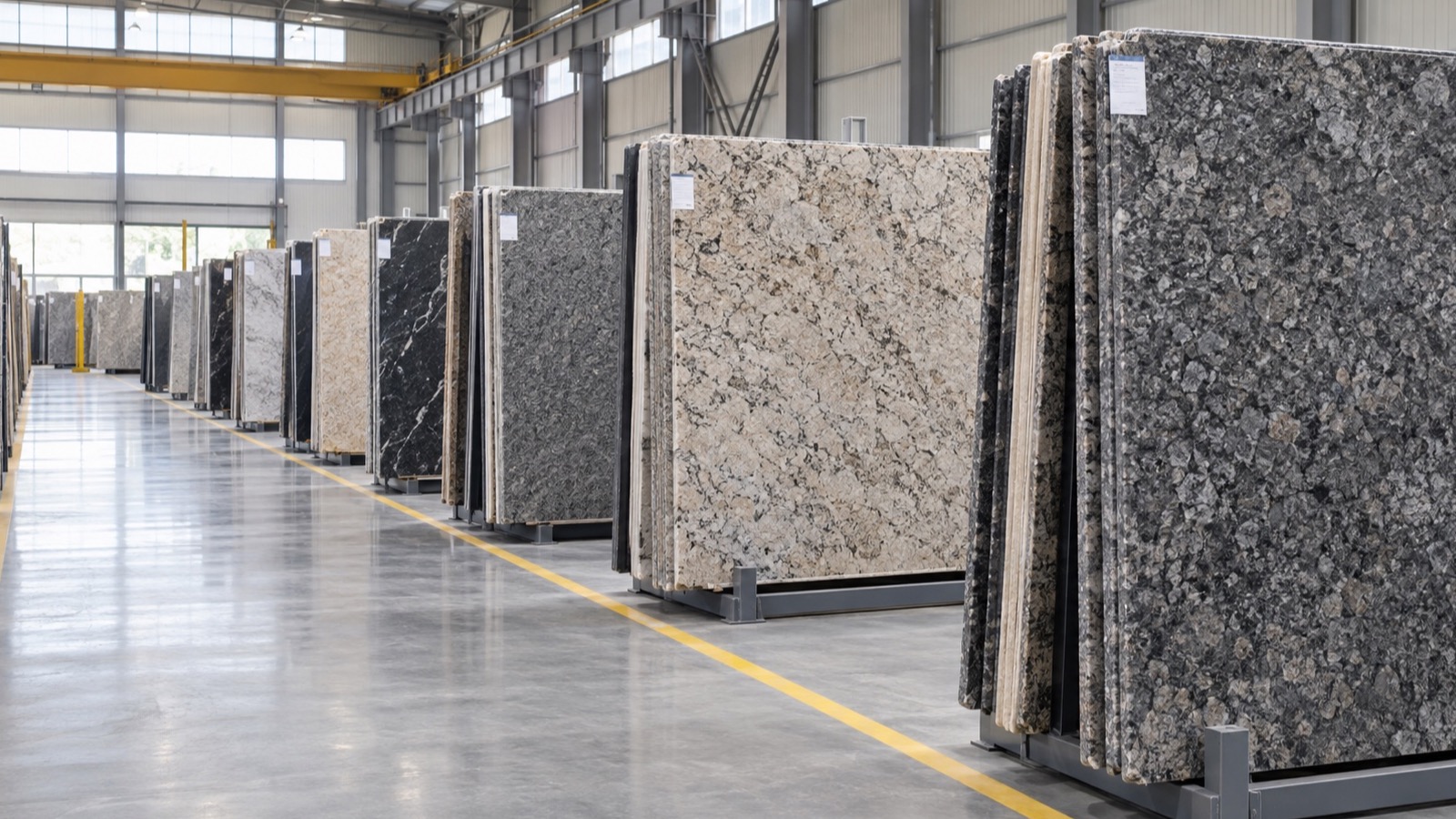
Granite slabs from China are supplied as raw, sawn, calibrated, polished, honed or otherwise finished sheets for further fabrication. A useful quotation must describe more than a nominal size and price per square metre. Buyers need usable face dimensions, thickness tolerance, material range, surface finish, repairs, net quantity, packing and shipment terms. Compare landed cost on the same specification.
Slab formats and usable size
Dimension stone is quarried and cut into blocks or slabs to meet size and shape requirements. Commercial descriptions such as gang-saw slab, cutter slab, strip or cut-to-size piece are not universal dimensional standards. Ask the supplier to list the actual length and width range, minimum billable size, net usable area and whether broken corners or edge defects are excluded from measurement.
A large nominal slab may yield less usable area after squaring, removing cracks and arranging templates. Fabricators should review photographs or a slab layout against the project’s largest pieces. If book matching or consecutive slabs are required, state the sequence and labeling method.
Thickness, calibration and flatness
Nominal 20 mm or 30 mm labels do not define the permitted variation. State nominal and minimum thickness, measurement locations, calibration requirement and allowable face or edge variation. Thin or large pieces may require additional handling controls and engineered support. Do not select thickness only from a supplier’s standard product list.
Check flatness and warpage in a defined way, especially when slabs will be cut into long counters, wall panels or narrow strips. Record mesh backing, fiberglass rods, resin treatment and filled areas because they affect cutting, bonding and appearance.
Finish and face quality
Polishing enhances color and reflection; honing produces a lower-sheen face; textured processes create different visual and performance effects. Approve the finish on the selected material. Define acceptable gloss variation, directional marks, pits, fills, resin patches, scratches, edge chips and contamination.
Inspect slabs after they are clean and dry under consistent light. Wet surfaces can temporarily hide cracks or color differences. Photograph the full face and identifying label together so records remain traceable after packing.
What drives price
Price depends on block recovery, slab size, thickness, grade or visual range, finish, resin and reinforcement, fabrication, order quantity, packing, inland transport, currency and commercial terms. Freight, insurance, customs, port handling, inspection, storage, delivery and breakage allowance belong in landed cost. Avoid publishing or relying on an undated “typical China price” without an exact specification.
Compare quotations line by line. A lower square-metre price may exclude export crates, higher-grade selection, calibrated thickness, surface protection or destination charges. Ask suppliers to identify exclusions and quotation validity.
Import records and classification
For U.S. imports, CBP notes that requirements depend on the product’s tariff classification and that country-of-origin marking must be considered. Raw, merely cut and more extensively worked stone can receive different treatment. Confirm the current classification, duty measures, origin marking and documentation with a qualified customs broker for the actual slab and processing history.
Inspection and packing
Inspect material identity, count, dimensions, thickness, finish, repairs and labeling before shipment. Crates or A-frames should be designed for the slab size, weight and transport mode, with appropriate separation and restraint. Stone should be dry before enclosed packing where moisture could damage packaging or cause staining. Loading plans must respect container and route weight limits established by the carrier and logistics professionals.
Turn the selection into a measurable specification
A trade name, photograph or sample is a starting point, not a complete order. Record the approved material name, quarry or block reference when available, surface finish, nominal and minimum thickness, face dimensions, edge work, dimensional tolerances, visual range, repair policy, quantity, spare allowance, packing and labeling. State which measurements will be checked, how many pieces form the inspection sample and what happens when a result falls outside the agreed limit.
Natural stone varies. A sensible approval defines an acceptable range rather than asking production to match one small photograph. Review multiple full-size samples or a dry layout when appearance continuity matters. Keep the signed sample and dated photographs available to the factory and destination inspector. For performance-sensitive work, ask for recent reports from representative material and identify the test method; a generic claim that granite is “strong” does not establish suitability for a particular assembly.
| Control | Record before production | Verify before shipment |
|---|---|---|
| Identity | Trade name, source and approved range | Labels and production match approvals |
| Geometry | Dimensions, thickness and tolerances | Measurements across a defined sample |
| Finish | Process, sheen or texture reference | Consistency under normal lighting |
| Fabrication | Edges, cut-outs, repairs and reinforcement | Workmanship and critical locations |
| Packing | Crate design, sequence and marks | Dry stone, protection and count |
Buying and approval checklist
- Ask the seller to distinguish quarry origin, processing location and shipment origin.
- Approve representative samples and retain a signed control sample.
- Put measurable tolerances and visual criteria on the purchase order.
- Confirm test methods and report dates for performance claims that affect the project.
- Inspect a first piece before full production and a defined sample before shipment.
- Match packing, crate marks and piece labels to the installation sequence.
- Keep a reasonable spare allowance for natural variation, cutting and future repair.
These controls do not remove variation or project risk. They create a record that lets the buyer, fabricator, installer and inspector evaluate the same requirements. Local building codes, engineering requirements and installation-system instructions remain controlling for the finished work.
Frequently asked questions
What should buyers verify before ordering granite slabs from China?
Verify the exact material and source, current representative samples, finish, dimensions and tolerances, relevant test evidence, repairs, packing, inspection plan and complete commercial terms.
Does a trade name or country guarantee performance?
No. Natural stone properties and factory controls vary. Evaluate the actual material, batch, finish, thickness and installation conditions with project-specific evidence.
How should natural variation be approved?
Review multiple representative pieces or full slabs, define an acceptable range, retain signed samples and record how veins, mineral clusters, fissures, fills and repairs will be judged.