
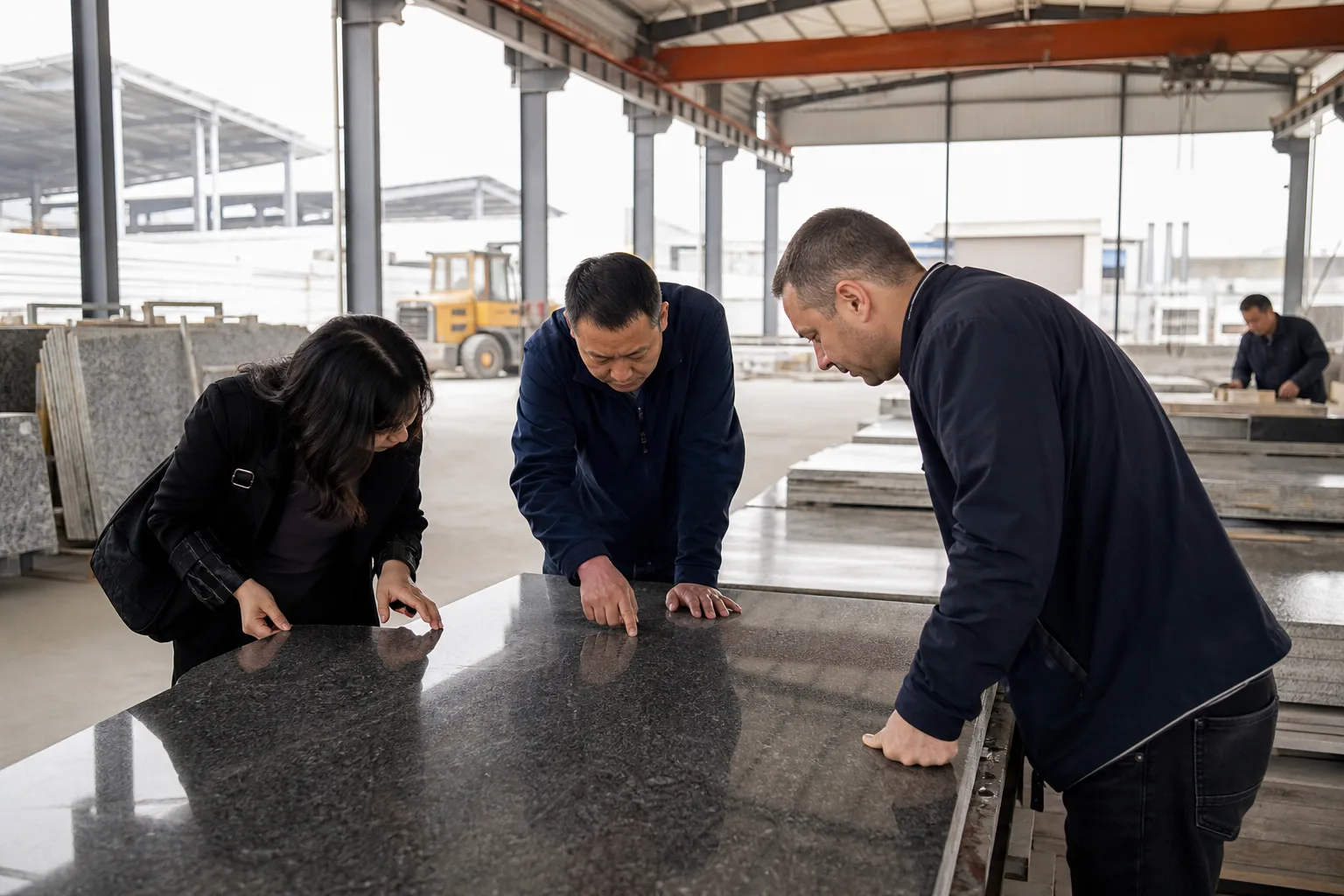
The practical difference between a granite factory and a trading company is responsibility for production. A factory operates at least some of the equipment and labor used to process the order; a trading company purchases or coordinates production through one or more factories. Neither model is automatically better. Buyers should select the structure that fits the product, volume and required level of coordination—and verify who will cut, finish, inspect and pack the stone before paying a deposit.
Factory and trading company: the working definitions
What counts as a granite factory?
A granite factory physically performs defined processing operations. Depending on its scope, these may include block sawing, slab calibration, surface finishing, bridge-saw cutting, edge profiling, drilling, dry laying, inspection and packing. A company does not need to own a quarry to be a factory. Quarry ownership, block supply and processing are separate questions.
Factory status is also product-specific. A plant capable of producing standard granite slabs may subcontract waterjet work, complex carving, specialized finishes or countertop fabrication. Buyers should therefore ask which operations will occur at the disclosed facility rather than accepting the word “manufacturer” as evidence of complete in-house production.
What does a trading company do?
A trading company handles commercial functions such as material sourcing, quotation, factory selection, specification translation, production follow-up, consolidation and export documentation. It may have inspectors, warehouse space or finishing equipment without being the primary manufacturer. Some businesses are hybrid organizations that operate a factory while also trading products made elsewhere.
Online directories can help create a candidate list, but listing categories and supplier statements are not proof of ownership or production control. For example, marketplace listings for granite tiles and slabs in China cover many products, finishes and supplier descriptions, while the actual manufacturing route remains a matter for order-level verification. See the StoneContact China granite supplier directory.
Which supplier model suits the order?
| Buying issue | Direct factory | Trading company | What to verify |
|---|---|---|---|
| Narrow, repeat product range | May provide a short production chain when the plant routinely makes the specified item | May add an additional commercial layer without adding necessary capability | Equipment, normal product range and recent order records for comparable dimensions |
| Mixed materials or products | One plant may need to subcontract items outside its normal range | Can coordinate several specialist factories and consolidate communication | Named production sites and separate quality records for each product group |
| Technical customization | Direct access to production staff can reduce interpretation gaps | A technically competent trader can translate drawings and coordinate specialists | Drawing review process, sample approval and responsibility for revisions |
| Small order | The factory may impose minimum runs or schedule it behind larger orders | May combine purchasing or place work with a smaller specialist plant | Actual production location, minimum quantity and batch-control method |
| Quality claim | Ownership of machinery does not by itself prove effective control | Outsourcing does not by itself mean poor quality | Written tolerances, inspection plan, traceability and corrective-action terms |
| Price comparison | A direct quote can remove one margin but may exclude coordination services | The quote may include sourcing, consolidation or inspection work | Equivalent scope, packaging, testing, inspection, delivery term and payment conditions |
The correct comparison is not simply factory price versus trader price. It is the total delivered scope and the buyer's exposure if material, dimensions, finish or packing do not conform. A well-managed trading company can be preferable for a mixed container. A verified specialist factory can be preferable for a repeat program based on one stone and one production method.
Verify the stone before evaluating the supplier
Geological identity and commercial names
“Granite” may be used more broadly in dimension-stone commerce than in geological classification. The U.S. Geological Survey defines dimension stone as natural rock quarried to obtain blocks or slabs meeting size and shape requirements, with color, grain, pattern, finish, durability and strength among the normal selection criteria. Its publications also distinguish broader commercial granite terminology from narrower petrographic usage. Buyers should not treat a trade name, color code or supplier label as a complete geological identification. USGS dimension stone reference.
Record the supplier's trade name, any local or export code, stated quarry country and geological description as separate fields. Similar-looking stones may be sold under overlapping names, while one trade name may cover visual variation or material from more than one source. Request current photographs of blocks or slabs allocated to the order, not only catalog images. If quarry origin is contractually important, require documentary traceability and do not infer origin from a Chinese processing address.
Finish and intended application
Finish descriptions also need physical references. Polished granite has a reflective surface, honed material has a lower-sheen appearance, and leathered or mechanically textured finishes create different surface profiles. Flamed, bush-hammered, split-face and sawn surfaces may be offered for paving, cladding or landscape work. A general overview of common finish terminology is available from Marble.com, but the approved sample and written specification should control the purchase.
Finish must be assessed in relation to use. A polished finish may suit certain interior surfaces, while bush-hammered or split-face stone has a different texture and dimensional character. Do not assume that a finish name establishes slip performance, stain resistance or suitability for flooring, facades, driveways or other applications. Those conclusions require project-specific criteria and, where necessary, appropriate testing.
Evidence that a supplier controls production
Documents to request
- Business license showing the legal Chinese company name, registered address and stated business scope.
- Quotation, pro forma invoice, bank beneficiary and export documents using consistent legal identities, with any differences explained before payment.
- Address and contact details for every plant expected to process the order.
- A production-flow statement identifying which party performs block selection, sawing, finishing, cut-to-size work, inspection and packing.
- An equipment list connected to the specified product, supported by dated photographs or a live video review.
- Current sample labels, production sheets or inspection records with commercially sensitive information redacted if necessary.
- Written disclosure of subcontracted operations and responsibility for nonconforming work.
A business license can establish that a legal entity exists, but it does not prove that machinery is owned, that the disclosed site will make the order or that the company can meet a particular specification. The U.S. International Trade Administration recommends continuing due diligence on potential foreign partners and provides background-check resources, including International Company Profiles. Trade.gov due-diligence guidance.
Remote or on-site verification
For remote review, ask the representative to move through the facility in one continuous live call. Confirm the exterior sign, office identity, stone yard, machinery, work in progress, inspection area and packing area. Ask to see a drawing or order identifier placed beside the relevant material. Pre-recorded promotional footage is useful for orientation but cannot establish current control of a specific order.
An on-site audit should compare legal identity, location, staffing, machinery and normal output with the sales claim. It should also record subcontracting and shared-premises arrangements. The objective is not to award a simplistic factory-or-trader label; it is to map the actual supply chain and assign responsibility at each stage.
Specifications and inspection should control the purchase
Build an order-specific specification
ASTM C615/C615M covers material characteristics, physical requirements and sampling for granite dimension stone used in general building and structural applications. Its scope includes sawed, cut, split or otherwise finished natural dimension stone and excludes artificially aggregated units. Relevant properties include absorption, density, compressive strength, modulus of rupture, abrasion resistance and flexural strength. Buyers should use the current applicable edition and project requirements rather than copying unverified values from a supplier brochure. ASTM granite dimension stone specification page.
The Natural Stone Institute notes that required testing depends on the stone's intended performance and application; where necessary data are unavailable, appropriate testing should be required or the material avoided for that use. It lists methods including ASTM C97 for absorption and bulk specific gravity, C170 for compressive strength and C880 for flexural strength. Natural Stone Institute standards reference.
A purchase specification should address:
- Material identification and approved control sample.
- Nominal and allowable length, width and thickness variation.
- Surface finish, gloss or texture reference where measurable and relevant.
- Edge treatment, chamfers, kerfs, holes, anchors and fabrication drawings.
- Permitted and prohibited visual characteristics, stated with photographs where possible.
- Resin, mesh, reinforcement, patching or other treatment disclosure.
- Application-specific test reports, sample identity, laboratory and test edition.
- Quantity, spare allowance, piece numbering, dry-lay requirements and packing method.
Use inspection stages, not a final glance
- Pre-production: approve material range, samples, drawings, finish and inspection method.
- During production: check allocated material, thickness, dimensions, finish consistency and emerging defects before the full quantity is completed.
- Pre-shipment: inspect a defined quantity under stated lighting and measurement conditions; reconcile piece counts and packing lists.
- Container loading: verify crate marks, condition, loading arrangement and container identity where this service is required.
The inspector should report evidence, not merely “pass” or “fail.” Useful records include measurement tables, defect counts, sample size, calibrated instrument details where relevant, photographs tied to piece or crate numbers and a list of unresolved deviations. See the related guide to granite quality control.
Price factors and contract risk
Supplier type is only one price factor. Granite cost can also vary with block yield, slab or tile dimensions, thickness, finish, edge work, hole patterns, matching requirements, reinforcement, rejection allowance, test scope, inspection, packing, quantity, inland transport, consolidation and delivery terms. A low quotation may reflect a narrower scope rather than greater manufacturing efficiency.
Compare offers through a normalized bid sheet. Require each bidder to identify exclusions, subcontracted operations, packaging assumptions and the applicable Incoterm. Do not rely on generic market prices to approve a project budget; obtain current quotations against the same drawings and quality criteria. The overview of granite price factors in China provides a broader framework.
The contract should name the responsible legal seller even when another plant manufactures the goods. It should also state whether subcontracting requires notice, what constitutes nonconformity, who pays for reinspection or rework, when title and risk transfer, and which approved samples and drawings form part of the agreement. Buyers importing into the United States should separately confirm current classification, origin marking, tariffs and entry requirements with qualified customs advisers; factory location alone does not resolve every origin or customs question.
Decision checklist for granite buyers
- Define the stone, finish, dimensions, application and acceptable variation before comparing suppliers.
- Ask whether the seller is a factory, trader or hybrid—and request an operation-by-operation production map.
- Match the seller's legal name to invoices, beneficiary details and available registration records.
- Verify the disclosed production site through a live review, independent audit or both, according to order risk.
- Identify all subcontracted processes and the party responsible for corrective action.
- Approve representative samples and retain them as contract references.
- Request test data only when relevant, then check the tested material, methods, dates and issuing laboratory.
- Use staged inspection with measurable acceptance criteria.
- Compare quotations on equivalent specifications, packing, inspection and delivery terms.
- Avoid making the deposit decision solely on website wording, showroom quality, marketplace badges or the lowest unit price.
In short, the granite factory vs trading company question is a starting point, not the final supplier decision. The stronger buyer position comes from knowing the stone's identity, mapping the real production route and making specifications, evidence and inspection—not the supplier's label—the basis of acceptance. For the wider procurement sequence, continue to the China sourcing hub and the guide to importing granite from China.
Frequently asked questions
Is buying granite directly from a factory always cheaper?
No. A direct factory quote may remove a trading margin, but it can exclude sourcing, consolidation, technical coordination or inspection services. Compare equivalent stone, fabrication, packing, testing, delivery terms and quality-control scope rather than unit price alone.
How can I check whether a Chinese granite supplier owns a factory?
Review the legal company identity, registered address, disclosed production address, equipment records and production documents. Use a continuous live facility review or an independent on-site audit to connect the company to the machinery, employees and work in progress. Even then, confirm which operations for your order will be subcontracted.
Can a trading company provide reliable granite quality?
Yes, if it selects suitable factories, translates specifications accurately, maintains traceability and uses effective inspection. A trading company should disclose production locations and accept clear contractual responsibility for nonconforming material.
Does owning a quarry prove that a supplier can fabricate finished granite?
No. Quarrying and factory processing are different capabilities. Verify block availability, sawing, finishing, cut-to-size fabrication, quality control and packing separately.
What should be approved before granite production begins?
Approve the material range or control sample, finish, dimensions and tolerances, fabrication drawings, permitted visual variation, treatment disclosures, packing method, test requirements and inspection plan.