
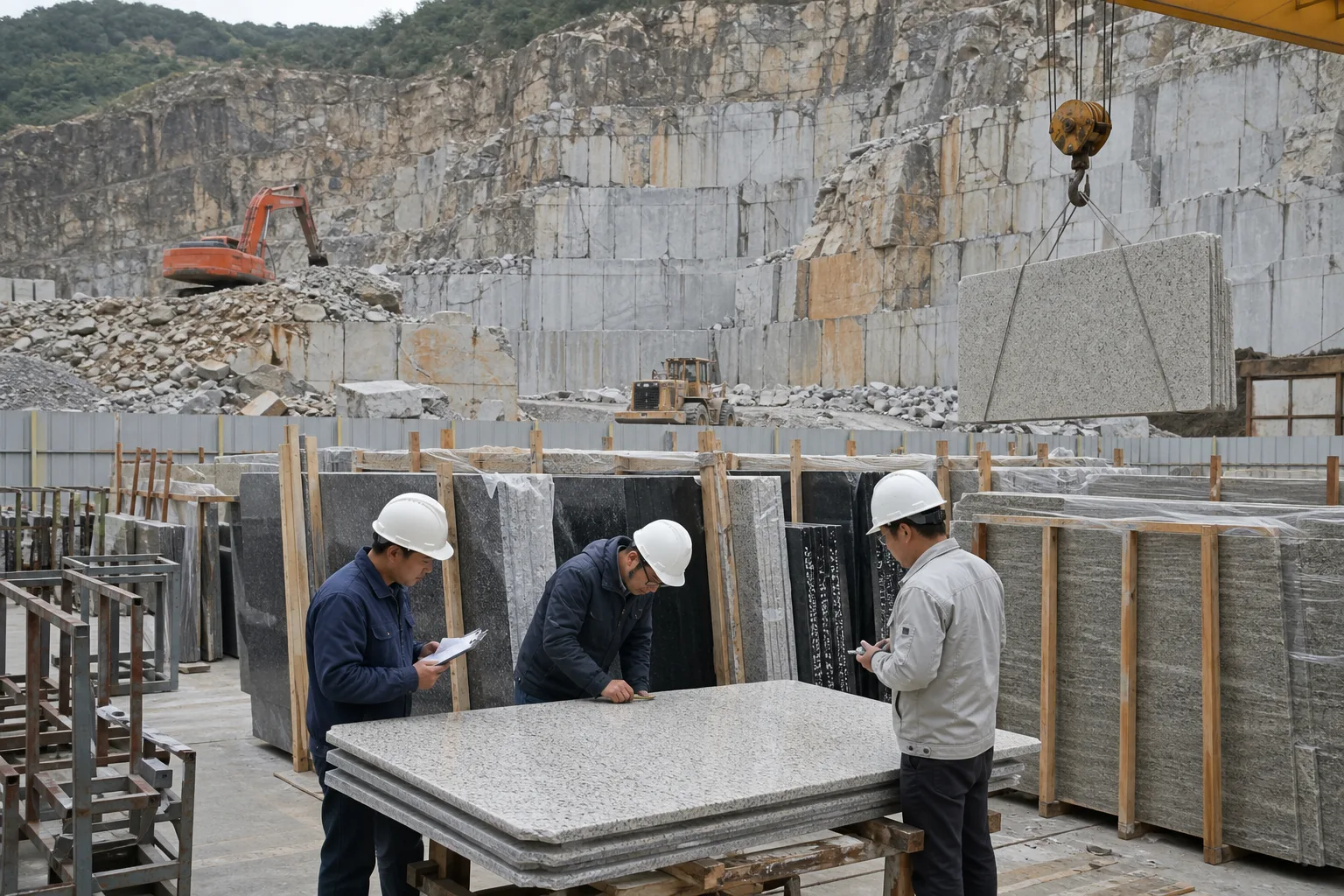
A usable China granite price is a specification-based quotation, not a single market rate. For commercial purchasing, ask suppliers to price the same material reference, dimensions, thickness tolerance, finish, visible grade, quantity, packing method, port and Incoterm. Marketplace listings reviewed for this guide show how strongly quoted FOB values can vary by product format and order basis, but they should be treated only as dated asking-price examples—not verified transactions, binding offers or landed-cost benchmarks.
Indicative China granite prices
Marketplace examples, not a universal price list
The following examples were publicly displayed on StoneContact product pages accessed on September 11, 2026. They illustrate the information that should accompany a price. Granite China has not verified the sellers, stock, quarry source, grade, test data or continued availability. A buyer should request a current written quotation and physical or approved production samples before relying on any figure.
| Product listing | Listed specification | Displayed price basis | Displayed MOQ |
|---|---|---|---|
| G654 grey granite tile | 600 × 300 × 20 mm, polished, grade A | US$17.60–21.40/m² FOB Xiamen | 100 m² |
| New G603 light-grey slab | 2400 × 1200 × 20 mm, polished, grade A | US$34/m² FOB listing | 500 m² |
| Yellow granite paver | 600 × 300 × 40 mm, flamed, grade A | US$29.99/m² FOB Xiamen | 100 m² |
Sources for these individual examples are the StoneContact listings for the G654 tile, G603 slab and flamed paver. The examples should not be averaged: they describe different materials, formats, thicknesses, quantities and listing dates.
What an FOB price excludes
FOB generally separates the quoted goods and export-side delivery from the subsequent ocean movement and destination costs. A landed budget may also need ocean freight, insurance, terminal charges, customs brokerage, duties, additional trade remedies where applicable, inland delivery, inspection, breakage allowance, financing and local fabrication. For imports into the United States, tariff treatment depends on the correct Harmonized Tariff Schedule classification and country of origin. CBP states that Section 301 measures apply according to country of origin rather than merely the country of export. Buyers should have a customs broker confirm the current classification and duty treatment for the exact product before ordering. CBP Section 301 guidance
Geological identity and trade names
Commercial granite is a broad category
In scientific geology, granite has a defined mineral composition. In the dimension-stone trade, “granite” is broader and can include several crystalline rocks that behave or are marketed like granite. The Natural Stone Institute notes that gabbro, diabase, anorthosite, gneiss, basalt and other rocks may be grouped commercially with granite. Consequently, a commercial name or visual resemblance does not establish a precise geological identity. Natural Stone Institute definition
Dimension stone is natural rock quarried as blocks or slabs and produced to requirements for size and shape; color, grain, pattern and finish are also normal selection criteria. USGS dimension-stone overview This distinction matters when comparing prices because two products sold as grey granite may differ in mineralogy, structure, appearance, performance and processing yield.
Do not buy by a G-number alone
Identifiers such as G603 or G654 are widely used commercial references, but a code alone is not a complete purchase specification. Similar or replacement stones may be offered under familiar names, and production from different sources can vary. The purchase order should attach approved samples, current slab or tile photographs, the supplier's declared source, and a written definition of acceptable color, grain, markings and repairs. See the database entry for G603 granite as a starting point, not as a substitute for batch approval.
How format and finish change cost
Slabs
Granite slabs are commonly priced by square metre, but yield affects their real cost. Larger dimensions, unusual thicknesses, strict sequential numbering, narrow color ranges and demands for defect-free usable area can reduce recovery from a block. Buyers should specify whether the quotation covers raw slabs, calibrated slabs, polished slabs or cut-to-size components. Confirm net dimensions, edge condition, resin or mesh use, surface treatment and the method used to calculate billable area.
Tiles and cut-to-size work
Standardized tiles may benefit from repeat processing, while multiple sizes, tight dimensional tolerances, book-matching, pattern layouts, drilled holes, rebates and finished edges add operations and sorting. A low square-metre price may therefore be misleading if it excludes calibration, edge work, dry laying, templates, crates or replacement pieces. Obtain separate prices for material, finishing, special fabrication and packing.
Pavers, kerbs and thick landscaping units
Paving products use more stone per square metre as thickness increases. Split surfaces, flamed faces, bush-hammered textures, sawn sides, chamfers and non-rectangular shapes also change processing requirements. Heavy units can reach a container's weight limit before using its full volume, making freight per square metre different from that of thinner tiles.
Finish selection
Polished granite has a reflective surface, honed granite is matte, and leathered granite has a brushed texture. Flamed, bush-hammered, sandblasted, tumbled and sawn finishes are also encountered, particularly outside countertop work. Marble.com granite finish overview Availability and cost depend on the stone and production route; it is unsafe to assume that one finish always carries the same premium. Review the finish directory and polished finish reference, then request an approved finish sample made on the proposed stone.
Specifications required for comparable quotations
Send every bidder the same request for quotation. If one supplier prices 18 mm tiles and another prices nominal 20 mm tiles, or if packing and tolerances differ, the totals are not directly comparable.
RFQ checklist
- Commercial name, alternative names and supplier-declared geological type.
- Declared quarry or block source, without assuming that a trading name proves origin.
- Product format: slab, tile, paver, kerb, tread, riser or fabricated component.
- Finished length, width and thickness, including permitted tolerances.
- Face finish, edge finish, calibration, chamfers, holes, cut-outs and other fabrication.
- Color and pattern range, grade definition, repair limits and unacceptable defects.
- Quantity by size, spare-piece requirement and overage policy.
- MOQ, production lead time and quotation-validity period.
- Packing design, crate count, estimated net and gross weight, and loading quantity.
- Incoterm, named port or place, currency, payment schedule and included documents.
- Sample, testing, pre-shipment inspection and non-conformance procedures.
Broader product categories can be reviewed under granite products, while the applications index helps relate specifications to intended use. Countertop buyers should separately define slab selection, finished thickness, edge profiles and cut-outs; see granite kitchen countertops.
Testing, inspection and acceptance
Match evidence to the application
A product name does not demonstrate fitness for flooring, paving, cladding or structural use. The Natural Stone Institute identifies ASTM C615 as the standard specification for granite dimension stone and lists test methods including ASTM C97 for absorption and bulk specific gravity, ASTM C170 for compressive strength, ASTM C241 or C1353 for abrasion resistance, and ASTM C880 for flexural strength. It advises selecting tests according to the performance required in service. Natural Stone Institute ASTM reference
Do not assume that a supplier holds current, applicable test reports. Where project requirements call for testing, request reports that clearly identify the tested stone, source, specimen condition, finish where relevant, test method, laboratory and date. The project specifier must decide whether the evidence applies to the proposed batch and application.
Pre-shipment inspection checklist
- Compare production with sealed reference samples under consistent lighting.
- Check quantity, dimensions, diagonals, thickness and edge geometry using an agreed sampling plan.
- Review finish consistency, gloss where specified, calibration and surface texture.
- Record cracks, chips, open seams, fills, mesh, resin, staining and other agreed acceptance points.
- Verify labels, piece marks, crate lists, moisture protection and crate construction.
- Photograph inspected pieces and sealed crates; reconcile gross weight with shipping documents.
- Define what happens to rejected pieces before the goods are loaded.
An inspection report reduces ambiguity but does not guarantee installation performance. Design, substrate preparation, anchoring, setting materials, drainage and workmanship remain separate responsibilities.
China sourcing and landed-cost control
Supplier location is not stone origin
A Chinese processor or exporter may offer Chinese stone or stone sourced elsewhere. Likewise, shipment from a Chinese port does not by itself prove quarry origin. Request the quarry declaration, block or batch identification and origin documents relevant to the contract. The guides to importing granite from China and evaluating China granite suppliers cover the wider procurement process.
Compare total evaluated cost
Build a comparison sheet that normalizes price to the same finished unit. Add inspection, testing, packing, freight, customs charges, inland delivery, expected fabrication yield and an approved contingency. Also compare commercial exposure: payment terms, replacement procedure, lead time, quotation validity and the cost of a rejected or delayed shipment. The lowest factory quotation is not necessarily the lowest installed cost.
Xiamen appears frequently as a quoted export port in the reviewed listings, but a port reference does not verify manufacturing location or capability. For regional context, see Xiamen's stone industry. Buyers considering another major supply market can also review China and India granite sourcing; the comparison should use identical specifications and current freight and duty inputs.
Scope limit
This page is a purchasing framework, not a live quotation service. The displayed examples can expire or change without notice, and no general China granite price can cover every stone, finish, format, quantity or destination. Obtain current supplier quotations and independent professional advice for testing, installation, customs classification and regulatory compliance.
Frequently asked questions
How much does granite from China cost?
There is no single China granite price. Cost depends on the stone, format, dimensions, thickness, finish, grade, quantity, packing, Incoterm and destination. Public listing prices should be treated as indicative until confirmed in a current written quotation.
Are China granite prices usually quoted per square metre?
Slabs, tiles and many pavers are commonly quoted per square metre, while kerbs, cubes, steps or fabricated pieces may be priced by piece, linear metre, cubic metre or tonne. Confirm the billable unit and included processing.
Does an FOB granite price include freight and import duties?
An FOB quotation normally does not include ocean freight, destination charges, import duties, customs brokerage or inland delivery. Request a landed-cost calculation based on the correct product classification and country of origin.
What should be checked before accepting a granite quotation?
Confirm the exact stone and batch, dimensions and tolerances, finish, visible grade, repairs, quantity, MOQ, packing, estimated weight, lead time, Incoterm, payment terms, testing requirements and inspection procedure.
Is a G-number enough to specify Chinese granite?
No. A G-number is a commercial reference rather than a complete specification. Attach approved samples and define the source, appearance range, dimensions, finish, tolerances, repairs and acceptance criteria in writing.